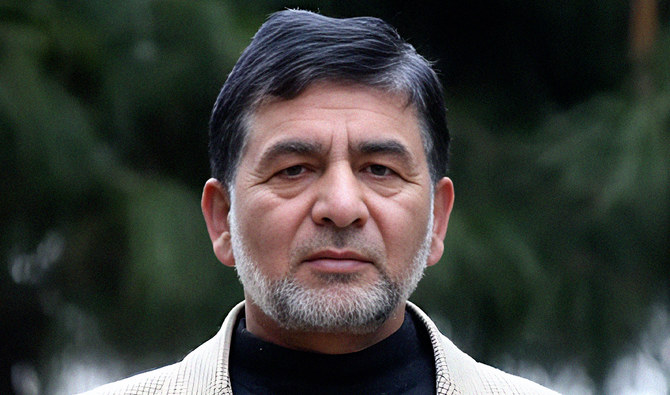

NEW DELHI: Altaf Ahmad Shah, a prominent politician in Kashmir who challenged India’s rule over the disputed region for decades and had been jailed by Indian authorities for the past five years, has died while in police custody, his family said Tuesday. He was 66.
Shah was arrested by Indian authorities in 2017 in a “terror-funding case” and was held in New Delhi’s Tihar jail, where he was diagnosed with kidney cancer in September. After repeated family appeals to senior government officials, including a letter to Indian Home Minister Amit Shah, the jailed leader was moved to New Delhi’s All India Institute of Medical Sciences for treatment, where he died Monday night.
Tihar jail officials did not immediately comment on Shah’s death.
Shah is the fourth separatist leader from India-administered Kashmir to have died in police custody in the last three years. He was part of Tehreek-e-Hurriyat, an anti-India political group, and one of the staunchest supporters of demands for Kashmir’s merger with Pakistan.
Last year, Shah’s father-in-law and the region’s staunchest anti-India leader, Syed Ali Geelani, 91, died at his residence in Srinagar after nearly 10 years of house arrest. Earlier in 2021, separatist leader Mohammed Ashraf Sehrai, 78, died due to multiple ailments while in jail.
India has arrested thousands of Kashmiris under stringent laws imposed when an armed rebellion erupted seeking the region’s independence or merger with Pakistan, which controls another part of the territory. Rights groups say India has used the law to stifle dissent and circumvent the justice system, undermining accountability, transparency, and respect for human rights.
India considers the armed rebellion a proxy war by Pakistan and deems it to be state-sponsored terrorism. Most Muslim Kashmiris consider it a legitimate freedom struggle and support the rebels’ goal for the divided territory to be united either under Pakistani rule or as an independent country.
Pakistan’s Prime Minister, Shahbaz Sharif, said he was deeply grieved by Shah’s death.
The “Modi regime denied him treatment despite knowing he was a cancer patient. Custodial killings are the norm in Modi’s India,” Sharif wrote on Twitter.
https://twitter.com/CMShehbaz/status/1579693287052804097?s=20&t=Pu525rfs...
Shah’s daughter Ruwa Shah, tweeted about her father’s condition on Sept. 21, saying he needed a “proper hospital” instead of the jail’s ICU. In a letter written to the Delhi High Court, she also sought for her father’s release on bail due to his poor health.
Shah was first shifted to New Delhi’s Dr. Ram Manohar Lohia Hospital, according to Ruwa, who said the health facility did not treat cancer patients. He was later shifted to the All India Institute of Medical Sciences, India’s premier health facility, after an intervention from the Delhi High Court.
“This was always his biggest concern since being jailed, that he will die a prisoner,” Ruwa told the Indian news website The Quint last week.
In August 2019, when India stripped Kashmir’s semi-autonomy, Indian authorities harshly clamped down on the group’s leaders, detaining scores of them and barring them from leading public protests.