

Pakistan rejects Indian PM’s assertion he ‘resolved’ Kashmir dispute by following Sardar Patel

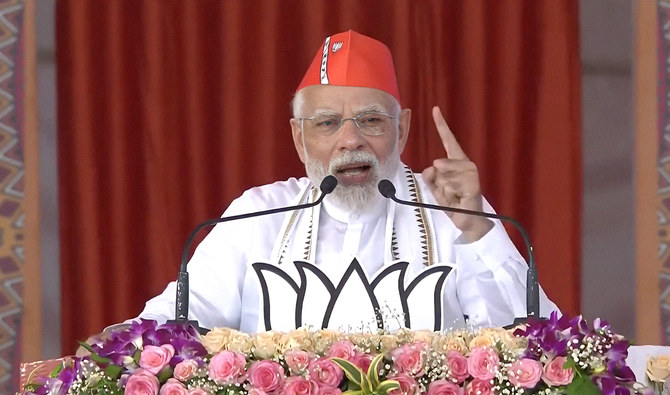
Indian Prime Minister Narendra Modi addresses a public rally in Gujrat, India, on October 10, 2022. (@narendramodi/Twitter)
Short Url
Updated 11 October 2022
Follow

Pakistan rejects Indian PM’s assertion he ‘resolved’ Kashmir dispute by following Sardar Patel

  • Modi made the statement at a public rally in Gujarat where he criticized Nehru for mishandling Kashmir
  • Pakistan says Indian PM’s statement reflects New Delhi is ‘oblivious’ to ground realities in the disputed region

ISLAMABAD: Pakistan’s foreign office on Tuesday rejected a comment made by Indian Prime Minister Narendra Modi during a recent public rally in Gujarat where he said he had managed to “resolve” the Kashmir dispute by following the first home minister of his country Sardar Vallabhbhai Patel.

Modi said that Patel made the merger of various princely states with India possible while making a veiled reference to the first Indian prime minister Jawaharlal Nehru and criticizing him for mishandling the Kashmir issue.

Reacting to the development, the foreign office dismissed Modi’s “farcical contention” that he had somehow “resolved the Kashmir issue,” adding his statement was not only false and misleading but also reflected how “oblivious” the Indian leadership was to the ground realities in Kashmir.

It maintained that Jammu and Kashmir was an internationally recognized disputed region, the resolution of which had been on the agenda of the United Nations since 1948.

“Instead of making delusional statements about having resolved the dispute unilaterally, the Indian leadership must deliver on their commitments to the Kashmiris and to the world and ensure that the people of Kashmir are accorded their inalienable right to self-determination,” said the foreign office statement.

The Modi administration decided to revoke the special constitutional status of Kashmir in August 2019 while deciding to integrate the region with the rest of the Indian union.

In response, Pakistan downgraded its diplomatic relations with New Delhi while asking the Indian government to reverse its “illegal” action.

Pakistan also maintained India was striving to change the demographic realities in Kashmir where a majority population is Muslim.

“The only solution to the Jammu and Kashmir dispute lies in ensuring that the Kashmiris are allowed to exercise their right of self-determination through the democratic method of holding a UN-mandated free and impartial plebiscite as espoused in the relevant UNSC resolutions and as per the wishes of the Kashmiri people,” the foreign office said.

Modi told his party supporters in Gujarat that Patel “persuaded all the princely states to merge with India,” though “another person handled this one issue of Kashmir.”

“As I am following in the footsteps of Sardar Sahib, I have values of the land of Sardar and that was the reason I resolved the problem of Kashmir and paid true tributes to Sardar Patel,” he continued.

India and Pakistan have fought several wars over Kashmir since their independence in August 1947.

The two countries claim the region in full, but control only parts of it.


Security forces kill four militants in Pakistan’s volatile southwest, military says

Updated 5 sec ago
Follow

Security forces kill four militants in Pakistan’s volatile southwest, military says

  • Balochistan, Pakistan’s largest province by land area bordering Iran and Afghanistan, has long been the site of a low-level insurgency
  • The Balochistan government has recently established a threat assessment center to strengthen early warning, prevent ‘terrorism’ incidents

ISLAMABAD: Pakistani security forces gunned down four militants in an intelligence-based operation in the southwestern Balochistan province, the military said on Tuesday.

The operation was conducted in Balochistan’s Kalat district on reports about the presence of militants, according to the Inter-Services Public Relations (ISPR), the Pakistani military’s media wing.

The “Indian-sponsored militants” were killed in an exchange of fire during the operation, while weapons and ammunition were also recovered from the deceased, who remained actively involved in numerous militant activities.

“Sanitization operations are being conducted to eliminate any other Indian-sponsored terrorist found in the area,” the ISPR said in a statement.

There was no immediate response from New Delhi to the statement.

Balochistan, Pakistan’s largest province by land area bordering Iran and Afghanistan, has long been the site of a low-level insurgency involving Baloch separatist groups, including the Balochistan Liberation Army (BLA) and the Balochistan Liberation Front (BLF).

Pakistan accuses India of supporting these separatist militant groups and describes them as “Fitna Al-Hindustan.” New Delhi denies the allegation.

The government in Balochistan has also established a state-of-the-art threat assessment center to strengthen early warning and prevention against “terrorism” incidents, a senior official said this week.

“Information that was once scattered is now shared and acted upon in time, allowing the state to move from reacting after incidents to preventing them before they occur,” Balochistan Additional Chief Secretary Hamza Shafqaat wrote on X.

The development follows a steep rise in militancy-related deaths in Pakistan in 2025. According to statistics released by the Pakistan Institute for Conflict and Security Studies (PICSS) last month, combat-related deaths in 2025 rose 73 percent to 3,387.

These included 2,115 militants, 664 security forces personnel, 580 civilians and 28 members of pro-government peace committees, the think tank said.