

UN passes resolution, urges support for flood-battered Pakistan

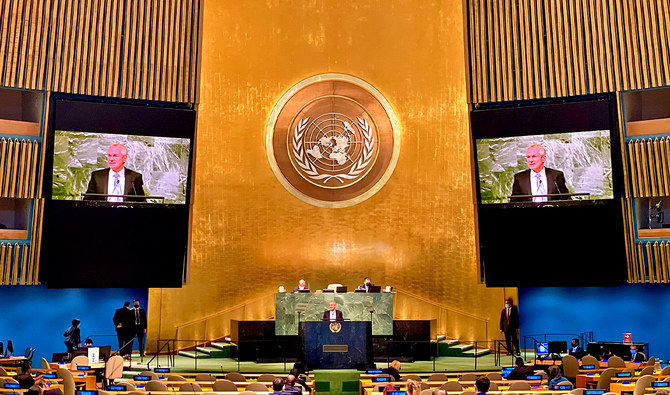
United Nations General Assembly President Csaba Kőrösi addresses UN session in New York, US, on October 7, 2022. (@UN_PGA/Twitter)
Short Url
Updated 08 October 2022
Follow

UN passes resolution, urges support for flood-battered Pakistan

  • UN chief says Pakistan is on the verge of a public health disaster and severe hunger is spiking in country
  • This is a tragedy of epic proportions and needs immediate interventions, says UN General Assembly president

ISLAMABAD: The United Nations General Assembly (UNGA) on Friday passed a resolution to express solidarity with flood-battered Pakistan and called on the international community to increase aid to the South Asian country. 

Pakistan and the United Nations this week jointly launched a humanitarian appeal of $816 million, revising it up five-fold from $160 million, as water-borne diseases and fear of growing hunger pose new dangers after weeks of unprecedented flooding in Pakistan that has left 33 million people struggling to survive. 

Csaba Korosi, President of the 77th session of the United Nations General Assembly, said the UNGA unanimously adopted Resolution 77/1 which will “strengthen the coordination of @UN.” 

“The food situation in the flood-affected parts of the country [Pakistan] is already an undeclared emergency. This is a tragedy of epic proportions,” Korosi said in his address on Friday. 

“Without immediate interventions, its consequences will take us down a path of permanent emergency.” 

Korosi said time was of the essence and the price the world was paying for delays rose each day. “The times are hard, but I am confident that we can rebuild better. And to do that, we must rebuild together,” he added. 

The deluges have killed at least 1,700 people, affected 33 million, washed away crops and caused losses worth an estimated $30 billion since August. 

According to official figures, 632 of the 1,700 killed so far in the floods have been children. In the aftermath, as flood waters begin to recede, which officials say may take two to six months, the regions have become infested with diseases including malaria, dengue fever, diarrhea and skin problems. 

On Saturday, UN Secretary-General António Guterres said Pakistan was on the verge of a public health disaster and urged the world to support the South Asian nation. 

Guterres, who saw some of the damages for himself during a visit to Pakistan last month, reminded the UNGA of the losses and the scale of the destruction. 

“Pakistan is on the verge of a public health disaster & severe hunger is spiking. While the rains may have ceased, the effects of the floods will linger for years to come,” Guterres said in a tweet, urging donors and relevant organizations to support rehabilitation and reconstruction efforts. 

“Massive needs require massive support. We are working with the Government of Pakistan to convene a pledging conference to bring together donors at the highest level to provide concrete support for rehabilitation and reconstruction efforts,” he said in his remarks to the General Assembly on Friday. 


Pakistan reviews austerity measures amid Middle East crisis, urges strict nationwide implementation

Updated 11 March 2026
Follow

Pakistan reviews austerity measures amid Middle East crisis, urges strict nationwide implementation

  • Deputy Prime Minister Ishaq Dar chairs review meeting of austerity steps
  • Officials briefed on salary cuts, school closures, four‑day week, petrol conservation

ISLAMABAD: Pakistan’s government on Wednesday assessed progress on a sweeping set of austerity measures introduced to mitigate the country’s economic strain from sharply rising global oil prices and supply disruptions linked to the ongoing war in the Middle East.

Prime Minister Shehbaz Sharif this week announced a series of austerity steps, including a four‑day work week for government offices, requiring 50  percent of staff to work from home, cutting fuel allowances for official vehicles by half, grounding up to 60  percent of the government fleet and closing all schools for two weeks to conserve fuel amid the global oil crisis.

The measures were unveiled in response to global oil market volatility triggered by the conflict involving the United States, Israel and Iran, which has disrupted supply routes such as the Strait of Hormuz and pushed crude prices sharply higher, straining Pakistan’s heavily import‑dependent energy sector.

“The meeting stressed the importance of strict and transparent adherence to the austerity measures, promoting fiscal responsibility and prudent use of public resources,” Deputy Prime Minister and Foreign Minister Senator Mohammad Ishaq Dar said in a statement.

He was chairing a meeting of the Committee for Monitoring and Implementation of Conservation and Additional Austerity Measures, constituted under the directions of the PM, bringing together federal and provincial officials to review execution of the broad cost‑cutting plan. 

Dar emphasized the government’s commitment to enforcing the PM’s austerity steps nationwide. The committee’s review also covered reductions in departmental expenditure, deductions from salaries of senior officials earning over Rs. 300,000 ($1,120), and coordination with provincial administrations to ensure uniform implementation of the plan.

Participants at the meeting reiterated that all ministries and divisions must continue strict monitoring and reporting, with transparent oversight mechanisms, as Pakistan navigates the economic pressures from the prolonged Middle East crisis and its fallout on global energy and trade markets.