Emboldened by Iran protests, Afghan women take to streets after deadly school attack

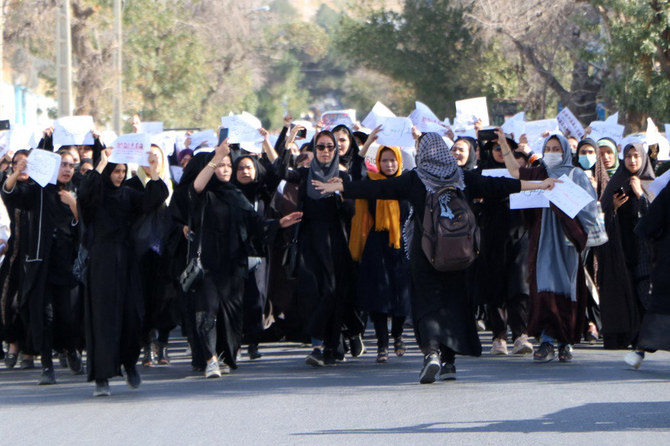
Afghan female students march from the University of Herat toward the provincial governor's office in Herat during a protest on Oct. 2, 2022. (AFP)
Short Url
Updated 08 October 2022
Follow

Emboldened by Iran protests, Afghan women take to streets after deadly school attack

  • Women are demonstrating in Kabul, Herat, Bamyan, Balkh, Nangarhar and Ghazni
  • Last week’s capital attack killed at least 45 people, mostly girls and young women

KABUL: Women’s demonstrations in Afghanistan have been on the rise since last week’s deadly bombing at an education center in Kabul, with activists saying that they are emboldened by ongoing protests in Iran.

The blast at the Kaaj education center in the Dasht-e-Barchi area in the west of the Afghan capital targeted teenage students taking a practice college exam.

At least 43 people were killed and 83 wounded when a suicide bomber detonated a device in the exam hall where about 500 children were sitting. Most of the victims were girls from the Hazara community, which has often been targeted by militants.

Since the Sept. 30 attack, female activists have taken to the streets across the country, mobilizing to condemn the unrelenting violence as well as restrictions on women and minorities.

Although the protests have been dissolved by Taliban authorities — which since taking control in August 2021 have curbed women’s rights — dozens of demonstrators showed up in Kabul and the provinces of Herat, Bamyan, Balkh, Nangarhar and Ghazni in the past six days.
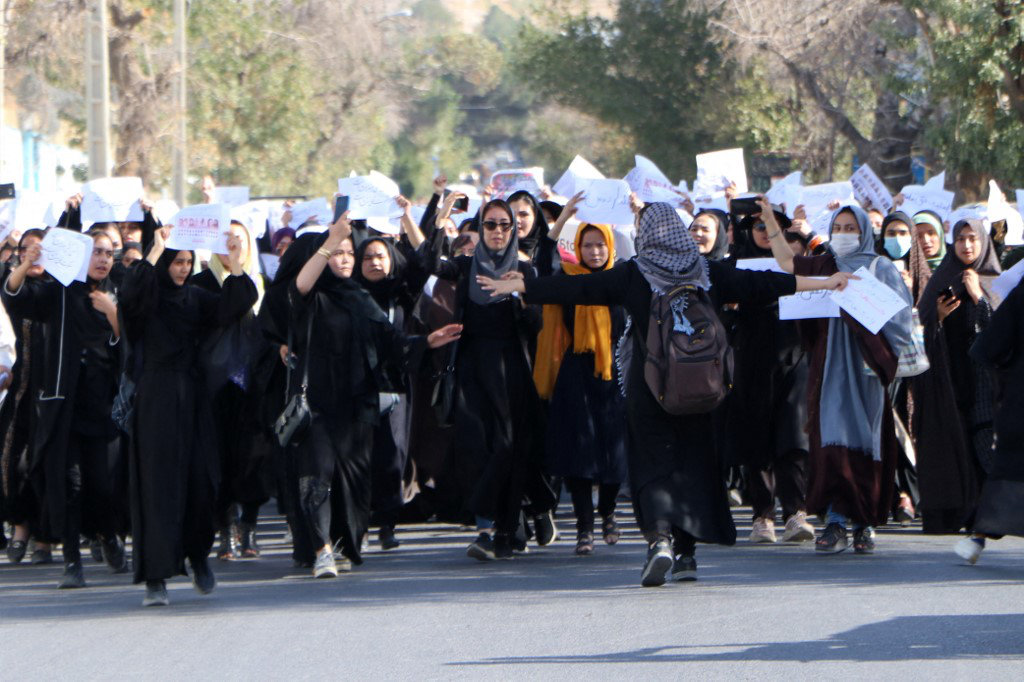


Afghan female students march from the University of Herat toward the provincial governor's office in Herat during a protest on Oct. 2, 2022. (AFP)

“I am glad women from different parts of the country are joining us in condemning the attack on Hazara female students in Kabul. I would request other sisters and brothers to do the same,” Razia Mohseni, a 34-year-old women’s rights activist from Kabul, told Arab News.

“The recent protests in Iran are inspiring to us as well. Women in Iran and here are suffering from almost the same problems. Women across the country and beyond should join hands to make their voices heard. Together we all win.”

In neighboring Iran, countrywide demonstrations, which began in mid-September, have been the largest manifestation of dissent in more than a decade.

Triggered by the death of 22-year-old Mahsa Amini, who died while in the custody of Iranian morality police, the protests have spread to all of Iran’s 31 provinces, with ethnic and religious minorities joining in despite violent responses from authorities.

For Afghan women, the protests in Iran are a “symbol of resistance and awakening,” Zarmina Sharifi, a 26-year-old activist from Nangarhar, said.

“Our sisters were killed in an attack on Kaaj education center in Kabul while getting an education. While we condemn the cowardly attack, we stand with our sisters in solidarity. We ask the authorities to protect students and educational centers.”

While security forces disperse protesters, as since September last year permission from the Ministry of Justice has been required to organize protests in Afghanistan, women say that they have to raise their voices.

“We can’t remain silent about the killing of our sisters. We want protection and our rights. We are not doing anything wrong by raising our voices for the oppressed,” Hafiza Jami, a student of the University of Herat, told Arab News.

“Women in Iran and Afghanistan should be able to live their lives free of fear. That is what our protest is all about. At times like this, being together gives us strength.”


North Korean POWs in Ukraine seeking ‘new life’ in South

Updated 1 sec ago
Follow

North Korean POWs in Ukraine seeking ‘new life’ in South

SEOUL: Two North Korean prisoners of war held by Ukraine have said they hope to start a “new life” in South Korea, according to a letter seen by AFP on Wednesday.
Previous reports have indicated that the two men, held captive by Kyiv since January after sustaining injuries on the battlefield, were seeking to defect to the South.
But the letter represents the first time the two of them have said so in their own words.
“Thanks to the support of the South Korean people, new dreams and aspirations have begun to take root,” the two soldiers wrote in a letter dated late October to a Seoul-based rights group which shared it with AFP this week.
North Korea has sent thousands of troops to support Russia’s nearly four-year invasion of Ukraine, according to South Korean and Western intelligence agencies.
At least 600 have died and thousands more have sustained injuries, according to South Korean estimates.
Analysts say North Korea is receiving financial aid, military technology and food and energy supplies from Russia in return.
North Korean soldiers are instructed to kill themselves rather than be taken prisoner, according to South Korea’s intelligence service.
In the letter, the two prisoners thanked those working on their behalf “for encouraging us and seeing this situation not as a tragedy but as the beginning of a new life.”
“We firmly believe that we are never alone, and we think of those in South Korea as our own parents and siblings and have decided to go into their embrace,” they wrote.
The letter is signed by the two soldiers, whose names AFP has been asked to withhold to protect their safety.

- ‘Death sentence’ -

Under South Korea’s constitution, all Koreans — including those in the North — are considered citizens, and Seoul has said this applies to any troops captured in Ukraine.
The letter was delivered during an interview for a documentary film coordinated by the Gyeore-eol Nation United (GNU) rights group, which works to help North Korean defectors.
That interview took place at an undisclosed facility in Kyiv where the two POWs are being held after they were captured.
During the interview, the pair also pleaded to be sent to the South, according to GNU chief Jang Se-yul, himself a North Korean defector who fled the isolated country in the 2000s.
The video has not yet been made public but is expected to be released next month, Jang said.
Yu Yong-weon, a lawmaker who met with the prisoners during a visit to Ukraine in February, said the prisoners had described witnessing wounded comrades kill themselves with grenades.
Sending the soldiers back to the North would constitute “a death sentence,” Yu said.
South Korea’s foreign ministry has urged Ukraine not to “forcibly repatriate North Korean prisoners of war against their will” and has asked that their desire to go to the South be respected.