Women’s Asia Cup: Nida Dar inspires Pakistan to 13-run win over India

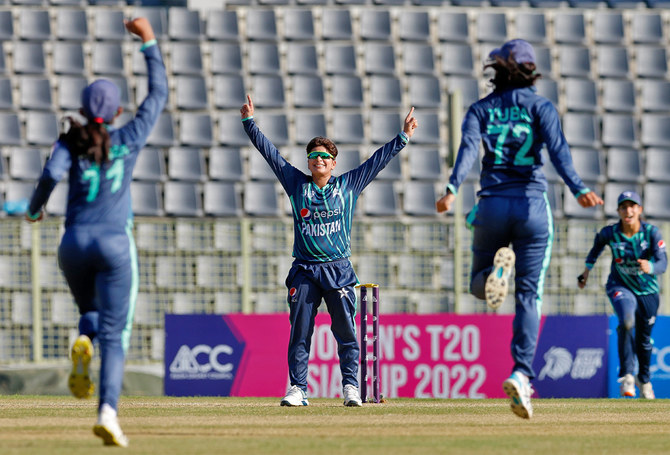
Pakistani all-rounder Nidar Dar celebrates after taking a wicket of Indian batsman in the Women’s Asia Cup 2022 at the Sylhet International Stadium in Bangladesh on October 7, 2022. (Pakistan Cricket Board)
Short Url
Updated 07 October 2022
Follow

Women’s Asia Cup: Nida Dar inspires Pakistan to 13-run win over India

  • Nida Dar scores unbeaten half-century, takes two wickets
  • Pakistan batted first, handing India a 138-run target

ISLAMABAD: All-rounder Nidar Dar on Friday inspired Pakistan women’s cricket team to beat arch-rivals India by 13 runs in the Women’s Asia Cup 2022, only 24 hours after suffering a shock defeat at the hands of Thailand. 

Pakistan captain Bismah Maroof chose to bat after winning the toss against India at the Sylhet International Stadium in Bangladesh.

The green shirts bolstered their spin options by bringing in Sadia Iqbal in place of pacer Diana Baig and also replaced seam-bowling allrounder Aiman Anwer for Kainat Imtiaz. 

Pakistani opening batters Muneeba Ali and Sidra Amin both failed to impress, departing for the pavilion after scoring 17 and 11 respectively. Skipper Maroof came out to bat and put on a respectable 32 off 35 balls before she was dismissed by Renuka Singh. 

After Deepti Sharma trapped Omaima Sohail for a duck, Pakistan seemed to be in trouble at 33-3. However, in stepped Dar and turned the game around for Pakistan. With Maroof, she put on a respectable 76-run partnership and scored a half-century as well. 
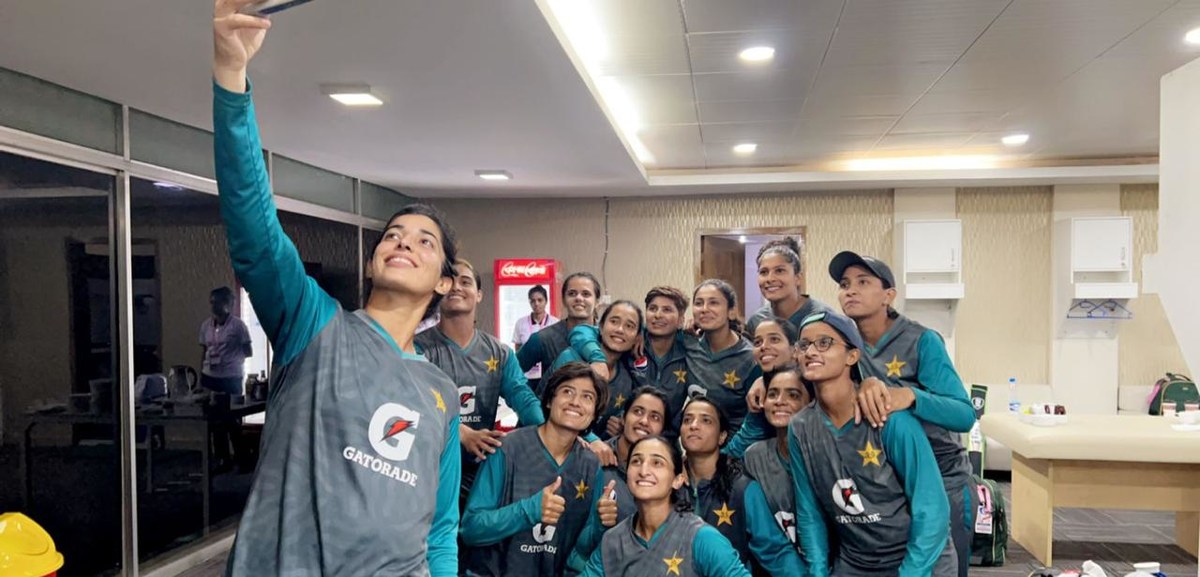


Pakistan women's cricket team poses for a selfie after defeating India at the Sylhet International Stadium in Bangladesh on October 7, 2022. (Pakistan Cricket Team)

Dar scored an unbeaten 56 off 37 balls, hitting five 4s and a six, as Pakistan finished at 137/6 at the end of their 20 overs. 

India’s Sharma ended up being the pick of the bowlers, finishing with figures of 3/27 while Pooja Vastrakar took 2/23 from her four overs. 

Pakistan put India on the back foot with back-to-back wickets, as Nashra Sandhu dismissed both openers. It was then Dar’s moment to shine as she took the important wickets of Jemimah Rodrigues and Harmanpreet Kaur. 

Dar finished with figures of 2/23 and walked away with the Player of the March award. The pick of the Pakistani bowlers, however, was Sandhu with figures of 3/30 while Sadia Iqbal also ended up with 2/24 from her four overs. 

Pakistani bowler Aiman Anwer took the last wicket of the Indian side, bundling out the blue shirts for a modest 124 runs from 19.4 overs. 

“A sensational performance!” wrote the PCB on Twitter. “Pakistan earn a 13-run win over India.” 

India, who were at the top of the table with three wins from three games, are now level with Pakistan. Both teams now have six points in the tournament. 


Rating firm S&P says it won’t rush Iran war downgrades, sees risks for countries like Pakistan

Updated 12 March 2026
Follow

Rating firm S&P says it won’t rush Iran war downgrades, sees risks for countries like Pakistan

  • Agency says it is monitoring indebted energy importers as higher oil prices strain finances
  • Gulf economies seen better placed to weather shock, though Bahrain flagged as vulnerable

LONDON: S&P Global ‌said it would not make any knee-jerk sovereign rating cuts following the outbreak of war in the ​Middle East, but warned on Thursday that soaring oil and gas prices were putting a number of already cash-strapped countries at risk.

The firm’s top analysts said in a webinar that the conflict, which has involved US and Israeli strikes ‌against Iran and Iranian ‌strikes against Israel, ​US ‌bases ⁠and Gulf ​states, ⁠was now moving from a low- to moderate-risk scenario.

Most Gulf countries had enough fiscal buffers, however, to weather the crisis for a while, with more lowly rated Bahrain the only clear exception.

Qatar’s banking sector could ⁠also struggle if there were significant ‌deposit outflows in ‌reaction to the conflict, although there ​was no evidence ‌of such strains at the moment, they ‌said.

“We don’t want to jump the gun and just say things are bad,” S&P’s head global sovereign analyst, Roberto Sifon-Arevalo, said.

The longer the crisis ‌was prolonged, though, “the more difficult it is going to be,” he ⁠added.

Sifon-Arevalo ⁠said Asia was the second-most exposed region, due to many of its countries being significant Gulf oil and gas importers.

India, Thailand and Indonesia have relatively lower reserves of oil, while the region also had already heavily indebted countries such as Pakistan, Bangladesh and Sri Lanka whose finances would be further hurt by rising energy prices.

“We ​are closely monitoring ​these (countries) to see how the credit stories evolve,” Sifon-Arevalo said.