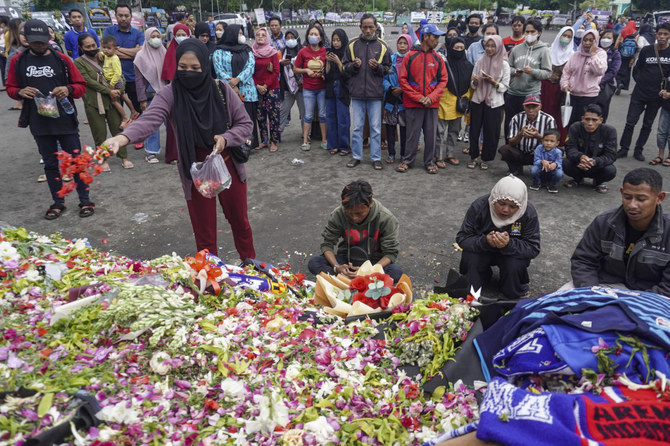
MALANG: Indonesians gathered for Friday prayers mourned 131 people killed in a soccer stampede six days ago, amid calls for a prompt investigation into one of the world’s most deadly stadium disasters to enable its victims to rest in peace.
Most of those killed after the match in the town of Malang, in East Java province, died of asphyxiation, caught in a panicked crush as they tried to flee after police fired tear gas in an attempt to disperse a rowdy crowd.
At Al Fatih Mosque near Malang an Islamic preacher led a tearful recital of tahlilan, or special prayers for the dead.
“Many of the supporters demand the case be immediately resolved so the souls of those who died can rest in peace,” said 53-year-old soccer fan Widodo after joining the prayer.
Widodo, who like many Indonesians uses one name, had been at Saturday’s match but left early fearing things could turn bad.
Police have named six suspects in an investigation into the stampede, including match organizers and three officers who were present.
The deadly incident has fueled accusations of heavy-handed policing in the soccer-mad Southeast Asian nation, with the use of tear gas inside the stadium — prohibited by world soccer body FIFA — widely criticized.
Messages and posters have been plastered on the stadium’s doors and walls, some demanding an end to “police brutality,” and Amnesty International Indonesia said on Friday that the tragedy “shows what can happen when excessive use of force by security forces is allowed to go on with impunity.”

Fans mourn victims of Indonesian stadium stampede at Friday prayers
Russia’s war footing may remain after Ukraine war, Latvia spy chief warns
MUNICH: Russia will not end the militarization of its economy after fighting in Ukraine ends, the head of Latvia’s intelligence agency told AFP on the sidelines of the Munich Security Conference which ends Sunday.
“The potential aggressiveness of Russia when the Ukraine war stops will depend of many factors: How the war ends, if it’s frozen or not, and if the sanctions remain,” Egils Zviedris, director of the Latvian intelligence service SAB, told AFP.
Some observers believe that Russia has so thoroughly embraced a war economy and full military mobilization that it will be difficult for it to reverse course, and that this could push Moscow to launch further offensives against European territories.
Zviedris said that lifting current sanctions “would allow Russia to develop its military capacities” more quickly.
He acknowledged that Russia has drawn up military plans to potentially attack Latvia and its Baltic neighbors, but also said that “Russia does not pose a military threat to Latvia at the moment.”
“The fact that Russia has made plans to invade the Baltics, as they have plans for many things, does not mean Russia is going to attack,” Zviedris told AFP.
However, the country is subject to other types of threats from Moscow, particularly cyberattacks, according to the agency he leads.
The SAB recently wrote in its 2025 annual report that Russia poses the main cyber threat to Latvia, because of broader strategic goals as well as Latvia’s staunch support of Ukraine.
The threat has “considerably increased” since Moscow’s full-scale invasion of Ukraine in 2022, it said.
The agency has also warned that Russia is seeking to exploit alleged grievances of Russian-speaking minorities in the Baltics — and in Latvia in particular.
Russia’s Ministry of Foreign Affairs has repeatedly claimed to be preparing cases against Latvia, Lithuania and Estonia at the UN International Court of Justice over the rights of their Russian-speaking minorities.
“The aim of litigation: to discredit Latvia on an international level and ensure long-term international pressure on Latvia to change its policy toward Russia and the Russian-speaking population,” the report said.
In 2025, approximately 23 percent of Latvia’s 1.8 million residents identified as being of Russian ethnicity, according to the national statistics office.
Following the Russian invasion of Ukraine in 2022, Latvian authorities decided to require Russian speakers residing in the country to take an exam to assess their knowledge of the Latvian language — with those failing at potential risk of deportation.
“The potential aggressiveness of Russia when the Ukraine war stops will depend of many factors: How the war ends, if it’s frozen or not, and if the sanctions remain,” Egils Zviedris, director of the Latvian intelligence service SAB, told AFP.
Some observers believe that Russia has so thoroughly embraced a war economy and full military mobilization that it will be difficult for it to reverse course, and that this could push Moscow to launch further offensives against European territories.
Zviedris said that lifting current sanctions “would allow Russia to develop its military capacities” more quickly.
He acknowledged that Russia has drawn up military plans to potentially attack Latvia and its Baltic neighbors, but also said that “Russia does not pose a military threat to Latvia at the moment.”
“The fact that Russia has made plans to invade the Baltics, as they have plans for many things, does not mean Russia is going to attack,” Zviedris told AFP.
However, the country is subject to other types of threats from Moscow, particularly cyberattacks, according to the agency he leads.
The SAB recently wrote in its 2025 annual report that Russia poses the main cyber threat to Latvia, because of broader strategic goals as well as Latvia’s staunch support of Ukraine.
The threat has “considerably increased” since Moscow’s full-scale invasion of Ukraine in 2022, it said.
The agency has also warned that Russia is seeking to exploit alleged grievances of Russian-speaking minorities in the Baltics — and in Latvia in particular.
Russia’s Ministry of Foreign Affairs has repeatedly claimed to be preparing cases against Latvia, Lithuania and Estonia at the UN International Court of Justice over the rights of their Russian-speaking minorities.
“The aim of litigation: to discredit Latvia on an international level and ensure long-term international pressure on Latvia to change its policy toward Russia and the Russian-speaking population,” the report said.
In 2025, approximately 23 percent of Latvia’s 1.8 million residents identified as being of Russian ethnicity, according to the national statistics office.
Following the Russian invasion of Ukraine in 2022, Latvian authorities decided to require Russian speakers residing in the country to take an exam to assess their knowledge of the Latvian language — with those failing at potential risk of deportation.
© 2026 SAUDI RESEARCH & PUBLISHING COMPANY, All Rights Reserved And subject to Terms of Use Agreement.


