PARIS: The mother of an Iranian teen who died after joining protests over Mahsa Amini’s death accused the authorities of murdering her, in a video sent Thursday to foreign-based opposition media.
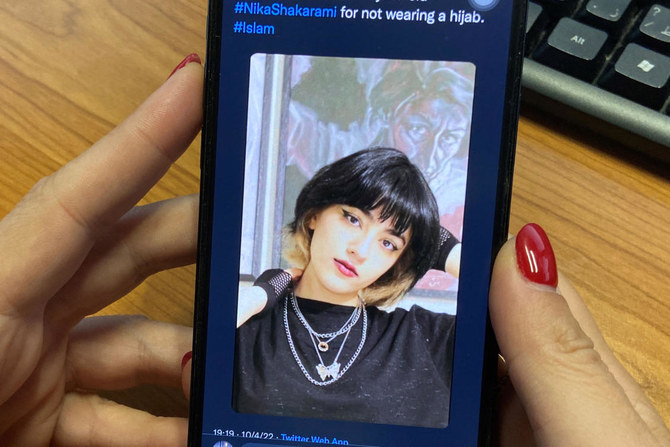
Nasrin Shahkarami also accused the authorities of threatening her to make a forced confession over the death of 16-year-old Nika, who went missing on September 20 after heading out to join an anti-hijab protest in Tehran.
Protests erupted across Iran over the death of Amini, a 22-year-old Kurd, after her arrest by the morality police in Tehran for allegedly breaching the Islamic republic’s strict dress code for women.
A crackdown by the security forces on the women-led protests has claimed dozens of lives, according to human rights groups.
After Nika Shahkarami’s death, her family had been due to bury her in the western city of Khorramabad on what would have been her 17th birthday, her aunt Atash Shahkarami wrote on social media.
But Persian-language media outside Iran have reported that the girl’s family were not allowed to lay her to rest in her hometown, and that her aunt and uncle were later arrested.
The aunt later appeared on television saying Nika Shahkarami had been “thrown” from a multi-story building.
But her sister said “they forced her to make these confessions and broadcast them,” in the video posted online Thursday by Radio Farda, a US-funded Persian station based in Prague.
“We expected them to say whatever they wanted to exonerate themselves... and they have in fact implicated themselves,” said Nasrin Shahkarami.
“I probably don’t need to try that hard to prove they’re lying... my daughter was killed in the protests on the same day that she disappeared.”
The mother said a forensic report found that she had been “killed on that date, and due to repeated blunt force trauma to the head.
“I saw my daughter’s body myself... The back of her head showed she had suffered a very severe blow as her skull had caved in. That’s how she was killed.”
Nasrin Shahkarami said the authorities had tried to call her several times but she has refused to answer.
“But they have called others, my uncles, others, saying that if Nika’s mother does not come forward and say the things we want, basically confess to the scenario that we want and have created, then we will do this and that, and threatened me.”
Oslo-based group Iran Human Rights (IHR) on Thursday said it held the Islamic republic responsible for Nika Shahkarami’s death.
“Contradictory claims by the Islamic republic about... Nika Shakarami’s cause of death based on grainy edited footage and her relatives’ forced televised confessions under duress are unacceptable,” it said
IHR director Mahmood Amiry-Moghaddam called for an independent investigation.
“The evidence points to the government’s role in Nika Shakarami’s murder, unless the opposite is proven by an independent fact-finding mission under the supervision of the United Nations,” he said in a statement.
“Until such a committee is formed, the responsibility for Nika’s murder, like the other victims of the current protests, rests with (Iran’s supreme leader Ayatollah) Ali Khamenei and the forces under his command.”


![]()

Iran woman accuses state of killing daughter at Mahsa Amini protest
Short Url
https://arab.news/2qys6
Iran woman accuses state of killing daughter at Mahsa Amini protest
- Nasrin Shahkarami also accused the authorities of threatening her to make a forced confession over the death of 16-year-old Nika
- A crackdown by the security forces on the women-led protests has claimed dozens of lives, according to human rights groups


Latest updates




Recommended


© 2026 SAUDI RESEARCH & PUBLISHING COMPANY, All Rights Reserved And subject to Terms of Use Agreement.