MOSCOW: Russia’s forces occupying Ukraine’s southern Black Sea region of Kherson have suffered serious territorial losses to Kyiv’s troops over recent days, maps published by Moscow’s defense ministry showed Tuesday.
The maps included in Tuesday’s daily military briefing showed that Russian forces were no longer in control of the village of Dudchany on the west bank of the river Dnieper, where Ukraine’s forces have been pushing to reclaim territory captured at the start of Moscow’s offensive.
In the northeastern Kharkiv region, defense ministry maps showed that Russian forces have left positions on the west bank of the Oskil river, in the aftermath this month of a counter-offensive by Kyiv’s army.
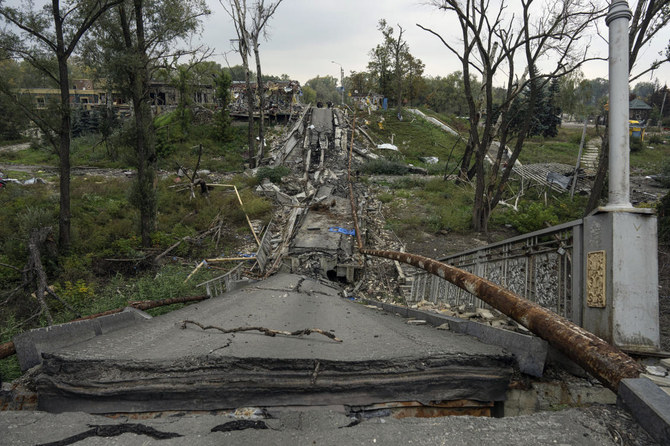
The Ukrainian military claimed in a statement Tuesday that Russian forces in Kherson are “demoralized” and were falling back on their positions, destroying ammunition depots and bridges in their wake.
“All this in order to slow down the offensive of our troops,” the defense ministry said in their statement.
Ukraine’s deputy interior minister Yevhen Enin said Tuesday that Ukraine’s forces had recaptured 50 towns and villages in Kherson, without specifying when.
Kyiv’s forces have been slowly clawing back territory in Kherson for several weeks but the advance has accelerated in recent days.
With a population of one million before the war, Kherson is a key agricultural area and forms the gateway to the Crimean peninsula.
Its main city, also named Kherson, was one of the first to fall to Russian forces after they launched what the Kremlin calls its “special military operations” in February.
The Kremlin last week formally annexed the region along with three others even though Russian troops do not fully control it.

Russian army maps show lost ground in key Kherson region
https://arab.news/2mgwf
Russian army maps show lost ground in key Kherson region
- The maps included in Tuesday's daily military briefing showed that Russian forces were no longer in control of the village of Dudchany
- The Ukrainian military claimed in a statement Tuesday that Russian forces in Kherson are "demoralised" and were falling back on their positions
Neighbors of alleged Bondi gunmen shocked by deadly rampage
- Local media named the two suspected gunmen as father and son Sajid and Naveed Akram
SYDNEY: Like many people in Sydney, Glenn Nelson spent his Sunday evening watching television coverage of a deadly shooting on the city’s iconic Bondi Beach.
But stepping onto his front porch, flanked by neatly trimmed box hedges, he saw armed police cordoning off the street before raiding the house opposite — home of the two suspects who are alleged to have killed 15 people in Australia’s worst mass shooting in decades.
“I thought, ‘Okay, I’ll catch the rest in the morning,’ the next thing, the drama is out the front door,” he said in an interview on Monday, shortly after mowing his lawn.
Nelson and other neighbors said the family living across the street kept to themselves, but seemed like any other in the suburb of Bonnyrigg, a working-class, well-kept enclave with an ethnically diverse population around 36 km (22 miles) by road from Sydney’s central business district.
Local media named the two suspected gunmen as father and son Sajid and Naveed Akram.
Police have not named the suspects, but they said the older man, 50, was killed at the scene, taking the number of dead to 16, while his 24-year-old son was in a critical condition in hospital.
Police said the son was known to authorities and the father had a firearms license.
The Sydney Morning Herald spoke to a woman on Sunday evening who identified herself as the wife and mother of the suspects.
She said the two men had told her they were going on a fishing trip before heading to Bondi and opening fire on an event celebrating the Jewish festival of Hanukkah.
“I always see the man and the woman and the son,” said 66-year-old Lemanatua Fatu, who lives across the street.
“They are normal people.”
Until Sunday’s shooting, Bonnyrigg was an otherwise unremarkable neighborhood typical of Sydney’s sprawling Western suburbs.
It has significant Vietnamese and Chinese communities, along with many residents who were born in Iraq, Cambodia and Laos, according to government data.
The town center, a strip mall with a large adjoining car park, is flanked by a mosque, a Buddhist temple and several churches.
“It’s a quiet area, very quiet,” Fatu said. “And people mind their own business, doing their own thing — until now.”
Not much is currently known about the suspects’ backgrounds.
A Facebook post from an Arabic and Qur'an studies institute appearing to show one of the men was removed on Monday and no one answered the door at an address listed for it in the neighboring suburb of Heckenberg.
On Monday afternoon, as police took down their cordon, several people re-entered the house, covering their faces. They made no comment to the media and did not answer the door.


