Schoolgirls across Iran remove hijabs in protest against government

A series of viral videos show teenage students across Iran waving their headscarves in the air and chanting anti-government slogans. (File/AFP)
Short Url
Updated 05 October 2022
Follow

Schoolgirls across Iran remove hijabs in protest against government

  • Viral videos show girls waving headscarves, chanting slogans against authorities
  • Protests began shortly after supreme leader blamed riots on US and Israel 

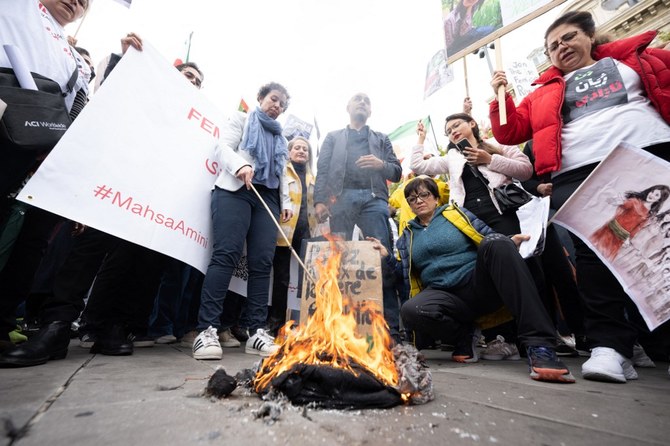
LONDON: Iranian schoolgirls have joined demonstrations against the death of Mahsa Amini, sparking Iran’s largest civil uprising in three years. 

A series of videos, verified by the BBC, show teenage students across Iran waving their headscarves in the air and chanting anti-government slogans. 

In a viral video, groups of hijab-less girls in Karaj were filmed chasing an alleged government official out of their school on Monday. 

The girls appeared to be throwing empty water bottles at the man while yelling “shame on you” until he retreated through a gate. 

In another clip from Karaj, a city west of Tehran, young students can be heard shouting “If we don’t unite, they will kill us one by one.”

On the same day, dozens of schoolgirls in Shiraz blocked traffic on a main road by waving their headscarves in protest against Supreme Leader Ayatollah Ali Khamenei. “Death to the dictator,” they chanted. 

Similar protests were reported on Tuesday in Tehran and the northwestern cities of Saqez and Sanandaj. 

Meanwhile, a group of girls in their classrooms were photographed hijab-less and making obscene gestures at images of Khamenei and the founder of the Islamic Republic, Ayatollah Ruhollah Khomeini.

The protests by the schoolgirls began swiftly after Khamenei broke his silence on the nationwide unrest by accusing arch-foes the US and Israel of instigating riots in the country.

The supreme leader also backed the security forces, who have reacted to the dissent with violent crackdowns. 

Demonstrations have entered into their third week in Iran since the death of 22-year-old Amini, who fell into a coma while in the custody of morality police in Tehran after allegedly breaking the hijab law. She died three days later in hospital.


Sudan defense minister dismisses ‘intelligence document’ as fabrication after convoy strike

Updated 12 February 2026
Follow

Sudan defense minister dismisses ‘intelligence document’ as fabrication after convoy strike

  • Gen. Hassan Kabroun tells Arab News claims that army hid weapons in aid convoy are “completely false”

RIYADH: Sudan’s defense minister has firmly denied reports attributed to Sudanese intelligence alleging that a convoy targeted in North Kordofan was secretly transporting weapons under the cover of humanitarian aid.

Gen. Hassan Kabroun described the claims as “false” and an attempt to distract from what he called a militia crime.

The controversy erupted after news reports emerged that a document attributed to Sudan’s General Intelligence Service claimed the convoy struck in Al-Rahad on Friday was not a purely humanitarian mission, but was instead carrying “high-quality weapons and ammunition” destined for Sudanese Armed Forces units operating in the state.

The report further alleged that the convoy had been outwardly classified as humanitarian in order to secure safe passage through conflict zones, and that the Rapid Support Forces had destroyed it after gathering intelligence on its route and cargo.

Kabroun categorically rejected the narrative.

“First of all, we would like to stress the fact that this news is false,” he told Arab News. “Even the headline that talks about the security of the regions, such as Al-Dabbah, is not a headline the army would use.”

He described the document as fabricated and politically motivated, saying it was designed to “cover up the heinous crime they committed.”

The minister affirmed that the area targeted by drones is under full control of the Sudanese Armed Forces and does not require any covert military transport.

“Second, we confirm that the region that was targeted by drones is controlled by the army and very safe,” Kabroun said. “It does not require transporting any military equipment using aid convoys as decoys because it is a safe area controlled by the army, which has significant capabilities to transport humanitarian aid.”

According to the minister, the Sudanese military has both the logistical capacity and secure routes necessary to move equipment openly when needed.

“The army is professional and does not need to deliver anything to Kadugli or Dalang on board aid convoys,” he said. “The road between Dalang and Kadugli is open. The Sudanese forces used that road to enter and take control of the region. The road is open and whenever military trucks need to deliver anything, they can do so without resorting to any form of camouflage.”

Kabroun further rejected any suggestion that the military uses humanitarian operations as cover.

“Aid is transported by dedicated relief vehicles to the areas in need of this assistance,” he said. “Aid is not transported by the army. The army and security apparatus do not interfere with relief efforts at all, and do not even accompany the convoys.”

He stressed that the Sudanese Armed Forces maintains a clear institutional separation between military operations and humanitarian work, particularly amid the country’s crisis.

“These are false claims,” he said. “This fake news wanted to cover up the heinous crime they committed.”

Sudan has been gripped by conflict since April 2023, when fighting broke out between the Sudanese Armed Forces and the Rapid Support Forces, plunging the country into what the United Nations has described as one of the world’s worst humanitarian disasters.

The latest dispute over the convoy comes amid intensified fighting in South Kordofan, a strategically sensitive region linking central Sudan with the contested areas of Darfur and Blue Nile.

The false report suggested that intelligence monitoring had enabled the RSF to strike what it described as a military convoy disguised as humanitarian aid. But Kabroun dismissed that version outright.

“The intelligence agency is well aware of its duties,” he said. “The Sudanese Army has enough weapons and equipment to use in the areas of operations. These claims are completely false.”

He argued that the narrative being circulated seeks to shift blame for attacks on civilian infrastructure and humanitarian movements.

“This shows that they are trying to cover up the atrocities,” he added, referring to the militia.

Kabroun maintained that the army has regained momentum on multiple fronts and remains fully capable of sustaining its operations without resorting to deception.

“The region is secure, the roads are open, and the army does not need camouflage,” he said. “We are operating professionally and transparently.”

“These claims are completely false,” Kabroun said. “The Sudanese Army does not use humanitarian convoys for military purposes.”