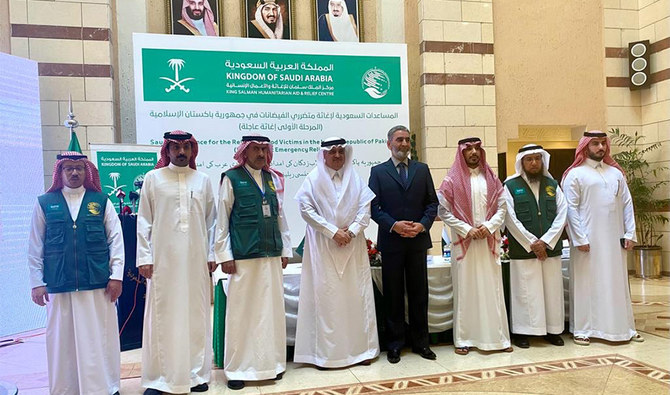

ISLAMABAD: Over 4,000 tons of flood relief goods that will benefit more than 785,636 people in 51 affected areas have been sent to Pakistan via land and air routes, the kingdom’s envoy to Islamabad said on Tuesday, adding that Saudi aid was being provided in four phases through the King Salman Humanitarian Aid & Relief Center (KSrelief).
The floods, caused by abnormal monsoon rains and glacial melt, have submerged huge swathes of the South Asian country and killed nearly 1,700 people, most of them women and children.
Hundreds of thousands of displaced people who are living in the open are being exposed to diseases like malaria, diarrhea, dengue fever, severe skin and eyes infections, all of which are fast spreading amid stagnant floodwaters that officials say will take several months to recede.
“So far, a total of 65,000 food packages, 50,000 mosquito nets, 5,000 relief tents, and 25,000 NFI (non-food items) kits have been distributed in 51 affected areas all over Pakistan,” Saudi ambassador Nawaf bin Said Al-Malki told media in Islamabad, saying the weight of the relief goods was over 3,965 tons and had been dispatched via a land bridge established by KSrelief.
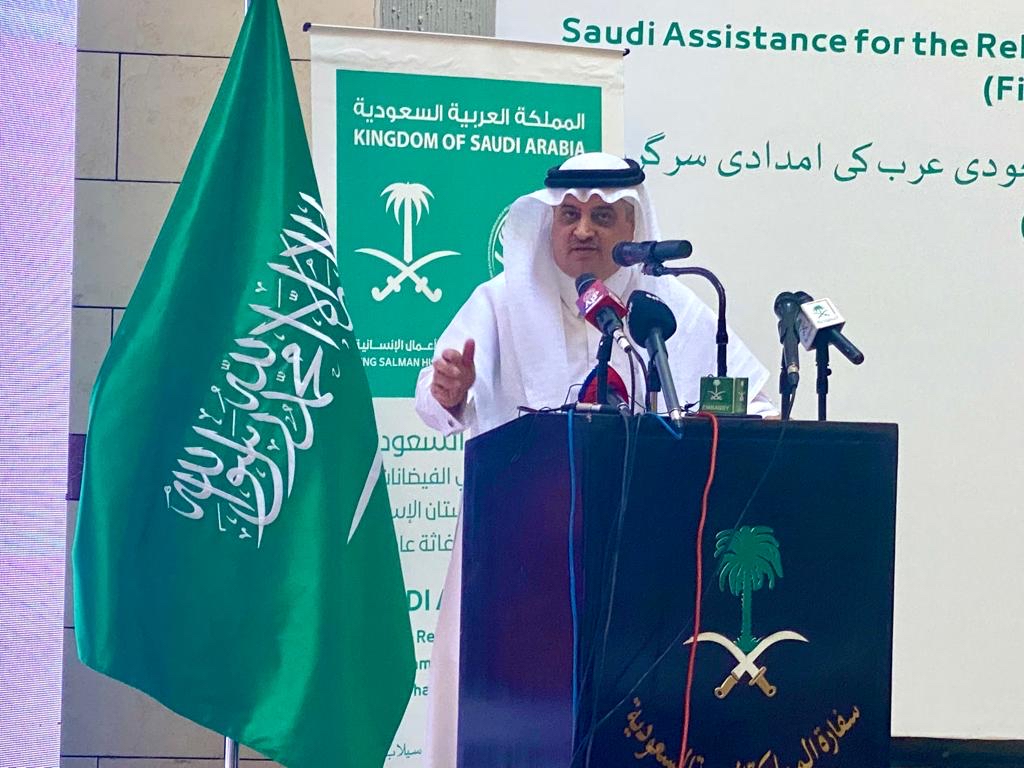
Saudi ambassador Nawaf bin Said Al-Malki addresses a media briefing in Islamabad, Pakistan, on October 4, 2022. (AN Photo)
Work on the provision of 25,000 winter kits was also underway, the envoy said.
Secondly, KSrelief had launched a people’s campaign for the collection of donations through an approved platform, “Sahim,” Al-Malki said, which had so far collected 40.9 million Saudi Riyals.
In the third phase, an air bridge was established, the envoy said, and 10 flights loaded with various relief goods weighing 420 tons had arrived in Pakistan, with aid packages handed over to the National Disaster Management Authority (NDMA).
In the fourth quarter, the ambassador said a field survey would be conducted in coordination with other government organizations to access damages that occurred due to the floods which swept away and destroyed houses, schools, health centers, water projects, bridges and roads.
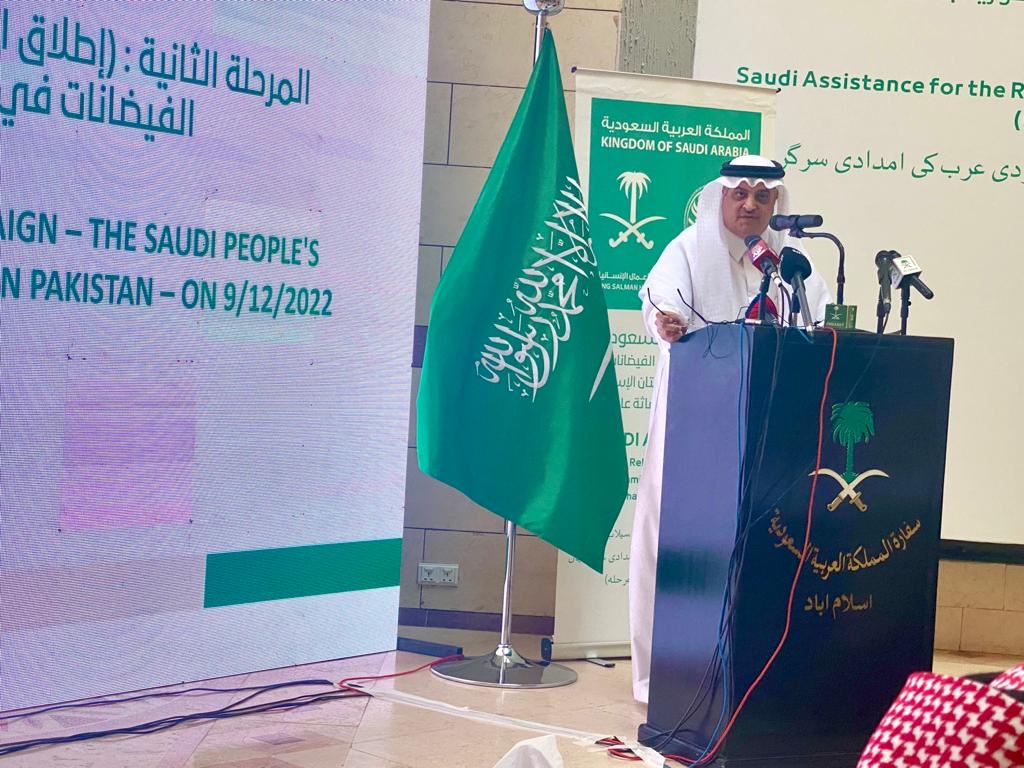
Saudi ambassador Nawaf bin Said Al-Malki addresses a media briefing in Islamabad, Pakistan, on October 4, 2022. (AN Photo)
“After the data is collected, the scope of the works will be studied, and the facilities will be rehabilitated by KSrelief together with the Saudi Fund for Development,” Al-Malki added.
Dr. Khalid Muhammad Al-Othmani, the director for KSrelief in Pakistan, said the agency had also distributed 15,000 packages containing more than 1,425 tons of essential food items in the southwestern province of Balochistan, one of the worst hit by floods.
“A total of 4,385 tons of different kinds of relief goods through land route and air bridges have been distributed so far, which benefited more than 785,636 people all across Pakistan.”
Chairman NDMA, Lt. Gen. Akhtar Nawaz, thanked the leadership of Saudi Arabia for the timely assistance.
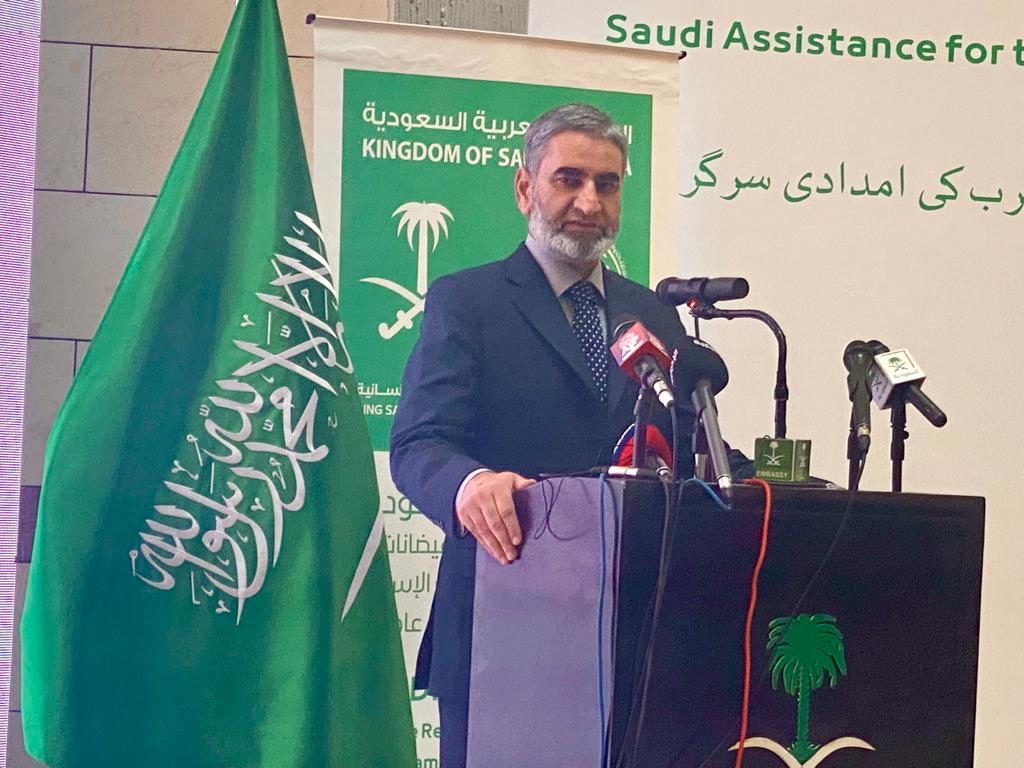
National Disaster Management Authority Chairman Lieutenant General Akhtar Nawaz addresses a media briefing in Islamabad, Pakistan, on October 4, 2022. (AN Photo)
“Saudi Arabia has always supported Pakistan in difficult times, be it the earthquake of 2005, the super flood of 2010, and these unprecedented monsoon triggered floods now,” he said.
“On behalf of the government of Pakistan and NDMA, I assure you [Saudis] that whatever support is coming, without delay it will be delivered to the affected people in the most proficient manner.”