

Pakistan expresses solidarity with Kuwait, urges dialogue as Iran war spreads

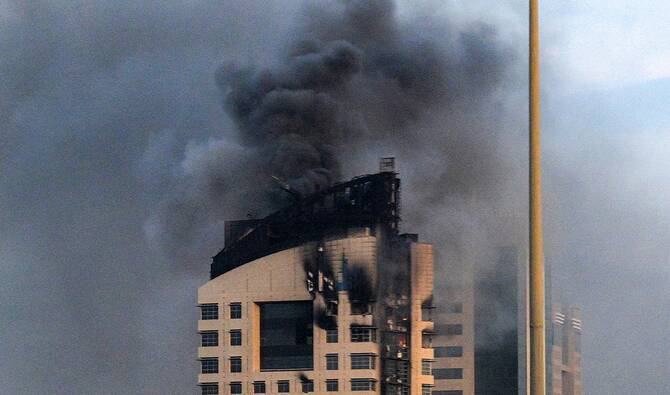
Smoke rises from a high-rise building following a drone attack in Kuwait City on March 8, 2026. (AFP)
Short Url
Updated 11 March 2026
Follow

Pakistan expresses solidarity with Kuwait, urges dialogue as Iran war spreads

  • Ishaq Dar speaks with Kuwait’s foreign minister after Iranian attacks target the Gulf state
  • They discuss matters before Security Council where Pakistan is a non-permanent member

ISLAMABAD: Pakistan expressed solidarity with Kuwait and called for dialogue and de-escalation in the Middle East after attacks linked to the ongoing Iran war struck the Gulf state, the foreign office said on Wednesday.

Deputy Prime Minister and Foreign Minister Ishaq Dar conveyed the message during a phone call with Kuwait’s Foreign Minister Sheikh Jarrah Jaber Al-Ahmad Al-Sabah, as Kuwait grapples with missile and drone attacks linked to the widening regional conflict.

Iranian strikes targeting US military facilities in the Gulf have spilled into several states including Kuwait, raising security concerns across the region and prompting governments to step up air defenses.

“Deputy Prime Minister / Foreign Minister Senator Mohammad Ishaq Dar spoke late last night with H.E. Sheikh Jarrah Jaber Al-Ahmad Al-Sabah, Foreign Minister of the State of Kuwait,” Pakistan’s foreign office said in a statement posted on social media.

“They expressed deep concern over regional developments, including attacks on Kuwait. DPM/FM conveyed Pakistan’s solidarity with the leadership and people of Kuwait and emphasized the urgent need for dialogue and de-escalation to promote peace and stability in the region.”

The two officials also exchanged views on issues under discussion at the United Nations Security Council, where Pakistan is currently serving as a non-permanent member for the 2025–2026 term. They also reaffirmed the longstanding relations between Pakistan and Kuwait.

Tensions in the Gulf have surged since coordinated strikes by the United States and Israel against Iran on Feb. 28, diminishing prospects of a diplomatic settlement to Tehran’s long-running dispute with Western countries and Israel over its nuclear program.

Iran subsequently said it was targeting American military bases in Gulf states, prompting condemnations from these countries, which said several strikes had hit civilian infrastructure.

Pakistan condemned both the initial strikes on Iran and Tehran’s retaliatory attacks across the region, urging all sides to halt hostilities.


Pakistan reviews austerity measures amid Middle East crisis, urges strict nationwide implementation

Updated 11 March 2026
Follow

Pakistan reviews austerity measures amid Middle East crisis, urges strict nationwide implementation

  • Deputy Prime Minister Ishaq Dar chairs review meeting of austerity steps
  • Officials briefed on salary cuts, school closures, four‑day week, petrol conservation

ISLAMABAD: Pakistan’s government on Wednesday assessed progress on a sweeping set of austerity measures introduced to mitigate the country’s economic strain from sharply rising global oil prices and supply disruptions linked to the ongoing war in the Middle East.

Prime Minister Shehbaz Sharif this week announced a series of austerity steps, including a four‑day work week for government offices, requiring 50  percent of staff to work from home, cutting fuel allowances for official vehicles by half, grounding up to 60  percent of the government fleet and closing all schools for two weeks to conserve fuel amid the global oil crisis.

The measures were unveiled in response to global oil market volatility triggered by the conflict involving the United States, Israel and Iran, which has disrupted supply routes such as the Strait of Hormuz and pushed crude prices sharply higher, straining Pakistan’s heavily import‑dependent energy sector.

“The meeting stressed the importance of strict and transparent adherence to the austerity measures, promoting fiscal responsibility and prudent use of public resources,” Deputy Prime Minister and Foreign Minister Senator Mohammad Ishaq Dar said in a statement.

He was chairing a meeting of the Committee for Monitoring and Implementation of Conservation and Additional Austerity Measures, constituted under the directions of the PM, bringing together federal and provincial officials to review execution of the broad cost‑cutting plan. 

Dar emphasized the government’s commitment to enforcing the PM’s austerity steps nationwide. The committee’s review also covered reductions in departmental expenditure, deductions from salaries of senior officials earning over Rs. 300,000 ($1,120), and coordination with provincial administrations to ensure uniform implementation of the plan.

Participants at the meeting reiterated that all ministries and divisions must continue strict monitoring and reporting, with transparent oversight mechanisms, as Pakistan navigates the economic pressures from the prolonged Middle East crisis and its fallout on global energy and trade markets.