

UAE, Saudi Arabia, others have sent 135 flood relief flights to Pakistan since August — foreign office

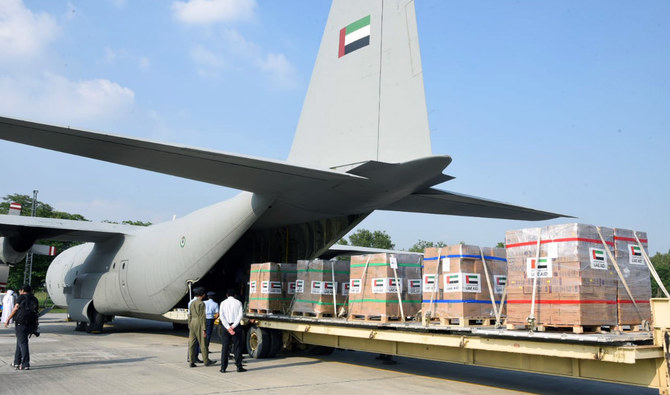
The file photo shows relief goods, for flood survivors, being offloaded from one of the two flights from UAE at the Jinnah International Airport Karachi on August 29, 2022. (Government of Pakistan/File)
Short Url
Updated 04 October 2022
Follow

UAE, Saudi Arabia, others have sent 135 flood relief flights to Pakistan since August — foreign office

  • Floods have affected 33 million Pakistanis and 5.7 million are facing a serious food crisis
  • The South Asian country is jointly launching with the UN a revised flash appeal on Tuesday

ISLAMABAD: Pakistan has received a total of 135 flood relief flights from different countries since August, the Pakistani foreign office said on Monday, with the United Arab Emirates (UAE), United States (US) and Saudi Arabia as top contributors.

Pakistan has been hit by unprecedented hit by the worst floods since the onset of monsoon season, which have killed nearly 1,700 people, affected 33 million and cost the country an estimated $30 billion. The flights carrying humanitarian aid have been a key source of supplies to the affectees in flood-hit areas, many of which still remain marooned.

So far, the UAE has dispatched 41 flights, US 21, Saudi Arabia 10, Turkiye 15, China 4, Uzbekistan 1, Qatar 4, France 1, UNICEF 4, UNHCR 14, Turkmenistan 1, WFP 3, Jordan 1, Nepal 1, UK 1, Oman 8, Russia 1, Greece 1, Italy 1 and Indonesia has sent 2 flights to Pakistan, the Pakistani foreign office said.

Together with the United Nations (UN), the South Asian country is jointly launching a revised flash appeal today, on Tuesday.

“The Floods Response Plan has been prepared in close coordination between the Government of Pakistan and the United Nations, and focuses on providing necessary assistance to the vulnerable people affected by the unprecedented floods,” the Pakistani foreign office said in another statement on Monday.

“It complements the Government’s overall response to the recent climate-induced floods in Pakistan.”

Also on Monday, the UN humanitarian agency warned that about 5.7 million Pakistani flood survivors will face a serious food crisis in the next three months.

A top UN official announced an increase in the humanitarian appeal for Pakistan to $816 million, from $160 million, amid rising deaths from disease.

In Geneva, Julien Harneis, the UN resident coordinator in Pakistan, told reporters that aid agencies needed more funds to prevent a “second wave of destruction” from waterborne and other diseases in Pakistan. He said the UN weeks ago issued an appeal for $160 million in emergency funding to respond to the floods but considering the scale of devastation, the Aug. 30 appeal was not enough.

The UN Office for the Coordination of Humanitarian Affairs in its latest report Saturday said the current floods are expected to exacerbate food insecurity in Pakistan and said 5.7 million people in flood-affected areas will be facing a food crisis between September and November.

Even before the floods, according to the World Health Organization, 16 percent of the population was living in moderate or severe food insecurity.


Pakistan saw 73% increase in combat-related deaths in 2025— think tank

Updated 28 December 2025
Follow

Pakistan saw 73% increase in combat-related deaths in 2025— think tank

  • Pakistan reported 3,387 deaths thus year, among them 2,115 militants and 664 security forces personnel, says think tank
  • Civilian deaths increased by 24% to 580 in 2025, compared to 468 in 2024, as Pakistan saw 1,063 militant attacks in 2025

ISLAMABAD: Combat-related deaths in Pakistan this year increased by 73%, with both security forces and militants suffering casualties in large numbers, a report published by an Islamabad-based think tank said on Sunday.

As per statistics released by the Pakistan Institute for Conflict and Security Studies (PICSS), combat-related deaths in 2025 rose 73% to 3,387, compared with 1,950 in 2024. These deaths included 2,115 militants, 664 security forces personnel, 580 civilians and 28 members of pro-government peace committees (combatants), the think tank said in a press release. 

“Militants accounted for about 62% of total combat-related deaths, and their 2,115 fatalities represented the highest annual militant death toll since 2015, when 2,322 militants were killed,” PICSS said. 

Compared to last year, militant deaths recorded a steep increase by 122% as the PICSS reported that 951 militants had been killed in 2024.

The think tank, however, said this year was also particularly bloody for Pakistani security forces. PICSS recorded 664 security personnel deaths in 2025, a 26% rise from 528 in 2024, and the highest annual figure since 2011, when 677 security forces personnel lost their lives. 

Civilian deaths also increased by 24% to 580 in 2025, compared with 468 in 2024, marking the highest annual civilian toll since 2015, when 642 civilians were killed. 

As per the PICSS report, at least 1,063 militant attacks took place in 2025, a 17% increase compared with 908 in 2024 and the highest annual total since 2014, when 1,609 militant attacks were recorded. 

The report also noted a 53 percent increase in suicide attacks this year, with 26 such incidents reported in 2025 compared with 17 in 2024. 

“PICSS noted an expanding trend in the use of small drones, including quadcopters, with 33 such incidents recorded during 2025, alongside increased use of unmanned aerial vehicles by security forces,” the report said. 

The report noted an 83% rise in arrests of suspected militants, with 497 arrested in 2025 compared to 272 in 2024. 

This 2025 figure is the highest annual total of suspected militants arrested since 2017, when 1,781 militants were either arrested or laid down their weapons.

“PICSS noted that most violence remained concentrated in Pashtun-majority districts of Khyber Pakhtunkhwa, including the tribal districts (erstwhile FATA), and in Balochistan,” it said. 

Pakistan has been grappling with a surge in militant attacks in its western provinces of Khyber Pakhtunkhwa and Balochistan, both bordering Afghanistan, this year. 

Islamabad blames Afghanistan for providing sanctuaries to militants it alleges use Afghan soil to carry out attacks against Pakistan. Kabul denies the charges.