

Typhoon havoc triggers calls for urgent climate action in Philippines

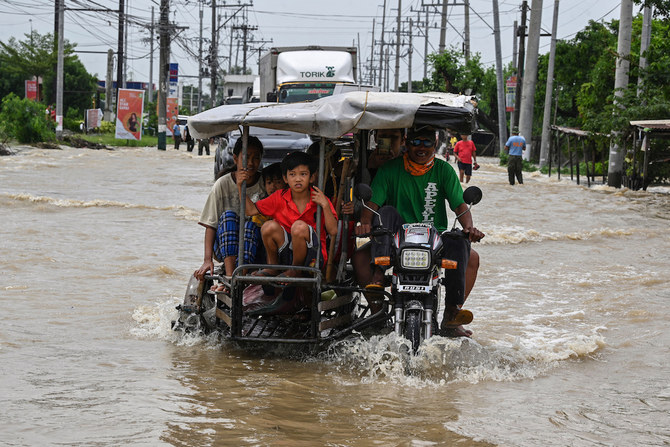
Residents and motorists commute along a flooded highway in the aftermath of Super Typhoon Noru in San Ildefonso, Bulacan province on September 26, 2022. (AFP)
Short Url
Updated 03 October 2022
Follow

Typhoon havoc triggers calls for urgent climate action in Philippines

  • Typhoon Noru was the most powerful cyclone to hit the country this year
  • Climate-related disasters have been battering the Philippines with growing intensity

MANILA: When a massive typhoon barreled through the Philippines last month, it left behind casualties and destruction, triggering calls for urgent climate action in the cyclone-prone country, where extreme weather events are on the rise.

Super Typhoon Noru, locally named Karding, made landfall on the evening of Sept. 25, sweeping the densely populated island of Luzon and plunging communities in the country’s north underwater.

At least 12 people were killed and over 1 million affected by Noru, according to disaster response officials, who estimate that the landfall caused damages of nearly $51 million, leaving farmland flattened just before the harvest season.

Poor rural communities have increasingly borne the brunt of climate-related disasters, which have battered the Philippines with growing frequency over recent years.

“The stormy season is far from over. We expect our farmers and fisherfolk to face more problems this year from climate change-intensified typhoons,” the Kalikasan People’s Network for the Environment said in a statement.

“We need to improve climate change adaptation mechanisms,” the network’s national coordinator Jon Bonifacio told Arab News. “Typhoon Noru is another wake-up call that we really need to act on the climate crisis.”

With winds of up to 240 kph and heavy rainfall, Noru quickly turned into the most powerful cyclone to hit the Philippines this year.

Emily Padilla, former agriculture undersecretary, who shared on social media photos from devastated areas, wrote after the landfall that it had brought flashbacks of the deadly Typhoon Santi, which struck Luzon in 2013.

“Trembling in fear last night, we had to cling on to God, and work on defending our only sanctuary, when it was being pounded by roaring Karding,” she said on Facebook. “Climate change is real. We must collectively work to reverse the impending death of earth, and so humankind.”

The typhoon had evolved from a tropical storm into a Category 5 typhoon over two days, which was one of the fastest such rapid intensifications ever recorded in the Pacific basin.

“This trend is caused by the effects of climate change, specifically the rising temperatures of the sea surface,” Greenpeace Southeast Asia consultant Jefferson Chua told Arab News.

“More extreme weather events will be coming our way. We are one of the most vulnerable countries to the effects of climate change, and that won’t stop.”

An archipelago of more than 7,000 islands in the Pacific Ocean, the Philippines is highly vulnerable to cyclones. Each year, about 20 typhoons, equivalent to 25 percent of the global occurrence, enter the country and about half of them wreak havoc in its northern parts.

With the changing climate and global warming, the intensity of devastating incidents has increased. Seven of the 11 strongest landfalls in recorded history have occurred since 2006.

Addressing climate change has been high on the agenda of President Ferdinand “Bongbong” Marcos, who during the UN General Assembly in New York last week said that developing countries had suffered the most from climate change effects.

“This injustice must be corrected and those who need to do more must act now,” he said. “Those who are least responsible suffer the most. The Philippines, for example, is a net carbon sink, we absorb (more) carbon dioxide than we emit. And yet, we are the fourth most vulnerable country to climate change.”

But as Marcos addressed UNGA, Greenpeace criticized him for not doing enough on the national level to help avert the disastrous effects of the changing climate, which it said will “heavily impact food security, as well as other fundamental issues such as water, energy, health and poverty alleviation.”

Mitigating the impacts of the changing climate should, according to Greenpeace, start with energy transition efforts in the country, which derives most of its electricity generation from coal.

“The introduction of renewable energy into our energy mix, and the gradual and eventual phaseout from fossil fuels, is one of the biggest solutions that governments can implement in the incoming climate crisis. What’s important here to note is that these are not being done at the level of urgency that we need,” Chua said.


No sign of progress on first day of Ukraine war talks in Geneva

Updated 4 sec ago
Follow

No sign of progress on first day of Ukraine war talks in Geneva

  • Two previous rounds of negotiation between Ukraine and Russia in Abu Dhabi failed to yield a breakthrough
  • Trump put pressure on Ukraine to make a deal, saying they “better come to the table, fast”

GENEVA: Ukrainian and Russian negotiators concluded the first of two days of US-mediated peace talks in Geneva on Tuesday, though neither side signalled they were any closer to ending Europe’s deadliest conflict since World War II.
Negotiations will resume on Wednesday.
The United States has been pushing for an end to the nearly four-year war, but has failed to broker a compromise between Moscow and Kyiv on the key issue of territory.
Two previous rounds of negotiation between the two sides in Abu Dhabi failed to yield a breakthrough.
The latest talks “were very tense,” said a source close to the Russian delegation.
“They lasted six hours. They have now concluded,” the source added, speaking on condition of anonymity.
Ukrainian President Volodymyr Zelensky said in his evening address he was ready “to move quickly toward a worthy agreement to end the war,” but questioned whether Russia was serious about peace.
“What do they want?” he added, accusing them of prioritising missile strikes over “real diplomacy.”
Russia launched its full-scale invasion of Ukraine in February 2022.
The ensuing conflict has resulted in a tidal wave of destruction that has left entire cities in ruins, tens of thousands of soldiers and civilians dead and forced millions of people to flee their homes.

- ‘Come to the table, fast’ -

Zelensky has repeatedly said his country is being asked to make disproportionate compromises compared to Russia.
US President Donald Trump on Monday put pressure on Ukraine to make a deal, saying they “better come to the table, fast.”
Russia occupies around one-fifth of Ukraine — including the Crimean peninsula it seized in 2014 — and areas that Moscow-backed separatists had taken prior to the 2022 invasion.
It is pushing for full control of Ukraine’s eastern Donetsk region as part of any deal, and has threatened to take it by force if talks fail.
But Kyiv has rejected this deeply unpopular demand, which would be politically and militarily fraught, and signalled it will not sign a deal without security guarantees that deter Russia from invading again.
Russia has been slowly capturing territory across the sprawling front line for months.
But its war-time economic worries are mounting, with growth stagnating and a ballooning budget deficit as oil revenues — choked by sanctions — drop to a five-year low.
Ukrainian forces recently made their fastest gains in two-and-a-half years, recapturing 201 square kilometers (78 square miles) last week, according to an AFP analysis of data from the Institute for the Study of War.
That total includes areas Kyiv and military analysts say are controlled by Russia (72 square kilometers), as well as those claimed by Moscow’s army (129 square kilometers).
The counterattacks likely leveraged the disruption of Russian forces’ access to Starlink, the ISW said, after the satellite Internet firm’s boss, Elon Musk, announced “measures” to end Russia’s use of the technology.

- Breakthrough hopes low -

For the talks in Geneva, the Kremlin reinstated nationalist hawk and former culture minister Vladimir Medinsky as its lead negotiator.
Ukrainian national security secretary Rustem Umerov was leading Kyiv’s side.
Hopes for a breakthrough are low.
Even before the talks were underway, Ukraine accused Russia of undermining peace efforts by launching 29 missiles and 396 drones in a series of attacks overnight that authorities said killed at least four people, wounded others and cut power to tens of thousands in southern Ukraine.
“The extent to which Russia disregards peace efforts: a massive missile and drone strike against Ukraine right before the next round of talks in Geneva,” Ukrainian Foreign Minister Andriy Sybiga wrote on social media.
A Russian drone strike killed three staff of a power plant in the frontline town of Sloviansk in eastern Ukraine, according to energy minister Denys Shmygal.
Another person was killed in the northeastern Sumy region, local officials said.
Russia meanwhile accused Ukraine of launching more than 150 drones overnight, mainly over southern regions and the Crimean peninsula — occupied by the Kremlin in 2014.
An oil depot in southern Russia caught fire, according to officials.
Kremlin spokesman Dmitry Peskov told journalists to expect no major news from the first day of talks.