

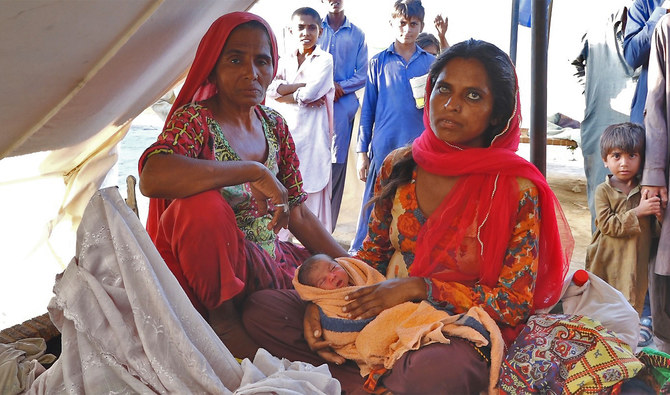

DADU: Writhing in pain, a feeble 20-year-old Farzana Bibi could not even muster the strength to swat away the flies that buzzed around her face as she lay inside a small tent along a highway in southern Pakistan, where hundreds like her have sought refuge after devastating floods swept away their homes last month.
It is hard to say if the worst has passed or is yet to come for Bibi.
As floods ravaged her village last month, the pregnant woman’s family was unable to get her to a doctor in time and she lost her baby. Now, she is one among nearly 15 million people affected by recent floods in the southern Sindh province, either living in tent-cities and makeshift shelters on roadsides or staying back in flooded villages, surrounded from all sides with water and struggling to live another day.
Among the survivors, the most vulnerable, doctors and officials say, are pregnant women, lactating mothers and newborns.
“It was raining there [at our village] … we could not reach here [the city] in time due to the rains… her son died in her womb” Bibi’s brother, Aijaz Ali, said as she lay next to him on a plastic mat on the dusty ground. “She is ill and complains that there is pain in her leg and body still.”
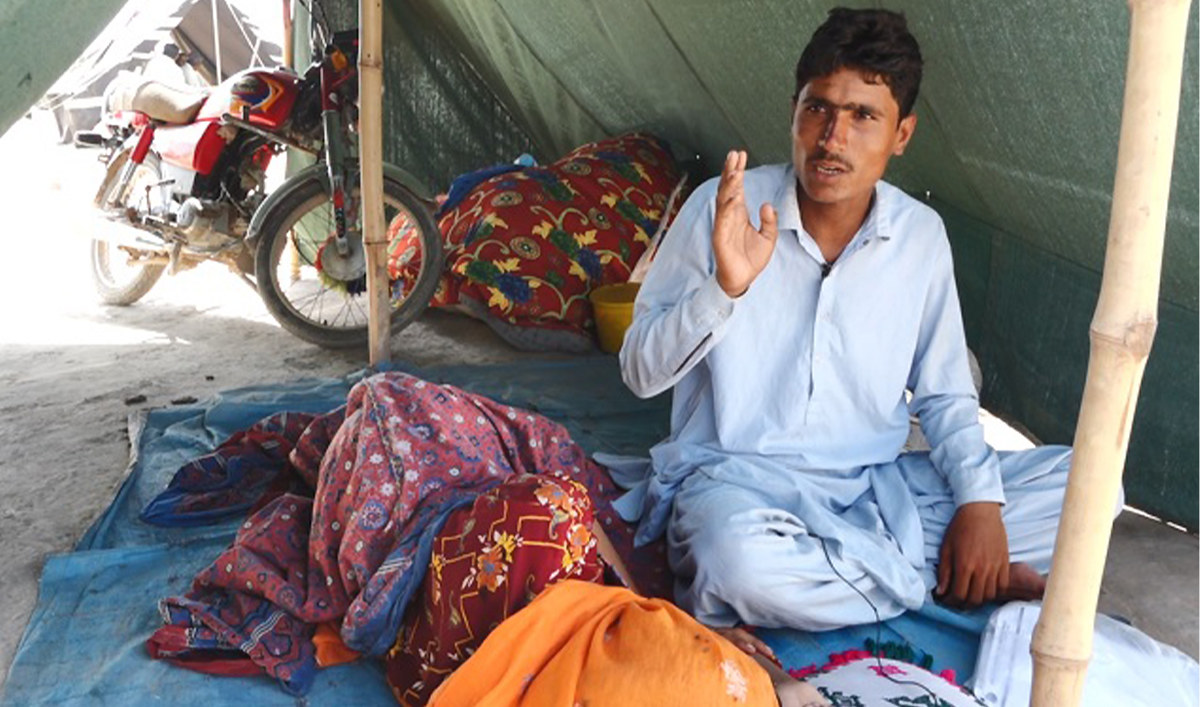
Aijaz Ali speaks to Arab News as his sister Farzana Bibi lies on a plastic mat inside a tent in Dadu, Sindh, on September 28, 2022. (AN Photo)
According to the Sindh health department, 9,749 pregnant women are living in camps across the province where 3,803 have given birth and 2,008 are lactating mothers.
According to the latest assessment by the UN Population Fund (UNFPA), around 138,000 women nationwide in need of humanitarian assistance due to the floods are pregnant and 40,000 are expected to deliver their babies in September or early October.
Medics are particularly concerned about women who cannot access medical care in time, who have complications requiring delivery via cesarean sections or those who develop postpartum haemorrhaging, both of which can be deadly or result in disability without access to specialized health care. Even before the flooding, nationally 186 women died per 100,000 live births, according to official figures.
That rises to 224 per 100,000 births in Sindh province, and 298 maternal deaths per 100,000 births in Balochistan, another province hard hit by floods.
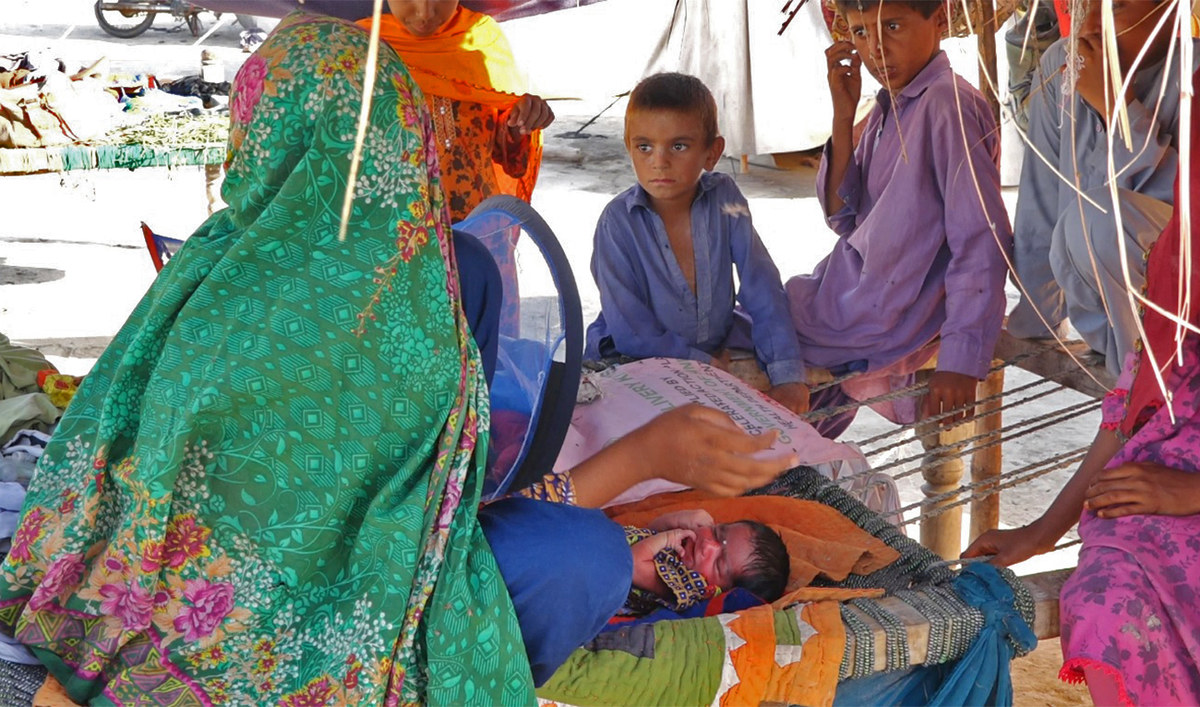
A mother swats flies away from her newborn baby at a temporary shelter in Mehar, Sindh on September 28, 2022. (AN Photo)
At the Kakkar tent-city camp in Sindh, more than 60 women are expecting while two have recently given birth. Doctors fear for their health.
“This is a vulnerable situation because they are not getting proper treatment,” Flight Lt. (R) Musarrat Shah, a social activist who runs the tent-city, told Arab News. “For two months, to live in this tent city is not very easy for newborn babies or for pregnant ladies.”
Dr. Muhammad Ali Chandio, a doctor at the Dadu tent-city, said he feared the spread of diseases among women and newborns without proper treatment.
“If the mothers have deficiencies due to [lack of] folic acid, abnormal children are born. If there emerges a case of birth asphyxia, it can be dangerous for the kid and the mother,” Dr. Chandio told Arab News.
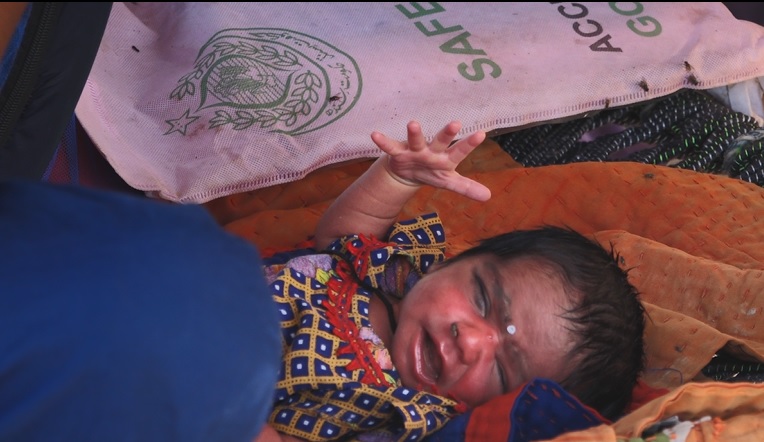
A newborn baby at a temporary shelter cries in Mehar, Sindh on September 28, 2022. (AN Photo)
Health authorities, however, said the government was making arrangements for women.
“Nutritional supplements for pregnant women and children are being provided to ensure that there is some resistance to malnutrition,” Mehar Khursheed, a spokesperson at the Sindh health department said, adding that UNFPA had collaborated with the Health Department, Aga Khan University Hospital, Pathfinder and Pakistan National Forum for Women Health to provide relief to pregnant women.
She said a record was being maintained for pregnant women, their gestation periods, delivery dates and medical histories. Ambulances were also on standby to shift pregnant women to tertiary hospitals and arrangement were in for makeshift operation theaters and women doctors.
But three government-run and private shelters in the cities of Dadu and Mehar had no female doctors when Arab News visited them last week. Women there complained they hardly had access to proper food.
“We are starving,” said Nazia, 27, who recently gave birth to a baby girl at the Mahar tent-city. “We get a plate of rice for the entire family.”


