

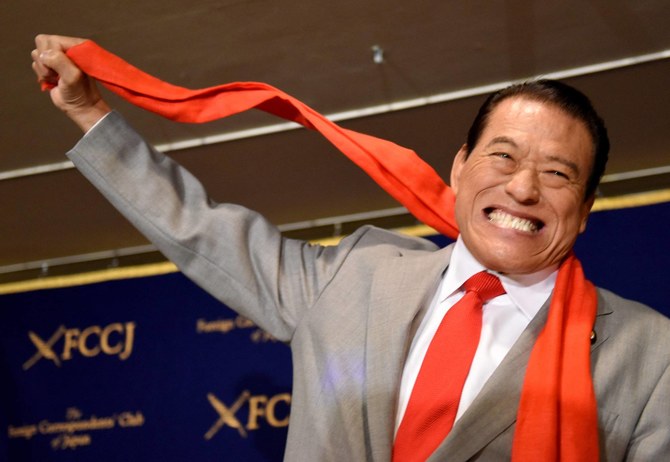
Japan wrestling trailblazer Antonio Inoki leaves behind a unique legacy

oki was a professional wrestler, martial artist, politician and promoter for both professional wrestling and mixed martial arts. (AFP)
Short Url
Updated 02 October 2022
Follow

Japan wrestling trailblazer Antonio Inoki leaves behind a unique legacy

  • The professional wrestler, martial artist, politician and promoter died on Saturday at the age of 79

RIYADH: Legendary Japanese figure Antonio Inoki, real name Muhammad Hussain Inoki, died on Saturday at the age of 79.

Inoki was a professional wrestler, martial artist, politician and promoter for both professional wrestling and mixed martial arts.

Born in Yokohama, Japan in 1943, he spent most of his childhood in Brazil where his family had relocated. There, he developed a passion for professional wrestling. Inoki was recruited by Rikidozan, one of the the most famous Japanese wrestlers of all time, and returned to Tokyo to join the Japanese Wrestling Association.

In his home country, Inoki became widely popular and revered for his versatility and for his charismatic demeanor in the squared circle. His contributions transcended achievements inside the ring, and he founded New Japan Pro-Wrestling in 1972.

Over the course of the next two decades, Inoki built NJPW into the most successful wrestling company in Asia, using talented competitors such as Tiger Mask, Dynamite Kid, Bob Backlund, and Vader.

In addition to running the promotion, Inoki himself was one of the top stars carrying the championship, stepping into the ring against the likes of Stan Hansen, Tiger Jeet Singh and Hulk Hogan.

He gained global fame in 1976 when he faced Muhammad Ali in a wrestler vs. boxer match in Tokyo. This encounter was credited for being a precursor to what is known today as mixed martial arts, and was one of the most watched fights of its generation. In addition to the sold-out crowd of more than 14,000 at the Nippon Budokan in Tokyo, it aired on closed-circuit across the world.

Shea Stadium in New York aired the bout on its big screen and drew a crowd of 32,897, with an undercard of pro wrestling and mixed-rules matches preceding the main event.

Outisde the ring Inoki used sport to forge peace and diplomacy. In 1990, he played a major role in freeing 36 Japanese hostages held in Iraq.

Inoki was also a outstanding ambassador for professional wrestling, bringing major events to places such as Russia and China.

He was also instrumental in organizing two large sporting events in Pyongyang in 1995, and another in 2014. The first event, known as “Collision in Korea” drew nearly 380,000 fans and is considered the biggest-pay-per-view in pro-wrestling history.

In 1998, Inoki retired from in-ring competition. In 2010, he was inducted to the WWE Hall of Fame. An WWE statement said: “This passion for competition earned him the nickname ‘Moeru Toukon’ among his peers, which translates to ‘The fighting spirit that burns’.”

Inoki leaves behind a unique legacy as a competitor. He was 12-time professional wrestling world champion, notably being the inaugural IWGP Heavyweight Champion and the first Asian WWF Heavyweight Champion in a reign not officially recognized by WWE.

The cause of Inoki’s death was not released, but he had been ill in recent years and confined to a wheelchair.


A powerful rivalry: Sabalenka and Svitolina set for Australian Open semifinal showdown

Updated 2 sec ago
Follow

A powerful rivalry: Sabalenka and Svitolina set for Australian Open semifinal showdown

  • Top-ranked Sabalenka, who is seeking a third title in four years in Australia, is from Belarus
  • Players from Ukraine do not shake hands with players from Russia or Belarus at the net after matches
MELBOURNE: Naturally there’ll be attention on the backstory when Aryna Sabalenka and Elina Svitolina meet in the Australian Open women’s semifinals.
Top-ranked Sabalenka, who is seeking a third title in four years in Australia, is a 27-year-old from Belarus. She’s popular on TikTok for her humorous posts and dance routines.
Svitolina is a 31-year-old Ukrainian who will be returning to the Top 10 next week for the first time since returning from a maternity break she took in 2022. She reached her first Australian Open semifinal with a lopsided win over No. 3 Coco Gauff, needing only 59 minutes to end her run of three quarterfinal losses at Melbourne Park.
They’re both regularly asked questions relating to Russia’s war on Ukraine. Both have regularly said they want the focus to be on tennis. Svitolina is trying to bring joy to the people of Ukraine, of course. Sabalenka said she supports peace.
“It’s very close to my heart to see a lot of support from Ukrainians,” she said. “So I feel like (I) bring this light, a little light, you know, even just positive news to Ukrainian people, to my friends when they are watching.”
Players from Ukraine don’t shake hands with players from Russia or Belarus at the net after matches. It’s accepted on both sides.
They’re both on 10-match winning streaks so far in 2026 and entered the season’s first major with titles in warmup tournaments — Sabalenka in Brisbane, and Svitolina in Auckland, New Zealand, her 19th career title. That was Svitolina’s first foray back after an early end to the 2025 season for a mental health break.
Sabalenka, who has 22 career titles including back-to-back Australian championships in 2023 and ‘24 and back-to-back US Open triumphs in 2024 and last year, is 5-1 in career meetings with Svitolina. She is into the final 4 at a major for the 14th time, and has made the final seven times.
“It’s no secret that she’s a very powerful player. I watched a little bit of her (quarterfinal) match. She was playing great tennis, and I think, the power on all aspects of her game is her strengths,” Svitolina said of Sabalenka. “She’s very consistent. For me, I’ll have to ... try to find the ways and the little holes, little opportunities in her game.
“When you play the top players, you have to find these small opportunities and then be ready to take them.”
Svitolina is playing her fourth semifinal at a major — 2019 and 2023 at Wimbledon and the 2019 US Open — and aiming for her first final.
Sabalenka played her quarterfinal against 18-year-old Iva Jovic before the searing heat forced organizers to close the roof of the Rod Laver Arena stadium on Tuesday. She was long gone before Svitolina and Guaff played under the roof at night. At that stage, she didn’t know who she’d next be playing, but was sure “it’s going to be a battle.”
“Because whoever makes it there, it’s an incredible player,” she said. “I think my approach going to be the same. Doesn’t matter who I’m facing.
“I’ll just go, and I’ll be focused on myself and on my game.”
Rybakina-Pegula, 5 vs. 6
Sixth-seeded Jessica Pegula completed the final 4 when she held off fellow American Amanda Anisimova 6-2, 7-6 (1) to move into a semifinal against 2022 Wimbledon champion Elena Rybakina.
Pegula beat 2025 champion Madison Keys in the previous round before ending Anisimova’s run of back-to-back Grand Slam finals.
The sixth-seeded Pegula is hoping to emulate Keys’ run here last year and claim her maiden Grand Slam title in Australia.
“I’ve been waiting for the time when I can kind of break through,” Pegula said. “I feel like I really play some good tennis here and I like the conditions.”
With a 7-5, 6-1 victory in the center court opener Wednesday, Rybakina, the 2023 Australian Open runner-up, ended No. 2-ranked Iga Swiatek’s bid to complete a career Grand Slam — at least for this year.
Rybakina, who was born in Russia but represents Kazakhstan, said she’d focus on the lessons she’d taken from previous trips to the deciding end of the majors.
“Now I’m more calm. In the beginning, when it’s the first final and you go so far in the tournament, of course you are more emotional,” she said. “Now I feel like I’m just doing my job, trying to improve each day. So it’s kind of another day, another match.”