

Europe’s biggest nuclear reactor reaches full power

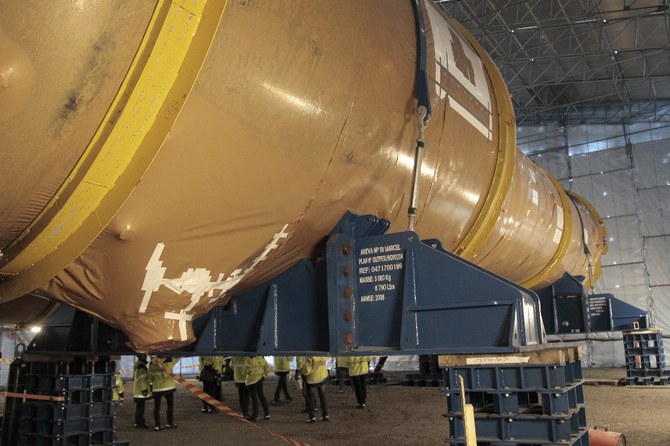
Picture taken on March 15, 2010 in the Olkiluoto 3 European Pressurised Reactor being built by French nuclear giant Areva in Finland (AFP)
Short Url
Updated 30 September 2022
Follow

Europe’s biggest nuclear reactor reaches full power

HELSINKI: Finland’s long-delayed Olkiluoto 3 nuclear reactor has reached full power to become the most powerful electricity production facility in Europe, operator TVO said Friday, a boost amid a continent-wide energy crunch, according to AFP.

With a power level of 1,600 megawatts, the plant located on the Nordic country’s southwestern coast is also now the third most powerful electricity production facility globally, the company said.

OL3’s production is being closely followed in Finland, where the hope is that the plant could ease the coming winter’s challenges as European energy prices have soared following Russia’s invasion of Ukraine.

“The plant unit is now the most powerful electricity production facility in Europe,” TVO said in a statement, adding that regular operation is expected to start in December 2022.

Around 40 percent of Finland’s electricity production now comes from Olkiluoto, as the OL1 and OL2 reactors combined produce approximately 21 percent and the new OL3 alone around 19 percent.

The reactor, built by the French-led Areva-Siemens consortium, went online in March — 12 years behind schedule — after suffering a long string of setbacks.

The plant’s regular production was expected to start this summer but was postponed to December, after “foreign material” was observed in the turbine’s steam reheater.

Operator TVO said that the ten remaining sets of tests will impact the power levels in the coming months.

“In some of the upcoming tests, the plant unit’s production is either intentionally interrupted or the power level is lowered,” the company said.

The European Pressurised Reactor model was designed to relaunch nuclear power in Europe after the 1986 Chernobyl catastrophe, and was touted as offering higher power outputs and better safety.


Lebanese social entrepreneur Omar Itani recognized by Schwab Foundation

Updated 23 January 2026
Follow

Lebanese social entrepreneur Omar Itani recognized by Schwab Foundation

  • FabricAID co-founder among 21 global recipients recognized for social innovation

DAVOS: Lebanon’s Omar Itani is one of 21 recipients of the Social Entrepreneurs and Innovators of the Year Award by the Schwab Foundation for Social Entrepreneurship.

Itani is the co-founder of social enterprise FabricAID, which aims to “eradicate symptoms of poverty” by collecting and sanitizing secondhand clothing before placing items in stores in “extremely marginalized areas,” he told Arab News on the sidelines of the World Economic Forum in Davos, Switzerland.

With prices ranging from $0.25 to $4, the goal is for people to have a “dignified shopping experience” at affordable prices, he added.

FabricAID operates a network of clothing collection bins across key locations in Lebanon and Jordan, allowing people to donate pre-loved items. The garments are cleaned and sorted before being sold through the organization’s stores, while items that cannot be resold due to damage or heavy wear are repurposed for other uses, including corporate merchandise.

Since its launch, FabricAID has sold more than 1 million items, reached 200,000 beneficiaries and is preparing to expand into the Egyptian market.

Amid uncertainty in the Middle East, Itani advised young entrepreneurs to reframe challenges as opportunities.

“In Lebanon and the Arab world, we complain a lot,” he said. Understandably so, as “there are a lot of issues” in the region, resulting in people feeling frustrated and wanting to move away. But, he added, “a good portion of the challenges” facing the Middle East are “great economic and commercial opportunities.”

Over the past year, social innovators raised a combined $970 million in funding and secured a further $89 million in non-cash contributions, according to the Schwab Foundation’s recent report, “Built to Last: Social Innovation in Transition.”

This is particularly significant in an environment of geopolitical uncertainty and at a time when 82 percent report being affected by shrinking resources, triggering delays in program rollout (70 percent) and disruptions to scaling plans (72 percent).

Francois Bonnici, director of the Schwab Foundation for Social Entrepreneurship and a member of the World Economic Forum’s Executive Committee, said: “The next decade must move the models of social innovation decisively from the margins to the mainstream, transforming not only markets but mindsets.”

Award recipients take part in a structured three-year engagement with the Schwab Foundation, after which they join its global network as lifelong members. The program connects social entrepreneurs with international peers, collaborative initiatives, and capacity-building support aimed at strengthening and scaling their work.