

Europe’s biggest nuclear reactor reaches full power

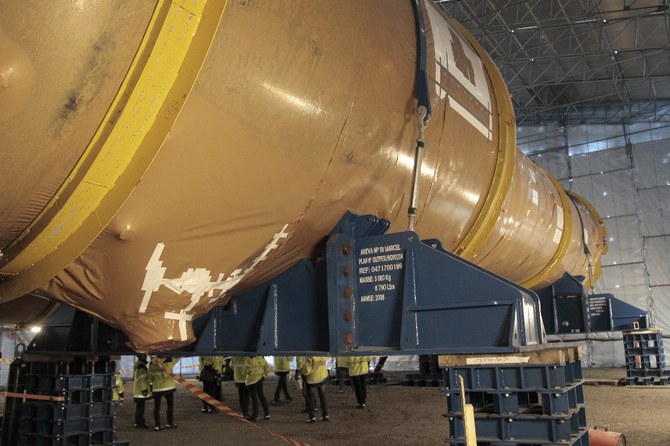
Picture taken on March 15, 2010 in the Olkiluoto 3 European Pressurised Reactor being built by French nuclear giant Areva in Finland (AFP)
Short Url
Updated 30 September 2022
Follow

Europe’s biggest nuclear reactor reaches full power

HELSINKI: Finland’s long-delayed Olkiluoto 3 nuclear reactor has reached full power to become the most powerful electricity production facility in Europe, operator TVO said Friday, a boost amid a continent-wide energy crunch, according to AFP.

With a power level of 1,600 megawatts, the plant located on the Nordic country’s southwestern coast is also now the third most powerful electricity production facility globally, the company said.

OL3’s production is being closely followed in Finland, where the hope is that the plant could ease the coming winter’s challenges as European energy prices have soared following Russia’s invasion of Ukraine.

“The plant unit is now the most powerful electricity production facility in Europe,” TVO said in a statement, adding that regular operation is expected to start in December 2022.

Around 40 percent of Finland’s electricity production now comes from Olkiluoto, as the OL1 and OL2 reactors combined produce approximately 21 percent and the new OL3 alone around 19 percent.

The reactor, built by the French-led Areva-Siemens consortium, went online in March — 12 years behind schedule — after suffering a long string of setbacks.

The plant’s regular production was expected to start this summer but was postponed to December, after “foreign material” was observed in the turbine’s steam reheater.

Operator TVO said that the ten remaining sets of tests will impact the power levels in the coming months.

“In some of the upcoming tests, the plant unit’s production is either intentionally interrupted or the power level is lowered,” the company said.

The European Pressurised Reactor model was designed to relaunch nuclear power in Europe after the 1986 Chernobyl catastrophe, and was touted as offering higher power outputs and better safety.


Saudi inflation edges up to 2.1% on higher rents: GASTAT 

Updated 5 sec ago
Follow

Saudi inflation edges up to 2.1% on higher rents: GASTAT 

RIYADH: Saudi Arabia’s annual inflation rate rose to 2.1 percent in December, up from 1.9 percent a month earlier, as housing rents continued to drive price gains, official data showed. 

According to the latest report released by the General Authority for Statistics, prices for housing, water, electricity, gas, and other fuels rose 4.1 percent year on year in December, driven by a 5.3 percent increase in actual rents. 

Saudi Arabia’s inflation path broadly aligns with International Monetary Fund projections released in October, which forecast inflation of about 2.1 percent in 2025, easing slightly to 2 percent in 2026. 

In its latest report, GASTAT stated: “The CPI in Saudi Arabia recorded an annual increase of 2.1 percent in December 2025 compared to the same month of the previous year, December 2024.” 

It added: “This increase was mainly driven by a rise in housing, water, electricity, gas, and other fuel prices by 4.1 percent food and beverage prices by 1.3 percent and transport prices by 1.5 percent.” 

According to the report, prices of fresh, chilled, or frozen meat rose 1.7 percent year on year in December. 

Spending on personal care, social protection, and other goods and services increased by 7 percent annually, while prices in the insurance and financial services division rose 4.1 percent, driven by a 6.6 percent increase in insurance costs. 

Costs in the entertainment, sports, and culture division climbed 2.4 percent year on year, reflecting a 3.9 percent rise in holiday deal prices. 

Education expenses increased by 1.5 percent, while restaurant and hotel services costs rose 0.9 percent over the year. 

Monthly inflation 

On a monthly basis, the CPI rose marginally by 0.1 percent in December compared to November, GASTAT said. 

The increase was mainly driven by a 0.2 percent rise in housing, water, electricity, gas, and other fuels. Food and beverage prices also increased by 0.1 percent, while expenses for personal care, social protection, and other goods and services rose 0.7 percent. 

“In contrast, the prices of clothing and footwear fell by 0.2 percent, transport by 0.1 percent, and insurance and financial services by 0.3 percent,” said GASTAT. 

Prices of education services and tobacco remained stable in December. 

Wholesale Price Index

In a separate report, GASTAT said Saudi Arabia’s Wholesale Price Index recorded a year-on-year increase of 3.1 percent in December. 

The rise was driven mainly by a 5.7 percent increase in prices of other transportable goods, excluding metal products, machinery, and equipment, as well as a 3.6 percent increase in agricultural and fishery product prices. 

“The prices of food products, beverages, tobacco, and textiles also rose by 0.2 percent, driven by a 0.7 percent rise in prices of grain mills, starch, and other food products,” said GASTAT. 

In contrast, prices of ores and minerals declined 0.1 percent, reflecting a drop in stone and sand prices. 

On a monthly basis, the WPI increased 1 percent in December, driven by a 1.8 percent rise in prices of other transportable goods and a 1.5 percent increase in agricultural and fishery products. 

“Both raw materials and metals, and food products, beverages, tobacco, and textiles divisions showed stable prices, with no notable changes recorded in December 2025,” added GASTAT. 

Average prices 

In another report, GASTAT highlighted notable movements in average prices of goods and services across the Kingdom in December. 

Lebanese peaches recorded the largest month-on-month increase at 11.3 percent, followed by local cucumbers at 9.8 percent, Abu Sorra Egyptian oranges at 9.5 percent, and local corchorus at 8.9 percent. 

Conversely, local tomatoes saw the steepest monthly decline at 21.4 percent, followed by Pakistani mandarins at 7.8 percent and imported tomatoes at 7.2 percent.