

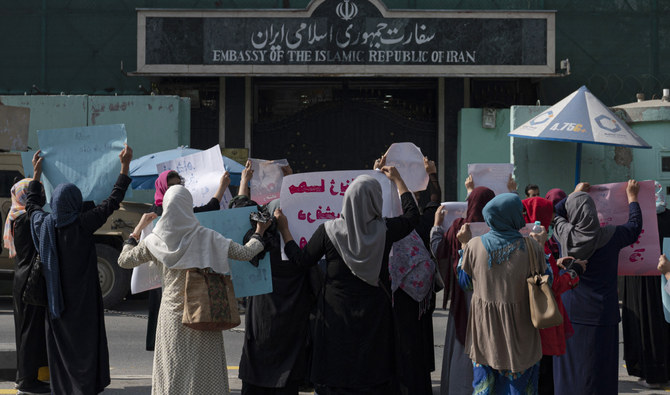

KABUL: Afghan women rallied in front of the Iranian Embassy in Kabul on Thursday, joining global protests over the death of a young woman in the custody of Iran’s morality police.
Mahsa Amini, 22, was detained in Tehran on Sept. 12 for failing to cover her hair in a manner deemed proper by the authorities. Women who were arrested along with Amini have said she was beaten inside a police van. Three days later she died in hospital after falling into a coma.
Public anger over her death has prompted days of rage and protests across Iran, in what has been the largest manifestation of dissent against the government in over a decade.
Protests have also spilled into other countries.
A group of about 25 women who gathered in front of the Iranian Embassy in Kabul carried placards that read: “Beautiful Mahsa, your blood is our way and inspiration,” as they chanted “women, life, freedom” — the phrase that has been used by demonstrators in Iran.
A 24-year-old university student who participated in the protest told Arab News she had attended the rally in solidarity.
“Women in Iran and we are facing the same oppression. We wanted to show that we can amplify the voices of our sisters in Iran while highlighting our own concerns for freedom and dignity,” she said, on condition of anonymity.
“The widespread protests in Iran supported by men and women also inspired us to continue our fight for the rights of Afghan women in Afghanistan. Afghan women have been brave enough to defy the Taliban’s restrictive attitude. We will not be silenced and we will rise again.”
The rights of Afghan women have been limited since the Taliban took control of the country after US-led forces withdrew from the country in August last year.
Although they had previously promised a softer version of the harsh rule during their first stint in power from 1996 to 2001, women have already been ordered to wear face coverings in public, banned from making long-distance journeys alone, and prevented from working in most sectors outside of health and education.
Since September last year, permission from the Ministry of Justice is required to organize a protest. Slogans used during rallies must also be approved by authorities.
Soon after Thursday’s rally in front of the embassy began, it was dispersed by Taliban security forces, who fired into the air.
For Afghan women’s rights activists like Muzhgan Noori, the protest was a “fine example of sisterhood and solidarity among women sharing the same pain and concerns.
“Afghan women have protested whenever they felt the need for it, and they should be able to do so now. The government must support and protect them instead of frightening them,” she told Arab News.
“I hope women continue to stand for each other.”


