

Egyptian representative urges nations to set aside political differences: COP27

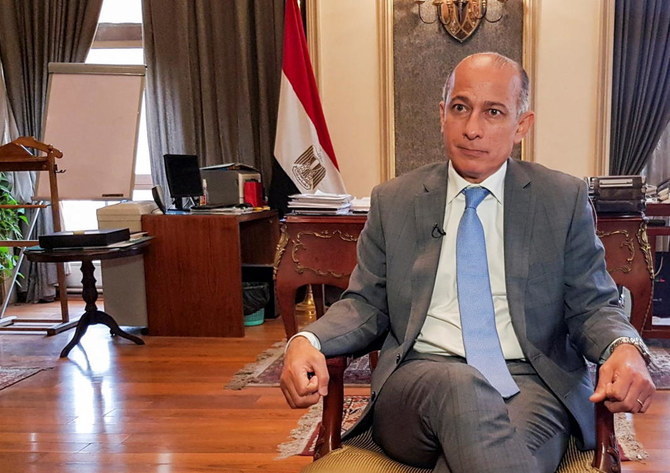
Wael Aboulmagd, the Egyptian government’s special representative for COP27. (File/Reuters)
Short Url
Updated 29 September 2022
Follow

Egyptian representative urges nations to set aside political differences: COP27

  • During June’s UN climate meeting in Bonn, some nations walked out when Russian took the floor
  • Aboulmagd said countries must not use geopolitical issues that have occurred since COP26 to conceal their inaction

LONDON: As they prepare to host in November the 2022 UN Climate Change Conference, commonly referred to as COP27, Egyptian hosts called on countries to put aside their political differences to concentrate on the climate crisis, the Guardian reported. 

The UN climate summit, which will be held in Sharm El-Sheikh, will seek to build on the many carbon-cutting pledges made by participating companies and countries at COP26 in Glasgow last November. 

However, the world’s geopolitical situation has shifted dramatically in the last year. 

The ongoing Russian invasion of Ukraine has not only had significant implications for the global energy and food markets, but it has also made facilitating climate talks far more difficult. 

The diplomatic standoff between the US and China, the world’s two largest emitters of greenhouse gasses, is another impediment to progress.

Wael Aboulmagd, the Egyptian government’s special representative for COP27, called on countries to focus on the urgency of the climate crisis and to continue negotiations despite any political tensions, the Guardian said.

“Animosity will have a cost. We as responsible diplomats ask everyone to rise to the occasion and show leadership,” Aboulmagd said on Wednesday. “Put political differences aside and come together.”

Under the UN Framework Convention on Climate Change, countries have a diplomatic responsibility to carry out negotiations irrespective of the external political context.

However, during a UN climate meeting in Bonn in June, some nations staged a walkout when Russia took to the conference floor before later returning. 

Aboulmagd said countries must not use the geopolitical issues that have occurred since COP26 to divert attention away from their inaction, according to the Guardian. 

“Show more ambition. I urge everyone not to use this unfolding geopolitical situation as a pretext for backsliding,” he said. 

Aboulmagd added that rising fossil fuel prices should instead serve as an incentive to find alternatives.

“I hope and urge everyone to take the right lesson from this: that overdependence on fossil fuels is problematic, and we need to expedite the transition to renewable energy.”

He reminded all countries who were present in Glasgow of the importance of cooperating to reduce greenhouse gas emissions and adapt to the effects of extreme weather.

“Set aside the adversarial zero-sum approach. With this most existential threat, we need to act to save lives and livelihoods. There is no time for delays, no pretext for not acting or backtracking.”


US presses missile issue as new Iran talks to open in Geneva

Updated 37 min 13 sec ago
Follow

US presses missile issue as new Iran talks to open in Geneva

  • New round of negotiations in Geneva comes after the US carried out a massive military build-up in the region
  • Iran’s president reiterates Tehran is not seeking nuclear weapons in line with policy

GENEVA: The United States and Iran are set to hold indirect talks in Switzerland on Thursday aiming to strike a deal to avert fresh conflict and bring an end to weeks of threats.
The new round of negotiations in Geneva comes after the US carried out a massive military build-up in the region and President Donald Trump repeatedly threatened to strike Iran if a deal is not reached.
In his State of the Union address on Tuesday, Trump accused Iran of “pursuing sinister nuclear ambitions.”
He also claimed Tehran had “already developed missiles that can threaten Europe and our bases overseas, and they’re working to build missiles that will soon reach the United States of America.”
The Iranian foreign ministry called these claims “big lies.”

Iran president says ahead of US talks not seeking nuclear weapon ‘at all’

TEHRAN: Iran’s President Masoud Pezeshkian reiterated on Thursday that Tehran was not seeking nuclear weapons in line with the policy set by the country’s supreme leader.

“Our Supreme Leader has already stated that we will not have nuclear weapons at all,” Pezeshkian said in a speech.

“Even if I wanted to move in that direction, I could not — from a doctrinal standpoint, I would not be permitted.” — AFP


The maximum range of Iran’s missiles is 2,000 kilometers according to what Tehran has publicly disclosed. However the US Congressional Research Service estimates they top out at about 3,000 kilometers — less than a third of the distance to the continental United States.
The dispute between the countries mostly revolves around Iran’s nuclear program, which the West believes is aimed at building an atomic bomb but Tehran insists is peaceful.
However the US has also been pushing to discuss Iran’s ballistic missile program, as well as Tehran’s support for armed groups hostile toward Israel.
Secretary of State Marco Rubio warned that Iran must also negotiate on its missile program, calling Tehran’s refusal to discuss ballistic weapons “a big, big problem” on the eve of the talks.
He followed up by saying “the president wants diplomatic solutions.”
Iran has taken anything beyond the nuclear issue off the negotiating table and has demanded that the US sanctions crippling its economy be part of any agreement.
‘Neither war nor peace’
Iranian President Masoud Pezeshkian said on Wednesday he had a “favorable outlook for the negotiations” that could finally “move beyond this ‘neither war nor peace’ situation.”
Foreign Minister Abbas Araghchi, who is leading the Iranian delegation at the talks, has called them “a historic opportunity,” adding that a deal was “within reach.”
In a foreign ministry statement that followed a meeting with his Oman counterpart, Araghchi said the success of the US negotiations depend “on the seriousness of the other side and its avoidance of contradictory behavior and positions.”


The US will be represented by envoy Steve Witkoff and Jared Kushner, who is married to Trump’s daughter Ivanka.
The two countries held talks earlier this month in Oman, which is mediating the negotiations, then gathered for a second round in Geneva last week.
A previous attempt at negotiations collapsed when Israel launched surprise strikes on Iran last June, beginning a 12-day war that Washington briefly joined to bomb Iranian nuclear sites.
In January, fresh tensions between the US and Iran emerged after Tehran engaged in a bloody crackdown on widespread protests that have posed one of the greatest challenges to the Islamic republic since its inception.
Trump has threatened several times to intervene to “help” the Iranian people.
Emile Hokayem, senior fellow for Middle East security at the International Institute for Strategic Studies, said that “the region seems to expect a war at this point.”
In January, there was “a big push by a number of Middle Eastern states to convince the US not to” strike Iran.
“But there’s a lot of apprehension at this point, because the expectation is that this time” a war would be “bigger” than the one in June.
Tehran residents who spoke to AFP were divided as to whether there would be renewed conflict.
Homemaker Tayebeh noted that Trump had “said that war would be very bad for Iran.”
“There would be famine and people would suffer a lot. People are suffering now, but at least with war, our fate might be clear,” the 60-year-old said.