

Sarah Inam murder: Pakistan investigators to search bank accounts over extortion accusations against suspect

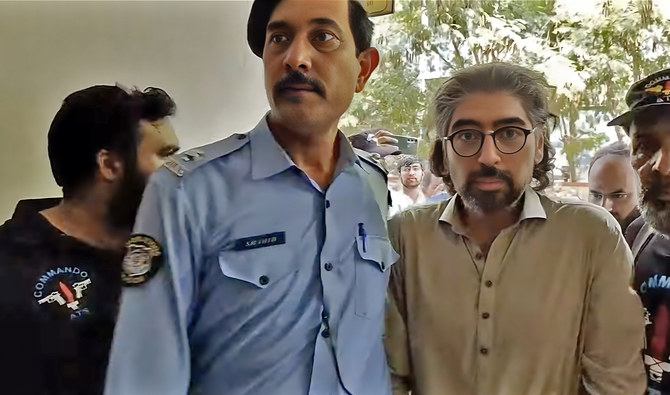
A police official escorts Shahnawaz Amir (right) to court in Islamabad, Pakistan, on September 29, 2022. (Photo courtesy: Shahid Saqlain/YouTube)
Short Url
Updated 29 September 2022
Follow

Sarah Inam murder: Pakistan investigators to search bank accounts over extortion accusations against suspect

  • Victim’s father says daughter was “trapped” into marriage by Shahnawaz Amir to fleece her out of money
  • Mobile phones of both suspect and victim sent to the Federal Investigation Agency for forensics analysis

ISLAMABAD: A police official who is leading an investigation into the beating death of a Pakistani-Canadian woman allegedly by her husband last week has said investigators had sought the court’s permission to obtain bank records of the suspect to prove accusations he had been extorting his wife.

Sarah Inam, a 37-year-old economist who worked in Abu Dhabi, was murdered with dumbbells, according to police, by her husband Shahnawaz Amir at a suburban Islamabad home last week. Inam got married to Amir of her own choice on July 18 in his hometown of Chakwal. The parents of the couple were not present at the event.

Amir is currently under arrest and being investigated by police.

At Inam’s funeral on Wednesday, her father Inam Rahim said his daughter had been “trapped” into marriage by Amir to fleece her out of money.

“We know the relevant bank account of the suspect in which he was receiving money from her wife Sarah Inam,” Habib-ur-Rehman, who is leading the investigation, told Arab News on Thursday. “The suspect has confessed during the investigation that he received around one million rupees from her wife, but we have yet to corroborate it with the banking transactions.”

Under Pakistani law, police cannot directly access the bank accounts of suspects but need to seek permission from a relevant court.

“We have filed an application in the Islamabad High Court for this,” the inspector said.

Investigators have also seized the mobile phones of both the suspect and the victim and dispatched them to the Federal Investigation Agency (FIA) for forensics analysis.

“The suspect has shared his mobile phone’s password with the police, while experts will open the victim’s phone with the help of certain softwares to look for the relevant information,” Rehman said.

A 1996 model Mercedes car was seized from the home where Inam died, the inspector said, which the victim had paid for but whose ownership was transferred fraudulently to the suspect. Police were also investigating the incident, he added. 

Rehman said the suspect had torn up Inam’s Canadian passport also, which investigators needed for their probe.

“Her passport was torn into pieces, and we have yet to put it together,” he said. “The police would know from Sarah’s passport how many times she traveled to Pakistan after her marriage.”

Rehman said a police team had also visited Chakwal, Amir’s hometown, to verify the couple’s nikah and question witnesses and others who participated in the ceremony.

“The nikah of the couple is verified,” the investigator said. “It was done at the residence of one of Shahnawaz Amir’s friends in Chakwal city.”

Meanwhile, a district court in Islamabad on Thursday extended the custody of Amir for another four days to allow police to complete the investigation. 

No member of Inam’s family or lawyers representing them appeared in the court to plead the case.


No casualties as blast derails Jaffar Express train in Pakistan’s south

Updated 26 January 2026
Follow

No casualties as blast derails Jaffar Express train in Pakistan’s south

  • Passengers were stranded and railway staffers were clearing the track after blast, official says
  • In March 2025, separatist militants hijacked the same train with hundreds of passengers aboard

QUETTA: A blast hit Jaffar Express and derailed four carriages of the passenger train in Pakistan’s southern Sindh province on Monday, officials said, with no casualties reported.

The blast occurred at the Abad railway station when the Peshawar-bound train was on its way to Sindh’s Sukkur city from Quetta, according to Pakistan Railways’ Quetta Division controller Muhammad Kashif.

No group immediately claimed responsibility for the bomb attack, but passenger trains have often been targeted by Baloch separatist outfits in the restive Balochistan province that borders Sindh.

“Four bogies of the train were derailed due to the intensity of the explosion,” Kashif told Arab News. “No casualty was reported in the latest attack on passenger train.”

The Jaffar Express stands derailed near Abad Railway Station in Jacobabad following a blast on January 26, 2026. (AN Photo/Saadullah Akhtar)

Another railway employee, who was aboard the train and requested anonymity, said the train was heading toward Sukkur from Jacobabad when they heard the powerful explosion, which derailed power van among four bogies.

“A small piece of the railway track has been destroyed,” he said, adding that passengers were now standing outside the train and railway staffers were busy clearing the track.

In March last year, fighters belonging to the Balochistan Liberation Army (BLA) separatist group had stormed Jaffar Express with hundreds of passengers on board and took them hostage. The military had rescued them after an hours-long operation that left 33 militants, 23 soldiers, three railway staff and five passengers dead.

The passenger train, which runs between Balochistan’s provincial capital of Quetta and Peshawar in the country’s northwest, had been targeted in at least four bomb attacks last year since the March hijacking, according to an Arab News tally.

The Jaffar Express stands derailed near Abad Railway Station in Jacobabad following a blast on January 26, 2026. (AN Photo/Saadullah Akhtar)

Pakistan Railways says it has beefed up security arrangements for passenger trains in the province and increased the number of paramilitary troops on Jaffar Express since the hijacking in March, but militants have continued to target them in the restive region.

Balochistan, Pakistan’s southwestern province that borders Iran and Afghanistan, is the site of a decades-long insurgency waged by Baloch separatist groups who often attack security forces and foreigners, and kidnap government officials.

The separatists accuse the central government of stealing the region’s resources to fund development elsewhere in the country. The Pakistani government denies the allegations and says it is working for the uplift of local communities in Balochistan.