Sterling falls as PM Truss defends economic plans and dollar rises

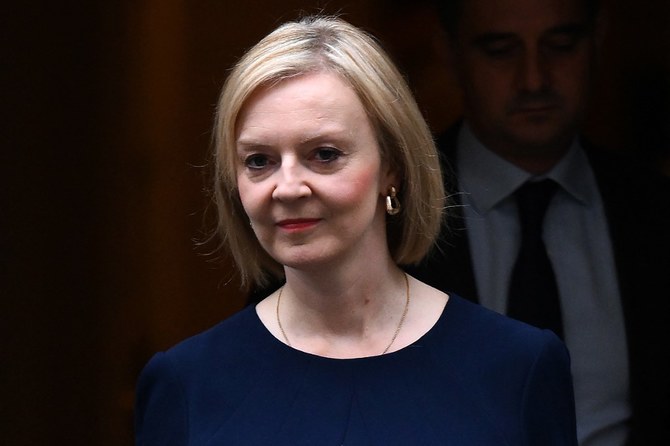
British Prime Minister Liz Truss said the UK is facing “difficult economic times" (AFP)
Short Url
Updated 29 September 2022
Follow

Sterling falls as PM Truss defends economic plans and dollar rises

LONDON: Sterling fell as much as 1 percent on Thursday before cutting some of its losses, as the dollar wavered and British Prime Minister Liz Truss defended the government’s economic plans that have contributed to the drop in the pound, according to Reuters.

Truss said big tax cuts were the right path for Britain and refused to consider reversing the so-called “mini budget” laid out last week, which triggered chaos in markets.

The pound was last down 0.3 percent to $1.0854 after hitting a session low of $1.0764. However, the euro was 0.12 percent lower against sterling at 89.27 pence.

Adam Cole, head of foreign exchange strategy at RBC Capital Markets, said the driver in the market was the dollar, which picked up in Asian trading but later fell back somewhat.

The dollar index pared earlier gains after Reuters reported Chinese state banks have been told to be prepared to sell the US currency in favor of the yuan.

Sterling crashed to a record low against the dollar of $1.0327 on Monday after new finance minister Kwasi Kwarteng unveiled plans to cut taxes, particularly for the rich, and raise borrowing.

The mini budget also wreaked havoc in the UK government bond market, forcing the Bank of England to intervene on Wednesday to protect pension funds, which are big holders of long-dated gilts.

The BoE said it would buy around £65 billion pounds ($70.54 billion) of long-dated government bonds to rectify “dysfunction” in the market.

Sterling bounced 1.41 percent on Wednesday to close at $1.0877 as investors digested the BoE’s plans.

But the currency it resumed its long-running slide on Thursday as Truss came out to defend her government’s policies.

“We are facing difficult economic times,” she said on local BBC radio. “I don’t deny this. This is a global problem. But what is absolutely right is the UK government has stepped in and acted at this difficult time.”

Jonas Goltermann, senior markets economist at consultancy Capital Economics, said both dollar strength and fears about the British economy were weighing on the pound.

“I don’t think (the BoE’s intervention) is going to be a long-term boost for sterling, although it might prevent an extreme downturn,” he said.

Goltermann said further falls in sterling are probable. He said traders are expecting the BoE to hike interest rates above 6 percent but are likely to be underwhelmed.

One analyst said they were also watching for signs of more selling of UK assets by pensions funds.

Pensions funds have been heavily selling gilts in recent days after the market falls triggered calls for collateral payments on their gilt derivatives positions, analysts and pensions advisers said.

The dollar regained ground after falling back from a new 20-year high on Wednesday after the BoE’s intervention. The dollar index was last up 0.17 percent to 113.22, after pulling back from a session high of 113.79.

Many analysts said they remained pessimistic about the pound, given the strength of the dollar and the storm clouds over the UK economy.

“There is no confidence in the Truss government right now. The problem is not fiscal spending per se, the problem is that people just don’t trust what she is doing,” Ipek Ozkardeskaya, senior analyst at Swissquote, said. 


G7 countries to release oil reserves as IEA agrees to largest ever market intervention

Updated 11 March 2026
Follow

G7 countries to release oil reserves as IEA agrees to largest ever market intervention

  • IEA recommends release of 400 million barrels

RIYADH: Germany, Japan and Austria will release part of their oil reserves after the International Energy Agency recommended the release of 400 million barrels of oil ‌from stockpiles, the largest ‌such move in IEA ​history.

In a statement, IEA Executive Director Fatih Birol said the flow of oil, gas and other commodities through the Strait of Hormuz have all but stopped, leading global energy supply to fall by around 20 percent.

Ahead of the confirmation of the move — a larger intervention than the 182.7 million barrels that were released in 2022 by in response to Russia’s invasion of Ukraine — several countries began setting out plans to bring their reserves into play as countries grapple with ​soaring crude prices amid ​the US-Israeli war with Iran. 

Birol said: “I can now announce that IEA countries have decided to launch the largest ever release of emergency oil stocks in our agency's history. 

“IEA countries will be making 400 million barrels of oil available to the market to offset the supply lost through the effective closure of the strait.

“This is a major action aiming to alleviate the immediate impacts of the disruption in markets.”

Germany’s Economy ⁠Minister ​Katherina Reiche ⁠confirmed on Wednesday her government plans to limit petrol price increases at filling stations to once a day and to introduce more stringent antitrust regulation of the sector.

She did not ⁠give an exact timing for ‌those measures, but added that ‌the US and ​Japan would be the ‌largest contributors to the release of the ‌oil reserves.

The US has not confirmed it would do so, but its Interior Secretary Doug Burgum told Fox News on Wednesday that “these are the kinds of moments that these reserves are used for.”

The announcements did not stop oil prices rising, with Brent crude up 3.26 percent to $90.66 a barrel at 4:29 p.m Saudi time, and West Texas Intermediate up 3.12 percent to $86.05. Both were some way below the $119 a barrel seen earlier in the week.

“The situation regarding oil supplies is tense, as the Strait of Hormuz is currently virtually impassable,” Germany’s Reiche said.

“We will comply with this request and ‌contribute our share, because Germany stands behind the IEA’s most important principle: mutual ⁠solidarity,” Reiche ⁠said about the IEA’s request.

According to a statement by Reiche’s ministry, Germany will contribute 2.64 million tonnes of oil. This corresponds to 19.51 million barrels.

Reiche stressed there was no supply shortage in the country, which has a legally mandated reserve of oil and oil products intended to cover 90 days’ demand.

South Korea will release 22.46 million ​barrels of oil, which represents 5.6 percent of the total IEA ask, the ⁠country's industry ministry said.

“The government will consult with the IEA ⁠secretariat on details, such ‌as ‌the ​timing ‌and amount, from ‌the perspective of national interests in accordance with domestic conditions,” ‌the ministry said in a statement.

The ⁠ministry ⁠said it would continue to coordinate closely with major countries in responding to high oil prices to minimise any domestic ​impact.

Austrian Economy Minister Wolfgang Hattmannsdorfer said his country was releasing part of the emergency oil reserve and extending the national strategic gas reserve, adding: “One thing is clear: in a crisis, there must be no crisis winners at the expense of commuters and businesses.”

Acting ahead of the IEA move, G7 ​member Japan announced plans to release 15 days' worth of ‌private-sector oil reserves and one month's worth of state oil reserves.

“Rather than wait for formal IEA approval ‌of a coordinated international reserve release, Japan will act first to ease global energy market supply and demand, releasing reserves as early as the 16th of this month,” Prime Minister Sanae Takaichi said in a broadcast statement.

Following a meeting with the IEA on Wednesday, G7 energy ministers said: “In principle, we support the implementation of proactive measures to address the situation, including the use of strategic reserves.”

All IEA member countries are required to keep 90 days’ worth of their nation’s oil use in reserve in case of global disruption.