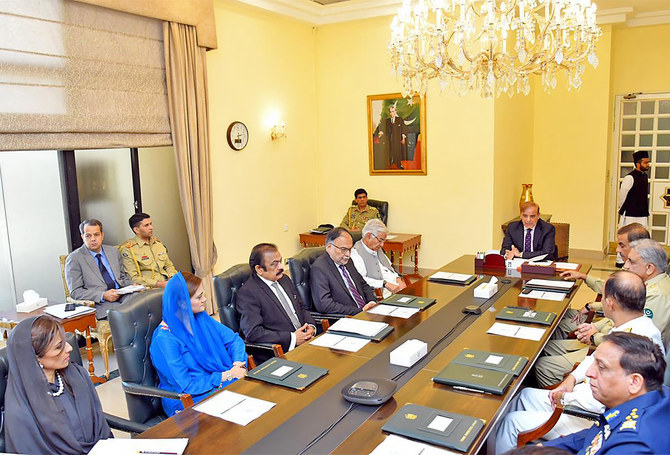

ISLAMABAD: The National Security Committee (NSC) on Wednesday approved the constitution of a committee headed by the interior minister to investigate audio leaks from the Prime Minister’s Office that have engulfed key politicians, including Prime Minister Shehbaz Sharif and ex-premier Imran Khan, in a fresh round of controversy.
The leaks, which were released last weekend, initially involve discussions between PM Sharif and members of his cabinet, including conversations with ruling party leader Maryam Nawaz over the performance of outgoing finance minister Miftah Ismail, and with an official about the possibility of facilitating the import of Indian machinery for a power project for Nawaz’s son-in-law.
But the controversy reached its crescendo on Wednesday with a leak featuring a conversation between Khan when he was PM and his then principal secretary Azam Khan, once again bringing into the spotlight a diplomatic cipher that is at the center of Khan’s allegations that his ouster in April this year was part of a regime change conspiracy hatched abroad.
Wednesday’s meeting of the NSC was chaired by PM Sharif and attended by cabinet members as well as military service chiefs, and other senior civil and military officials.
“The meeting approved the constitution of a high-powered committee to investigate the issue of audio leaks. Interior minister Rana Sanaullah will be the head of this committee,” a statement issued by the PM Office said.
The heads of intelligence institutions gave a detailed briefing to participants at the meeting on the security of the PM Office and other important buildings, cyberspace, and other related aspects.
“The meeting was informed that emergency measures are being taken to ensure the security of the Prime Minister House and other important places, buildings, and ministries in order to avoid any such situation in the future,” the statement added.
“The committee agreed to review the security, and safety of government communications keeping in mind the current changing environment of modern technology and cyberspace to ensure security and security systems are not breached,” the statement said.
In April, the Khan government handed an official protest to the US embassy over what it called Washington’s interference in the country’s affairs, referring to a diplomatic note from a Pakistani diplomat based on his meetings with US officials that Khan has said was evidence of a foreign conspiracy to oust him from power.
Just weeks later, Khan was removed from office in a parliamentary vote of no-confidence, which he blamed, and continues to blame, on a conspiracy hatched by the United States with Khan’s rivals in Pakistan, including current PM Sharif. Both deny the charge but Khan has held rallies across the country since, sticking to the theory of a foreign conspiracy and challenging the mandate of the Sharif government.
Speaking to reporters after the latest leak, Khan did not deny the authenticity of the audio file featuring him, saying the diplomatic cipher itself should be released so the nation could see “magnitude of the conspiracy.”
The latest audio file starts midway through a purported conversation between Khan and Azam.
“Now we have to play with this [cipher],” Khan is heard saying. “Don’t take America’s name, just play with this.”
Azam then suggests that the PM call a meeting with Shah Mahmood Qureshi, then foreign minister, and the Foreign Secretary Suhail Mahmood to put on record the threat allegedly contained in the cipher.
“Qureshi would read out the letter and whatever he reads out, we will turn it into a copy. I will do that in the minutes [of the meeting] that the Foreign Secretary has told this. Then the analysis will be done here [at the PM Office],” the former principal secretary said.
“We will do analysis of minutes [of meeting] of our own choice, this way minutes would be on the records of the [PM] office. The analysis will be that [the cypher] was a threat.”
On Tuesday, PM Sharif had called the audio leaks a ‘serious security lapse’ and said it would be thoroughly investigated.