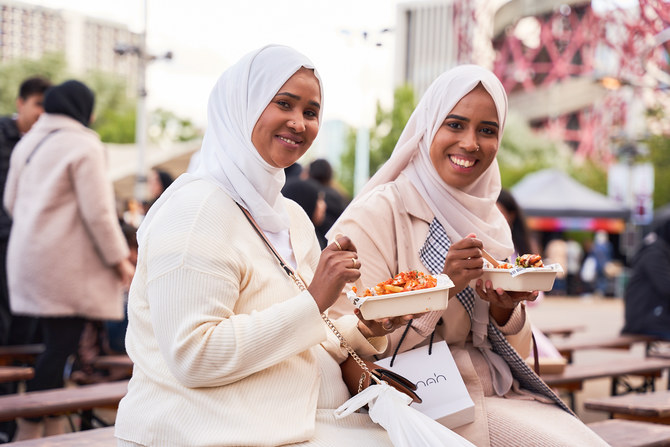
London Halal Food Festival opens its gates to 18,000 visitors

Foodies at the sixth edition of the Halal Food Festival in London. (Supplied)
Short Url
Updated 28 September 2022
Follow

London Halal Food Festival opens its gates to 18,000 visitors

  • With 150 vendors, festival showcases 25 cuisines from around the world
  • Festival’s mission is to help support halal SMES

LONDON: The Halal Food Festival returned to the UK capital this year for its sixth edition with 25 cuisines on offer at more than 150 stalls.

At least 18,000 people attended the two-day event, which ran from Sept. 24-25 at London Stadium in Queen Elizabeth Olympic Park.

The scale and scope of the festival mean London now hosts one of the largest specifically halal food gatherings in the world, according to organizers. 

Kevin Jackson, director of Algebra Festivals, launched the festival with his partner Waleed Jahangia seven years ago. 

“We created an event that would put food at the heart of the community. There’s no better way of sharing culture than through food,” he said.

After two years of the COVID-19 pandemic, organizers have invested heavily in infrastructure, transforming the festival into an experience that goes beyond food.

The event featured a VIP lounge, shopping stalls, live entertainment, cookery theater, picnic area, kids play area, mechanical bull and fun competitions. 

One of the highlights was a live demonstration by NHS doctor and former “MasterChef” winner Dr. Saliha Mahmood Ahmed. 

Using bread dough to teach women how to examine themselves for early signs of breast cancer, Ahmed aimed to overcome cultural taboos that contribute to low cancer awareness among the Muslim community in the UK. 

The new additions reflect the growing view that halal is more than just about food but is a lifestyle, too. 

Jackson recalled that when he and Jahangia launched the festival, most Muslim events in London were held in community centers or school halls. 

But the London Stadium event shows the Muslim community now has access to some of the most renowned venues in the capital. 

The festival has also evolved into a cultural melting pot, with both its cuisine and its foodies coming from around the globe. 

“We’ve got people from Manchester, Birmingham, people who came on a day trip from Paris yesterday. We’ve got people from Spain. We’ve got people from Scotland. This is such a big event for the Muslim community that they travel for miles to come to it,”  Jackson said.  

Chef Fatima El-Rify of Mama Hayam reported positive feedback from visitors tasting her Egyptian cuisine. 

“They didn’t know what it was completely. They knew a little about kosheri, but now they have a really strong idea. They’re coming back for more. They’re bringing their friends. They really love kosheri and mahshi, so that’s really good.” 

She added: “I think there is nowhere else in London that you can try all these different cuisines and just have this ease of it all being halal.” 

The festival also features the timeless and the contemporary, from Jordan’s traditional Anabtawi Sweets to London’s Lola’s Cupcakes.

Apart from catering to Muslim visitors, it aims to provide an international platform for the halal economy, while helping to nurture halal small and medium enterprises. 

“We’re building business relationships. The traders all trade with one another. The suppliers, our partners here, Tariq Halal, are providing products for our exhibitors,” Jackson said. 

Founder Shahin Bharwani of Mocktail Company, which sells non-alcoholic beverages,  said that she was fortunate to have been able to exhibit at the Halal Food Festival in 2016 within months of launching her business. 

“It was brilliant in terms of being a startup to get the brand exposure needed at this type of event.” 

Festival vendors reflected on the halal industry’s growth in the past decade. 

Bharwani said: “There’s so many variations of businesses here, particularly the food. Years ago you could never imagine halal tacos hell or gourmet burgers, that type of thing, so to have those kinds of halal options now is amazing.” 

Co-partner Abid Haider of Proper Burgers said that the event “just keeps getting bigger and bigger.” 

With the industry now worth billions, the London festival is part of a growing movement placing halal on high street.


Ramadan routines around the Kingdom 

Updated 58 min 26 sec ago
Follow

Ramadan routines around the Kingdom 

RIYADH: Saudi Arabia is home to a diverse array of Ramadan customs, with each region boasting time-honored traditions. Here  is how the holy month is celebrated in various parts of Saudi Arabia.

NAJD 

One of the most significant Ramadan traditions in parts of Najd is Isha Al-Walidayn (the ‘parents’ dinner’), in which families prepare meals that are shared with relatives, neighbors and those in need. Often organized by neighborhood groups, the gatherings take place during iftar or after taraweeh. Families either invite relatives, neighbors and passersby to share the meal at home or send dishes to surrounding households and those in need. 

While rooted in charity, the tradition is equally about memory and community, offering a way to honor loved ones while strengthening social ties.  

In places including Qassim, the practice may be repeated several times throughout the month. The custom has been passed down through generations and remains part of Najd’s social fabric, reflecting the family-centered rhythm of Ramadan in the area.  

Hajar Alqusayer 

HIJAZ 

For more than a century, the chant of “Sidi Shaheen” has echoed through the narrow alleys of Madinah, marking the approach of Ramadan and signaling one of Hijaz’s most cherished folk traditions. Observed in the second half of Sha’ban — the month preceding Ramadan — the custom sees groups of boys walking through neighborhoods, singing traditional verses in celebration of the holy month’s imminent arrival. The practice remains particularly strong in Madinah, though it is also known across the wider Hijaz region. 

As part of the tradition, children carry a small container known as a quff, used to collect sweets, nuts and coins offered by households they visit. Moving from door to door, they chant in unison, their songs met with open doors and generous smiles. 

In preparation, families stock up on treats — particularly nuts and traditional sweets such as mushabak (pictured) — ensuring they are ready to share in the joy. 

Nada Hameed 

EASTERN PROVINCE 

Gargee’an, a traditional festival which is primarily celebrated mid-Ramadan in Gulf countries; specifically Kuwait, Bahrain, Iraq, the UAE, and in Saudi Arabia’s Eastern Province. It is not commonly observed in other parts of the Kingdom.  

Traditionally, boys in crisp white thobes and girls adorned in intricate jalabiyas go door-to-door in their neighborhoods and collect sweets and goodies in their handwoven baskets. It is a chance for them to reconnect with the community and spread colorful cheer. 

In recent years, however, the King Abdulaziz Center for World Culture (Ithra) in Dhahran has staged its own Gargee’an, providing candies for the kids as well as numerous indoor and outdoor activities for youngsters of all ages — including the young at heart — alongside performances of traditional folk songs and other live shows. 

The main plaza at Ithra, the Library and Energy Exhibit will each have Instagram-worthy moments. Entry to the center is free, though certain events — such as those at The Children’s Museum — require you to purchase tickets on the premises. 

Jasmine Bager 

JAZAN 

In Jazan, Ramadan is scented with wood smoke and freshly baked bread. Across villages and coastal towns, families still use the traditional mifa — a clay oven — to prepare corn and millet breads to eat at iftar. A staple of the season is mafalt (pictured), a creamy mixture of flour and milk often eaten at suhoor, valued for its simplicity and ability to sustain you through long fasting hours.  

Another distinctive feature of Ramadan in Jazan is the communal spirit of preparation. Neighbors exchange dishes before sunset, ensuring no table is without the region’s signature flavors. Evenings often extend into open-air gatherings where stories are shared and elders recount how Ramadan was observed generations ago. In Jazan, the holy month is less about extravagance and more about preserving culinary heritage and close-knit community bonds.  

Rahaf Jambi 

HAIL 

Since Ramadan this year is taking place while the weather in Hail is still relatively cool, it has been common to see dozens of people gathering along the banks and beds of nearby valleys — particularly in Mashar, Tuwaren, and Naqbin in the late afternoon, setting up seating and making arrangements for iftar. 

Coffee and tea are typically brewed over a fire, and participants often bring homemade dishes including lamb or chicken soups, vegetable or meat pastries, and Hail-style keubaiba —square-folded vine leaves filled with rice and a blend of spices, including cumin, black pepper, and dried lime. Sometimes, participants pool resources to buy a young lamb to eat. The liver is seasoned and cooked with onions, while the rest of the meat is prepared with rice for consumption at suhoor. 

Between iftar and suhoor, people socialize or play volleyball — a favorite activity for many Saudis during Ramadan. 

Hebshi Alshammari 

QATIF 

On the fifteenth night of Sha’ban, and again in the middle of Ramadan, children run through the streets of Qatif in traditional dress, going from house to house in celebration of Nasfa, a holiday celebrated in cities across the Arab world, but, in Saudi Arabia, only in Qatif (although it is practically identical to Gargee’an).  

“This celebration is not a fleeting ritual; it is a collective memory, a bridge connecting past to present,” Ismail Hejles, a Saudi researcher of traditional architecture from Qatif, told Arab News. “It teaches that religion was never meant to be stern, and that joy can be part of worship when it is pure.” 

Historians suggest the custom of children going door to door to receive gifts developed in tightly knit urban neighborhoods, where strong community bonds allowed the practice to flourish. And Nasfa is not just a distribution of sweets; it is a distribution of joy.  

“On that night, homes are equal,” Hejles said. “The rich give, and the poor give. The child is not asked who they are or which family they belong to.” 

Tamara Aboalsaud