PARIS/SULAIMANIYA, Iraq: Iran’s Revolutionary Guards said on Wednesday they fired missiles and drones at militant targets in the Kurdish region of neighboring northern Iraq, where authorities said 13 people were killed.
The strikes were reported after Iranian authorities accused armed Iranian Kurdish dissidents of involvement in unrest now shaking Iran, especially in the northwest where most of the country’s population of over 10 million Kurds live.
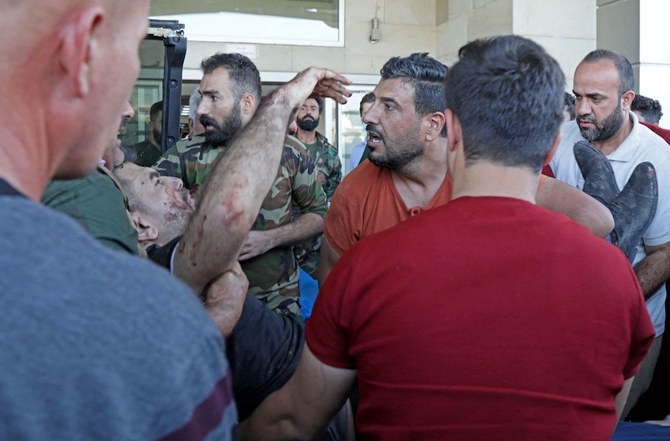
Thirteen people were killed and 58 wounded in the attacks near Irbil and Sulaimaniya in Iraqi Kurdistan, Iraq’s state news agency said citing its counter-terrorism service in Kurdistan.
Iraqi Kurdish sources told Reuters drone strikes targeted at least 10 bases of Iranian Kurds near Sulaimaniya in Iraqi Kurdistan on Wednesday morning, without elaborating about possible casualties.
The US Army Central Command said it downed an Iranian drone on Wednesday while it was on its way to Irbil, adding that the drone posed a threat to US personnel in the region.
“No US forces were wounded or killed as a result of the strikes and there is no damage to US equipment,” it said in a statement.
A senior member of Komala, an exiled Iranian Kurdish opposition party, told Reuters that several of their offices were struck as well.
Tariq Haidari, mayor of the Iraqi Kurdish city of Koye, told Reuters that two people including a pregnant woman were killed and 12 wounded. Some of the wounded were rushed in critical condition to hospital in Irbil, he said.
The Revolutionary Guards, Iran’s elite military and security force, said after the attacks that they would continue targeting what it called terrorists in the region.
“This operation will continue with our full determination until the threat is effectively repelled, terrorist group bases are dismantled, and the authorities of the Kurdish region assume their obligations and responsibilities,” the Guards said in a statement read on state television.
Iraq’s foreign ministry condemned the attacks.
Iraq’s foreign ministry spokesman said in a statement on Wednesday that the ministry would summon the Iranian ambassador to inform him of Iraq’s objection to the attacks on Iraqi territories and that Iraq considers this action as a violation of sovereignty.
The attacks were condemned by the UN mission in Iraq.
The US condemned the “brazen attacks” and Britain said Iraq’s “indiscriminate bombardment” demonstrates “a repeated pattern of Iranian destabilizing activity in the region”.
Germany slammed the “escalation... against the backdrop of domestic political protests in Iran” and rejected “attempts to locate the causes of the Iranian protests in the neighboring country”.
The Kurdish Democratic Party of Iran, one of the groups targeted, charged that “these cowardly attacks are occurring at a time when the terrorist regime of Iran is unable to crack down on ongoing protests inside and silence the Kurdish and Iranian peoples’ civil resistance”.
Protests erupted in Iran this month over the death of a young Iranian Kurdish woman, Mahsa Amini, in police custody.
Amini, 22, from the northwestern Kurdish city of Saqez, was arrested on Sept. 13 in the capital Tehran for “unsuitable attire” by the morality police, who enforce the Islamic Republic’s strict dress code.
She died three days later in hospital after falling into a coma, sparking the first big show of opposition on Iran’s streets since authorities crushed protests against a rise in gasoline prices in 2019.
On Wednesday, Iran’s President Ebrahim Raisi condemned the “chaos” sparked by a wave of women-led protests over Amini death.
“Those who took part in the riots must be dealt with decisively, this is the demand of the people,” said Raisi in a televised interview.
“People’s safety is the red line of the Islamic republic of Iran and no one is allowed to break the law and cause chaos,” he said.
“The enemy has targeted national unity and wants to pit people against each other,” added the ultraconservative president, accusing Iran’s archfoe the United States of stoking the unrest.
Raisi said the nation had felt “grief and sorrow” over Amini death, and that forensics and judiciary experts would soon present a final report, but also warned that “protests are different to riots”.
“Woman, Life, Freedom!” the protesters have chanted in Iran’s biggest demonstrations in almost three years, in which women have defiantly burned their headscarves and cut off their hair.
Their actions have been matched in solidarity protests worldwide, with British-Iranian Nazanin Zaghari-Ratcliffe, who spent six years in jail in Iran, cutting her hair in a video shared on the BBC Persian service.
Amini’s bereaved parents have filed a complaint, demanding “a thorough investigation” and the release of “all videos and photographs” of her while in custody, said their lawyer Saleh Nikbakht.
An Iraq-based cousin of Amini, who is a member of a Kurdish nationalist group, charged that she died after a “violent blow to the head” and that one officer had vowed to “instil the rules in her and teach her how to wear the hijab and how to dress”.
As the Iranian protests have flared for 12 nights in a row, Iran’s police command vowed its forces would confront them “with all their might”, in a crackdown that one rights group says has already killed at least 76 people.
The Iranian government — its economy already hit by sanctions over its nuclear program — has sought to play down the crisis.
Iranian Foreign Minister Hossein Amir-Abdollahian said he told Western diplomats at recent UN meetings that the protests were “not a big deal” for the stability of the clerical state.
“There is not going to be regime change in Iran. Don’t play to the emotions of the Iranian people,” he told National Public Radio in New York, also accusing “outside elements” of stirring up violence.
Fars news agency said Tuesday “around 60” people had been killed since Amini’s death. But the Oslo-based group Iran Human Rights said the crackdown has killed at least 76 people.
Iran’s response has drawn concern from the UN and condemnation from the around the world, with Germany and Spain summoning the Iranian ambassadors and the US and Canada announcing new sanctions.
The son of Iran’s late shah, in an interview near Washington with AFP, hailed the protests and urged the world to add to the pressure on the clerical leadership.
Reza Pahlavi, whose father was toppled in the 1979 Islamic Revolution, urged greater preparation for a future Iranian system that is secular and democratic.
“It is truly in modern times, in my opinion, the first revolution for the women, by the women — with the support of the Iranian men, sons, brothers and fathers,” said Pahlavi.


![]()

Thirteen reported killed as Iran Revolutionary Guards target dissident sites in Iraq
Short Url
https://arab.news/4jc7b
Thirteen reported killed as Iran Revolutionary Guards target dissident sites in Iraq
- Iranian authorities accuse Iranian Kurdish dissidents of involvement in unrest
- Drone strikes targeted at least 10 bases of Iranian Kurds near Sulaimaniya in Iraqi Kurdistan


Latest updates


© 2026 SAUDI RESEARCH & PUBLISHING COMPANY, All Rights Reserved And subject to Terms of Use Agreement.