

UN says disease outbreaks remain ‘growing concern’ in flood-hit Pakistan

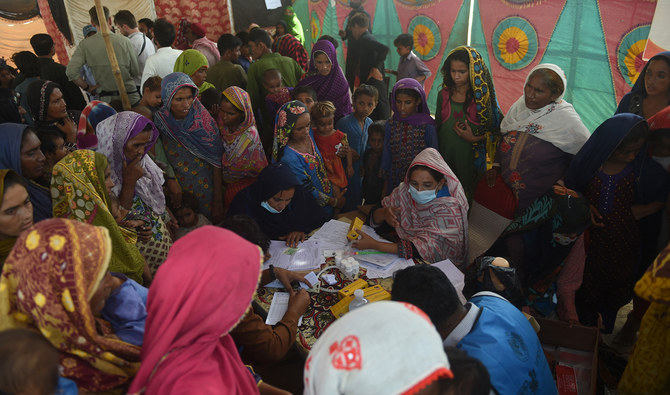
Local residents displaced by floods gather at a makeshift medical camp set in Dadu district, Sindh province on September 27, 2022. (AFP)
Short Url
Updated 28 September 2022
Follow

UN says disease outbreaks remain ‘growing concern’ in flood-hit Pakistan

  • Deaths from infections, malaria, dengue have caused more than 300 deaths since July in worst-hit province of Sindh
  • Flood-ravaged regions have become infested with diseases including malaria, dengue fever, diarrhea and skin problems

ISLAMABAD: The United Nations has said outbreaks of mosquito-borne and water-borne diseases in flooded Pakistan were a “growing concern,” as deaths from infections, malaria and dengue fever have caused more than 300 deaths since July in the worst-hit province of Sindh, according to health officials.

The death toll from the deluge itself has reached 1,663, including 614 children and 333 women, a figure that does not include deaths from fast-spreading diseases, according to data from the National Disaster Management Authority.

“Outbreaks of vector-borne and water-borne diseases are a growing concern in Sindh and Balochistan provinces, where many districts remain inundated by floodwaters,” Stephane Dujarric, a spokesperson for UN Secretary-General Antonio Guterres, said on Tuesday.

He said floods had damaged nearly 1,500 health facilities across the country, including more than 300 refrigerators and solar power systems, which was disrupting vaccine cold chains.

“Assessments are continuing, but an estimated 7.9 million people remain displaced by the catastrophic floods.  Nearly 600,000 people are living in relief camps, and more than 7,000 schools across Pakistan are being used as temporary relief camps,” the spokesperson said, adding that the UN and its humanitarian partners were continuing to scale up response and had reached more than 1.6 million people impacted by the floods.

“Nearly 600,000 people are living in relief camps, and more than 7,000 schools across Pakistan are being used as temporary relief camps … More than two million houses have been damaged by the heavy rains and floods. More than 25,000 schools and 13,000 km of roads have also reportedly been damaged.”

Record monsoon rains in south and southwest Pakistan and glacial melt in northern areas triggered the flooding that has affected nearly 33 million people in the South Asian nation of 220 million, sweeping away homes, crops, bridges, roads and livestock and causing an estimated $30 billion of damage.

Hundreds of thousands of displaced people are in dire need of food, shelter, clean drinking water, toilets and medicines. Many have been sleeping in the open by the side of elevated highways.

The economic losses from the flooding will slash the country’s GDP growth to around 3 percent from the estimated target of 5 percent set out in the budget when it had narrowly escaped defaulting on its debt in a balance of payment crisis.

Pakistan was already reeling from economic blows when the floods hit, with its foreign reserves falling as low as one month’s worth of imports and its current account deficit widening.


Pakistan bulk cargo terminal signs deal to ship copper-gold output from Reko Diq

Updated 6 sec ago
Follow

Pakistan bulk cargo terminal signs deal to ship copper-gold output from Reko Diq

  • Pakistan International Bulk Terminal says the deal positions it as the primary logistics gateway for Reko Diq’s mineral output
  • A top Barrick Mining official says the agreement marks a ‘step forward,’ with exports from the project expected to begin in 2028

ISLAMABAD: A bulk cargo terminal operating at Pakistan’s Port Qasim has signed an agreement to handle and export copper-gold commodities from Reko Diq, including minerals, metals and other natural earth resources, in a move expected to support multibillion-dollar mineral exports from the country, the company said on Monday.

The terminal operator, Pakistan International Bulk Terminal Limited (PIBT), said the agreement positions it as the primary export gateway for Reko Diq’s mineral output and strengthens Pakistan’s ambitions to expand its footprint in global commodity markets.

The deal covers logistics, storage and exports for output from the Reko Diq copper-gold project in southwestern Balochistan province, one of the world’s largest undeveloped mineral deposits, with shipments expected to begin from 2028.

“This agreement is a historic milestone for PIBT and Pakistan, enabling exports from one of the world’s most significant mining projects and serving as a cornerstone for national economic growth,” Sharique Azim Siddiqui, CEO of PIBT, said in a statement.

He expressed appreciation to the government, the Special Investment Facilitation Council, the Ministry of Maritime Affairs and the Port Qasim Authority for their “pivotal role.”

Barrick Mining Corporation, which is developing Reko Diq, also welcomed the agreement.

“We’re delighted to have signed this important agreement with PIBT which marks another step forward in ensuring that Reko Diq delivers lasting value to all our stakeholders but particularly the people of Balochistan and Pakistan,” Mark Hill, the company’s top official, said.

PIBT is a fully mechanized multipurpose bulk terminal located at Port Qasim and was developed with a $305 million investment in partnership with the International Finance Corporation.

The terminal currently has an annual handling capacity of 12 million tons of imports and 4 million tons of exports, with further investment planned to upgrade its export systems, the company said.