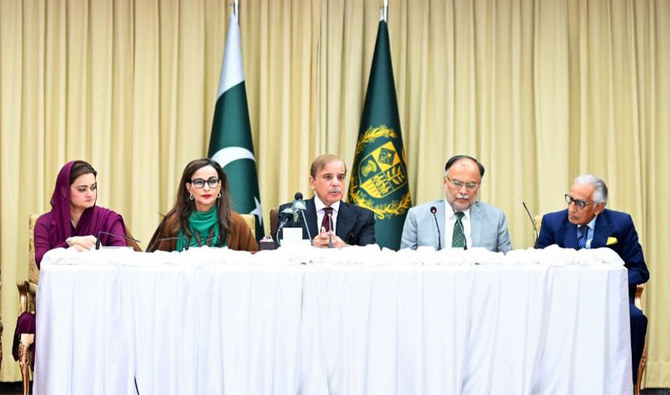

ISLAMABAD: Prime minister Shehbaz Sharif said on Tuesday he had spoken to the managing director at the International Monetary Fund and communicated that Pakistan would not be able to fulfill its commitments to the global lender due to losses from recent floods, estimated at around $30 billion.
A historic monsoon brought about three times as much rain this year as Pakistan’s three-decade average, killing over 1,600 people. Combined with glacial melt, this caused unprecedented flooding that has affected nearly 33 million people in a nation of 220 million, sweeping away homes, crops, bridges, roads and livestock.
In an interview with Bloomberg Television in New York last week, the Pakistani PM had said Pakistan had debt obligations in the next two months and his government had just signed an agreement with the International Monetary Fund with “very tough conditionalities” that included taxes on petroleum and electricity. He said “all hell” would break loose without debt relief, including from rich nations.
“I have talked to the managing director of the IMF that we cannot fulfill the commitments given to the monetary fund due to losses of floods,” Sharif said at a media briefing on Tuesday. “She has given a good response and promised to talk to her board on this.”
In August, Pakistan secured a $1.1 billion loan from the IMF, part of a $6 billion program signed in 2019. Sharif has said in recent comments that he had spoken to the World Bank about immediate debt relief and would begin talks with China after the Paris Club. Pakistan owes $30 billion to China, or about a third of its total external debt.
Speaking about the appointment of a new army chief when General Qamar Javed Bajwa retires in November, Sharif said it should be done according to the law.
Bajwa will complete his tenure on November 28. He became the army chief in November 2016 and was given a three-year extension in 2019 when now former PM Imran Khan was in power.
Khan, who was ousted in a no-trust vote in April, alleged during a speech at a rally this month that PM Sharif and his allies were delaying elections in the country as they hoped to appoint an army chief of their own choice who would not question them over corruption.
The military shot back at the former PM, saying it was “aghast” at the statement, which it saw as an attempt “to discredit and undermine the senior leadership.” Sharif’s party has called Khan’s comments an attempt to “politicize” the chief’s appointment.
“When he [Khan] had given an extension to the army chief, had he consulted me?” Sharif asked at the media talk. “Everyone has to follow the constitution and law. Everyone will and should follow the constitution and law, and this [army chief’s appointment] should be done as per law, that’s it.”
Commenting on a recent leak of audio conversations from the PM Office, Sharif called it a “very serious lapse” that he said had put Pakistan’s prestige at stake, announcing that a high-level committee would be set up to investigate the matter.
The leaks, which surfaced last weekend, involve discussions between PM Sharif and members of his cabinet, including conversations with ruling party leader Maryam Nawaz over the performance of outgoing finance minister Miftah Ismail, and with an official about the possibility of facilitating the import of Indian machinery for a power project for Nawaz’s son-in-law.
“Audio leaks is an important issue and it is a very serious lapse,” Sharif said. “It is not about my privacy, rather it is about the prime minister of Pakistan.”
“Whoever will visit the prime minister’s house from the outside world, whether a sympathizer or a friend, they will think 100 times before talking. This is about the respect of 220 million people of the country,” Sharif added. “I am taking notice of this and a high-level committee will be formed to get to the bottom of this matter”.