

Taif in driving seat to promote Saudi tourism: Development fund executive

1 / 2
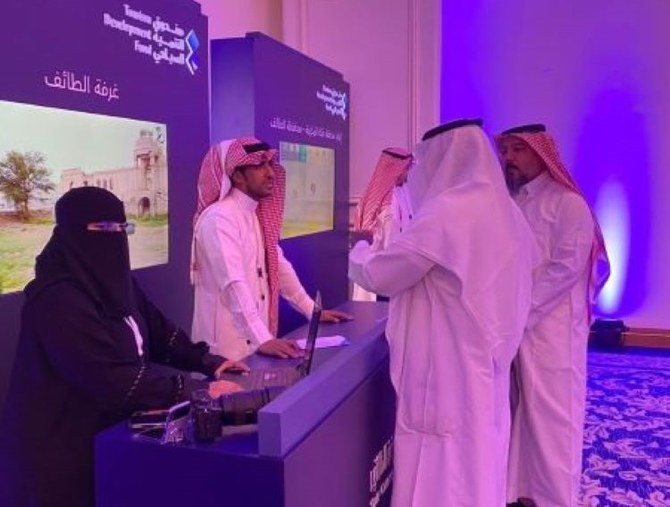
The Taif Chamber of Commerce booth at Discover Beyond Taif.
2 / 2
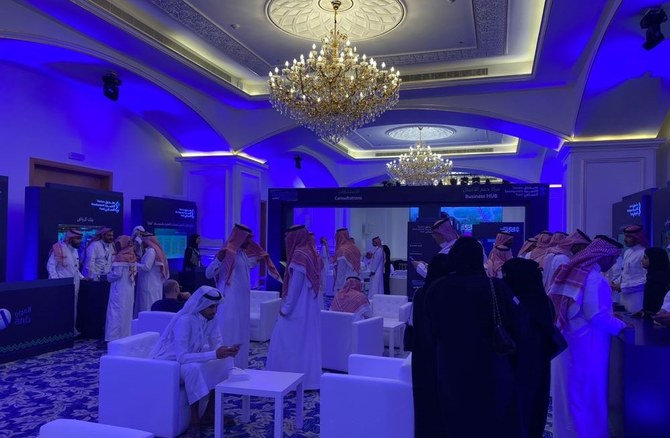
Over 200 businessmen attended Discover Beyond Taif.
Short Url
Updated 27 September 2022
Follow

Taif in driving seat to promote Saudi tourism: Development fund executive

  • Taif is a popular summer destination for local and regional tourists drawn by its pleasant weather, hiking trails, picnic spots, and rich history
  • The city is also known for agri-tourism, and its rose production has earned it the title City of Roses

JEDDAH: More than 200 business leaders on Monday attended a Saudi Tourism Development Fund event aimed at promoting investment opportunities.

The fund’s first roadshow, Discover Beyond Taif, was held at the city’s Iridium Hotel.

Located 1,879 meters above sea level in the Makkah region, Taif is a popular summer destination for local and regional tourists drawn by its pleasant weather, hiking trails, picnic spots, and rich history. The city is also known for agri-tourism, and its rose production has earned it the title City of Roses.

Khalid Al-Sharif, the fund’s associate director of coverage of large institutions, said: “The Tourism Development Fund was established in 2020, and since then the Kingdom has gone through a huge transformation in the tourism industry.”

He noted that Taif had been selected to stage the fund’s first roadshow because of its strategic location.

“It has been one of the hotspots of tourism in the Kingdom for a long time. We believe our presence here is very important to introduce our services and ourselves to the people in Taif, and the people interested in investing in Taif,” he added.

The fund provides guidance and financial support to those interested in investing in the city.

“We believe that both options are very important for investors so we can support them from the beginning. If you have just a small idea, we will help you develop this idea to see it into reality,” Al-Sharif said.

Financial backing can be provided through direct funding, guarantees, or direct equity.

The TDF works with partners including the Arab National Bank, and Riyad Bank, in addition to government bodies such as Kafalah and Monsha’at.

“We all have the one same objective that is to promote tourism in Saudi Arabia and invest in tourism in Saudi Arabia. And since we are in Taif, we need to invest in Taif and take advantage of the amazing weather, geography, great people, and the close distance to Makkah.

“Taif is one of the main destinations that will drive the tourism industry in the Kingdom. Mountain resorts can also be leveraged on due to the weather. We are also looking to have a wellness resort in the near future as well.

“The fund’s strategy is aligned with the Kingdom’s strategy, with Vision 2030. It is in alignment with the national tourism strategy, to increase the number of visitors up to 100 million by 2030, in addition to increasing the GDP (gross domestic product) contribution and the job creations that are derived from the tourism industry,” Al-Sharif added.


Red Sea Global unveils scientific model for regenerative tourism worldwide

Updated 45 min 58 sec ago
Follow

Red Sea Global unveils scientific model for regenerative tourism worldwide

  • The report details the model’s rollout at “The Red Sea” and “AMAALA” destinations, backed by studies covering 8 marine habitats

TABUK: Red Sea Global (RSG) has unveiled a science-based model aimed at achieving a 30 percent net positive conservation benefit across its tourism destinations by 2040. 

The framework is now available for global adoption, according to a statement released by RSG.

Owned by Saudi Arabia’s Public Investment Fund (PIF), Red Sea Global is the multi-project developer behind ambitious regenerative tourism destinations like “The Red Sea” and “AMAALA.” 

As a cornerstone of the Kingdom’s Vision 2030, the company aims to diversify the national economy while setting new global benchmarks for sustainable, nature-positive development.

CEO John Pagano stated that openly sharing this detailed approach will help elevate the global tourism sector and secure a healthier environment for future generations.
 

Map showing the boundaries of the Red Sea Zone. (Graphic from the RSG report)

The cornerstone of this initiative is the proprietary SIIG Model, a four-step framework:
• Survey: Establish biodiversity baselines and monitor long-term changes.
• Identify: Assess risks to priority habitats and species.
• Intervene: Execute evidence-based actions, such as regulating fishing and enhancing natural habitats.
• Gain: Measure and verify biodiversity improvements.

The report details the model’s rollout at “The Red Sea” and “AMAALA” destinations, backed by extensive 2022–2023 environmental baseline studies covering eight marine habitats and priority species groups during 2022 and 2023. 

A major intervention is the 5,015-square-kilometer Fishery Management Area in Al-Wajh Lagoon. The plan reserves 38 percent of the area for priority conservation—protecting 62 percent of local coral reefs—while allocating 61 percent for sustainable fishing.

According to scientific modeling, eliminating fishing in high-protection zones could increase reef fish populations by 113 percent, sharks and rays by 72 percent, and marine mammals by 24 percent. These measures are expected to boost coral resilience, support ecosystem recovery, and protect vulnerable species like sea turtles and seabirds.
Ihab Kindi, RSG’s Red Sea Destination Executive Director, called the data-driven model a practical roadmap for large-scale marine recovery. The complete methodology is available in the new report, “The SIIG Model: A Roadmap Toward Achieving Measurable Conservation Gains.”