ISLAMABAD: A senior member of the Taliban-run government in Afghanistan on Tuesday called on Afghanistan’s new rulers to reopen schools for girls beyond the sixth grade, saying there is no valid reason in Islam for the ban.
The appeal from Sher Mohammad Abbas Stanikzai, the Taliban deputy foreign minister, came during a top Taliban gathering in Kabul. It was a rare moderate voice amid the harsh measures imposed by the Taliban since they overran the country and seized power in August 2021.
The measures include banning girls from middle school and high school despite initial promises to the contrary. Women are required to cover themselves from head to toe in public, with only their eyes showing.
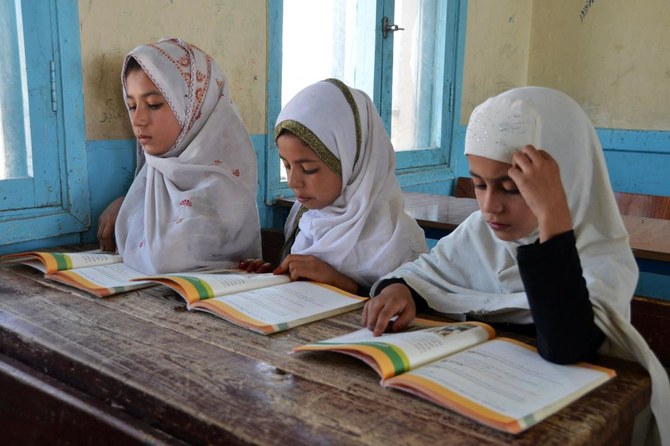
The Taliban have said they are working on a plan to open secondary schools for girls but have not given a timeframe.
The United Nations has called the ban “shameful” and the international community has been wary of officially recognizing the Taliban, fearing a return to the same harsh rule the Taliban imposed when they were last in power in the late 1990s.
“It is very important that education must be provided to all, without any discrimination,” Stanikzai said. “Women must get education, there is no Islamic prohibition for girls’ education.”
“Let’s not provide opportunities for others to create a gap between the government and people,” he added. “If there are technical issues, that needs to be resolved, and schools for girls must be opened.”
Still, it was unclear if and how much Stanikzai could sway hard-liners, who appear to hold the reins in the Taliban administration.
Stanikzai was once head of the Taliban team in talks that led to the 2020 agreement in Qatar between the Taliban and the United States that included the complete withdrawal of foreign troops from Afghanistan.
His remarks follow the Taliban appointment of a new education minister, days after the UN called on them to reopen schools for girls. The UN estimates that more than 1 million girls have been barred from attending most of middle school and high school over the past year.
A year after the Taliban took over the country as the Western-backed government and military crumbled, the UN says it is increasingly concerned that restrictions on girls’ education, as well as other measures curtailing basic freedoms, would deepen Afghanistan’s economic crisis and lead to greater insecurity, poverty, and isolation.


Afghan Taliban deputy calls for reopening schools for girls
https://arab.news/54sw5
Afghan Taliban deputy calls for reopening schools for girls

- The Taliban have said they are working on a plan to open secondary schools for girls but have not given a timeframe


Trump Maritime Action Plan eyes levies on China goods to resurrect US shipbuilding
- US shipbuilding has shrunk since World War II and now severely lags China and other nations
- Endorsing the plan, Republican Senator Todd Young said: “It’s time to make American ships again”
WASHINGTON: The Trump administration on Friday released its plan to rebuild US shipbuilding and other maritime businesses, paid for in part by port fees on cargo delivered to the United States on ships made in China — levies the US and China agreed to pause for one year.
The Maritime Action Plan offers a road map for the revival of US shipbuilding, which has shrunk since World War Two and now severely lags China and other nations.
Coming in at more than 30 pages, the plan calls for establishing maritime prosperity zones to bolster investment, reforming workforce training and education, expanding the fleet of US-built and US-flagged commercial ships, establishing a dedicated funding stream through a Maritime Security Trust Fund and reducing regulations.
The Trump administration early last year announced plans to levy fees on China-linked ships to loosen the country’s grip on the global maritime industry and help pay for a US shipbuilding renaissance. The so-called Section 301 penalties followed a US probe that concluded China uses unfair policies and practices to dominate global shipping.
The fees, which sparked intense pushback from the global shipping industry and intensified tensions between the world’s two largest economies, hit on October 14 and were expected to generate an estimated $3.2 billion annually from Chinese-built vessels sailing to US ports.
But China retaliated with its own port fees on US-linked ships and the tit-for-tat fees disrupted global shipping. Soon after, the two sides struck a deal to put the levies on hold for 12 months.
On Friday, Shipyard owners, investors and the bipartisan sponsors of the Shipbuilding and Harbor Infrastructure for Prosperity and Security (SHIPS) for America Act welcomed President Donald Trump’s maritime plan, which landed months later than hoped.
US Senator Todd Young, a Republican from Indiana, said there is substantial overlap between Trump’s vision and the plan in that proposed law, which he reintroduced last year with Democratic Senator Mark Kelly of Arizona and other lawmakers.
Importantly, the SHIPS Act would establish a Maritime Security Trust Fund to reinvest port fee proceeds into maritime security and infrastructure projects such as shipyard revitalization. It has rare backing from both Democratic and Republican lawmakers in Washington, but has not made swift progress.
“The announcement today should serve as a wake-up call for Congress to act quickly on this bill in order to provide the legal authorities and resources necessary to make this plan a reality,” Young said. “It’s time to make American ships again.”