



NEW YORK CITY: The plight of women in Afghanistan under the Taliban is not only an issue of concern for the wider international community, “it should be an issue for the Muslim world” to address, Pakistan’s foreign minister, Bilawal Bhutto Zardari, told Arab News on Friday.
Since the Taliban seized control of Kabul in August 2021, following the withdrawal of Western troops from the country, two decades of progress in the rights of women to education, employment and empowerment have been dramatically rolled back. As a result there have been calls for the international community to increase pressure on the regime to reverse the trend.
Bhutto Zardari said that while Pakistan is waiting with the rest of the international community for “the interim Afghan regime” to keep its initial promise that girls would be allowed to attend school and gain a secondary education, the issue should also be one “for the Muslim Ummah” in particular.
“Because Islam is what first gave women their rights,” he said. “Islam is what guarantees women their rights to participate within society and their rights to education.
“So we expect, not only in Afghanistan but across the world, for women to not only be guaranteed these rights but also for these rights to be protected.”
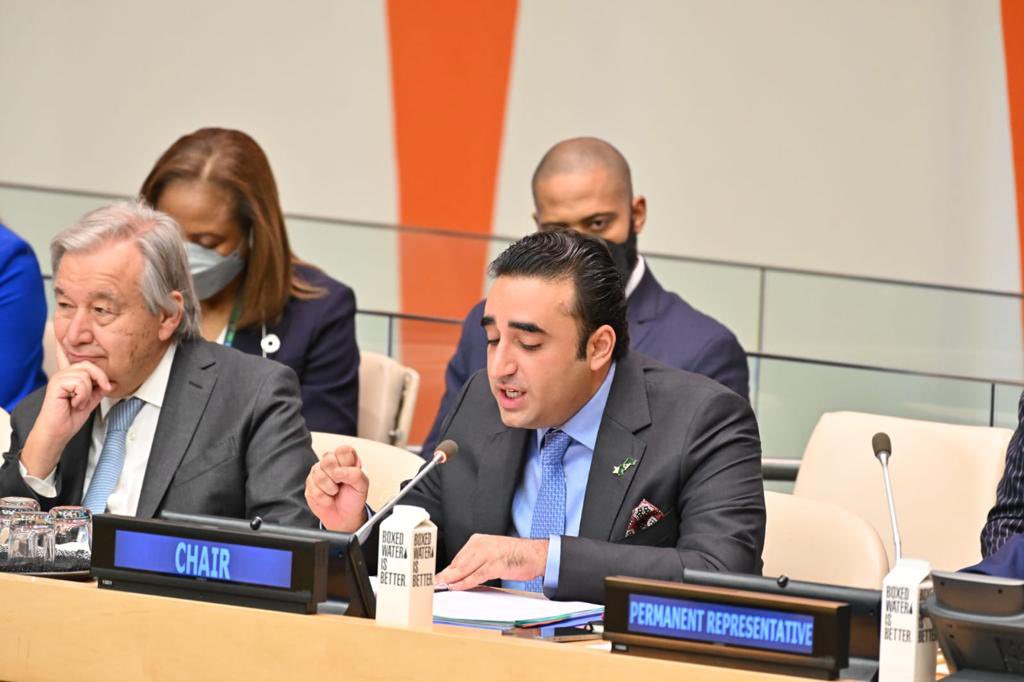
Pakistan's Foreign Minister Bilawal Bhutto-Zardari addressing the 46th Annual Ministers Meeting of G77 on the sidelines of the United Nations General Assembly session in New York on Sep 23, 2022. (@BBhuttoZardari/Twitter)
Bhutto Zardari’s mother, Benazir Bhutto, was the first woman to lead a democratic government in a Muslim-majority country.
Naheed Farid, a women’s rights activist who in 2010 became the youngest-ever politician elected to Afghanistan’s parliament, this month urged world leaders to label the Taliban a “gender apartheid” regime.
Speaking to reporters in New York, she said: “Afghan women are experiencing one of the biggest human rights crises in the world, and in the history of human rights.
“What is happening in Afghanistan is gender apartheid. I’m not the first to say that. But the inaction of the international community and decision-makers at large makes it important for all of us to repeat this every time we can.”
Farid called on the Organization of Islamic Cooperation and other multilateral bodies to create a dedicated platform for Afghan women to directly negotiate with the Taliban on issues of women’s rights and human rights.
Bhutto Zardari, who is currently chairperson of the OIC’s Council of Foreign Ministers, told Arab News that “before our chairmanship expires” he plans to convene an event, under the auspices of the organization, to focus on the rights of women in Islam.


