


CAIRO: With its severe environments and large areas of unused land, the Middle East and North Africa region is in prime need of agricultural and technological advancement.
Agri-tech, also called agtech, the use of technology in agriculture, horticulture, and aquaculture, is reshaping the traditional model of farming to improve yield, efficiency and profitability.
Although agri-tech’s potential may be overlooked by investors, the sector has been performing well, raising $265 million in H1 2022 and ranking as the fifth best performing sector in terms of amount invested, according to a report by MAGNiTT.

Red Sea Farms Founders.
Arab News has compiled a list of four agri-tech startups headquartered in the MENA region which have received the highest amount of funding in the sector.
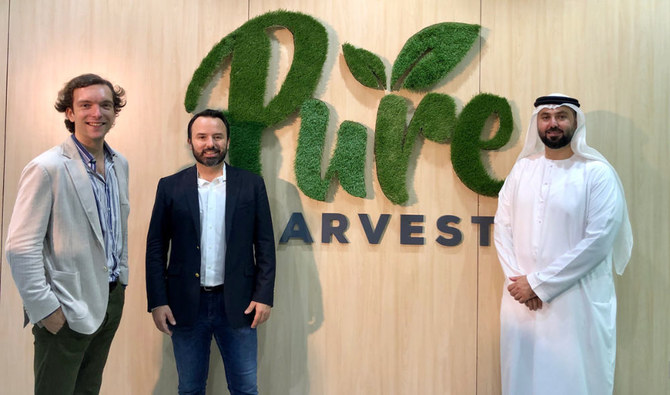
Pure Harvest Farms
Total Funding: $334.4m
Founders: Mahmoud Adi, Sky Kurtz and Robert Kupstas
Main investors: Shorooq Partners, IMM Investment, Abu Dhabi Investment Office, Mohammed Bin Rashid Investment Fund, and Shuaa Capital
Headquarters: UAE
Founded: 2016
Pure Harvest Smart Farms is an agri-tech company based in the UAE focusing on the year-round production of premium fruits and vegetables. The company is not only ranked the first startup in terms of funding in the agri-tech sector, but also one of the most funded in the entire MENA startup ecosystem. In its last funding round, Pure Harvest Smart Farms secured $180.5 million by global investors to fuel its expansion across Gulf Cooperation Council countries and Asia.
Red Sea Farms
Total Funding: $38.8m
Founders: Ryan Lefers, Mark Tester and Derya Baran
Main investors: Saudi Aramco Entrepreneurship Ventures, KAUST Innovation Fund, Savola Group, Global Ventures, and Future Investment Initiative Institute.

Hussein Abo Bakr, Co-founder of Mozare3 (L) and Gregory Lu, Founder of Natufia. (Supplied)
Headquarters: Saudi Arabia
Founded: 2018
Founded by three industry specialists, Red Sea Farms is an agri-tech company that allows farmers to crop using primarily salt water. The company tackles the region’s arid environment by providing farmers with the right technology to sustainably grow their produce. In April 2022 the company raised its most recent funding round of $18.5 million to expand its regional and global footprint.
Natufia Labs
Total funding: $4.8m
Founders: Gregory Lu, Lauri Kapp and Nadim Taoubi
FASTFACT
Although agri-tech’s potential may be overlooked by investors, the sector has been performing well, raising $265 million in H1 2022 and ranking as the fifth best performing sector in terms of amount invested, according to a report by MAGNITT.
Main investors: KAUST Innovation Fund and Butterfly Ventures
Headquarters: Saudi Arabia
Founded: 2014
Estonian-born agri-tech Natufia Labs relocated its headquarters to Jeddah after receiving an investment led by the Saudi-based KAUST Innovation Fund. The company is providing a mixture of advanced technology and years of research and development experience in sustainable indoor food production. Natufia Labs raised $3.5 million in a series A funding round led by KAUST which was used for the relocation as well as research and development.
Mozare3
Total funding: $1m
Founders: Hussein Abou Bakr and Tamer El-Raghy
Main investors: Algebra Ventures, Disruptech, and EFG-EV
Headquarters: Egypt
Founded: 2020
Founded in 2020, Mozare3 is aiming to provide over 20 million farmers in Egypt with access to credit and market solutions. The company helps farmers sell their crops by working with international buyers as well as reducing the risk of waste. In 2021, Mozare3 was able to raise $1 million in a pre-seed funding round co-led by Algebra Ventures and Disruptech, to build the first digital community for farmers that offers expert support.


