Philippines, US on track to deepen alliance as Marcos concludes American trip

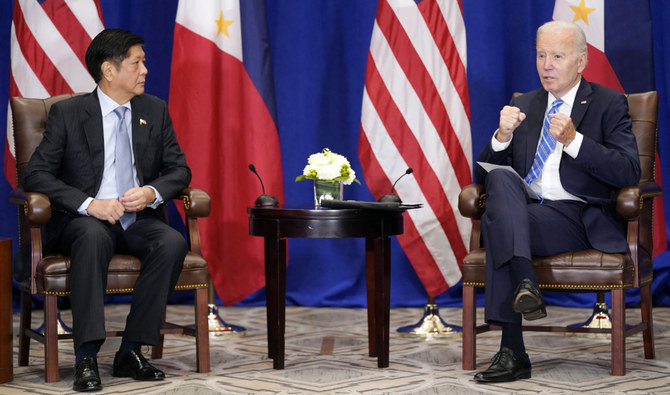
President Joe Biden meets with Philippine President Ferdinand Marcos Jr., Thursday, Sept. 22, 2022, in New York. (AP)
Short Url
Updated 24 September 2022
Follow

Philippines, US on track to deepen alliance as Marcos concludes American trip

  • Leader’s approach breaks from predecessor, who embraced Beijing-friendly direction
  • Deepening relations with Manila appears to be ‘high priority’ for Biden administration, expert says

MANILA: The Philippines is on track to deepen its alliance with the US, experts said this week, as the first meeting between President Ferdinand Marcos Jr. and his US counterpart Joe Biden showed mutual intention to revive long-standing ties that were undermined during the previous Philippine presidency.

Marcos and Biden held their inaugural face-to-face talks on the sidelines of the UN General Assembly in New York City, a few months after the son of the late dictator took office following a landslide victory in the Philippine elections.

Since becoming president, Marcos has held meetings with a number of top US officials, including US Secretary of State Antony Blinken, in a foreign policy shift from the days of former president Rodrigo Duterte, who oversaw a strategy to distance Manila from Washington and embrace a Beijing-friendly direction.

We are your partners, we are your allies, we are your friends. And in like fashion, we have always considered the US our partner, our ally and our friend.

Marcos Jr., Phillipine president

“We are your partners, we are your allies, we are your friends. And in like fashion, we have always considered the US our partner, our ally and our friend,” Marcos told Biden during their meeting.

Marcos, who is set to return to the Philippines on Saturday, said that he cannot envision his country without the US as a partner during an economic forum earlier in the week.

Biden had reaffirmed the US’ “ironclad commitment” to the defense of the Philippines during the occasion, the White House said in a statement, as they discussed various other issues, including tensions in the South China Sea and the Russian invasion of Ukraine.

“The relationship between the US and the Philippines, to state the obvious, has very deep roots. We’ve had some rocky times but the fact is it’s a critical, critical relationship from our perspective,” Biden said.

Their meeting conveyed eagerness on both sides to strengthen ties, Southeast Asia expert Gregory Poling of the Center for Strategic and International Studies in Washington D.C., told Arab News.

“The meeting certainly shows both sides are eager to deepen the relationship, and that doing so is a high priority for the Biden administration,” Poling said.

As the White House “doesn’t organize a ton of meetings like this” on the sidelines of the UN General Assembly, Poling said that “prioritizing this one sends its own message.

“The US-Philippines alliance is undergoing a process of modernization that started last year and is moving rather quickly,” he added.

Victor Andres Manhit, president of the Stratbase ADR Institute for Strategic and International Studies in Manila, said the meeting showed how Manila is “strengthening and believes” in its partnership with Washington.

“Hopefully, this could be a fresh start in how to strengthen this alliance and turn this alliance beyond defense and security but really a consistent support from the US with regard to trade, investments that can generate jobs, that can then generate more growth for the Philippines,” Manhit told Arab News.

He added that strong relations between the two countries have “always been what the Filipinos want.”

Marcos said that the Philippines will be “a friend to all, and an enemy to none” during his first address to the nation in July, with his administration’s approach toward the US showing a marked contrast to his predecessor, who went to China in the early days of his presidency and announced a “separation” from Washington, its former colonial master.


In show of support, Canada, France open consulates in Greenland

Updated 3 sec ago
Follow

In show of support, Canada, France open consulates in Greenland

COPENHAGEN, Denmark: Canada and France, which both adamantly oppose Donald Trump’s wish to control Greenland, will open consulates in the Danish autonomous territory’s capital on Friday, in a strong show of support for the local government.
Since returning to the White House last year, Trump has repeatedly insisted that Washington needs to control the strategic, mineral-rich Arctic island for security reasons.
The US president last month backed off his threats to seize Greenland after saying he had struck a “framework” deal with NATO chief Mark Rutte to ensure greater American influence.
A US-Denmark-Greenland working group has been established to discuss ways to meet Washington’s security concerns in the Arctic, but the details of the talks have not been made public.
While Denmark and Greenland have said they share Trump’s security concerns, they have insisted that sovereignty and territorial integrity are a “red line” in the discussions.
“In a sense, it’s a victory for Greenlanders to see two allies opening diplomatic representations in Nuuk,” said Jeppe Strandsbjerg, a political scientist at the University of Greenland.
“There is great appreciation for the support against what Trump has said.”
French President Emmanuel Macron announced Paris’s plans to open a consulate during a visit to Nuuk in June, where he expressed Europe’s “solidarity” with Greenland and criticized Trump’s ambitions.
The newly-appointed French consul, Jean-Noel Poirier, has previously served as ambassador to Vietnam.
Canada meanwhile announced in late 2024 that it would open a consulate in Greenland to boost cooperation.
The opening of the consulates is “a way of telling Donald Trump that his aggression against Greenland and Denmark is not a question for Greenland and Denmark alone, it’s also a question for European allies and also for Canada as an ally, as a friend of Greenland and the European allies also,” Ulrik Pram Gad, Arctic expert at the Danish Institute of International Studies, told AFP.
“It’s a small step, part of a strategy where we are making this problem European,” said Christine Nissen, security and defense analyst at the Europa think tank.
“The consequences are obviously not just Danish. It’s European and global.”

Recognition

According to Strandsbjerg, the two consulates — which will be attached to the French and Canadian embassies in Copenhagen — will give Greenland an opportunity to “practice” at being independent, as the island has long dreamt of cutting its ties to Denmark one day.
The decision to open diplomatic missions is also a recognition of Greenland’s growing autonomy, laid out in its 2009 Self-Government Act, Nissen said.
“In terms of their own quest for sovereignty, the Greenlandic people will think to have more direct contact with other European countries,” she said.
That would make it possible to reduce Denmark’s role “by diversifying Greenland’s dependence on the outside world, so that it is not solely dependent on Denmark and can have more ties for its economy, trade, investments, politics and so on,” echoed Pram Gad.
Greenland has had diplomatic ties with the European Union since 1992, with Washington since 2014 and with Iceland since 2017.
Iceland opened its consulate in Nuuk in 2013, while the United States, which had a consulate in the Greenlandic capital from 1940 to 1953, reopened its mission in 2020.
The European Commission opened its office in 2024.