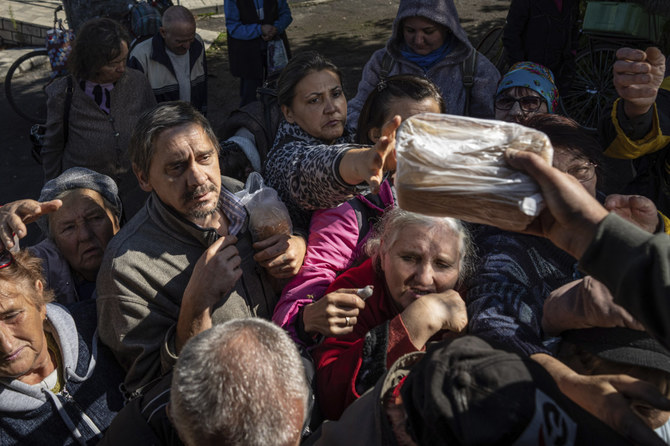
LEBYAZHE, Ukraine: Ukraine’s farmland is famed for its rich black soil and considered a breadbasket for the world, but on Thursday, after months of war, residents of a frontline farming village were queueing for food.
The Russian invasion force that crossed the border on February 24 did not quite reach little Lebyazhe, as Ukrainian troops scrambled to defend routes to the country’s second city, Kharkiv.
But the quiet rural community, sometimes hit by shelling, found itself embroiled in the ensuing conflict, until this month’s lightning Ukrainian counteroffensive drove the invader back.
“It’s been terrible, terrible. I can’t even describe it,” said 75-year-old Galina Mykhailivna, hunkered down while waiting for food rations in front of a village cultural center with a gaping shell hole in the facade.
“It’s tragic, they destroyed the whole village,” she declared, exaggerating in her distress as most of the houses remain standing, although signs of war are everywhere.
“It was so nice before, now it’s ruined,” she said.
As the residents gathered, a Ukrainian army truck-mounted multiple rocket launcher rumbled through the narrow lanes of the village, while artillery detonations boomed from time to time.
Ominously, Lebyazhe lies downstream from a major dam on the Siversky Donets river damaged this week by a Russian missile, amid signs Moscow is targeting civilian infrastructure.
Its hinterland boasts vast swathes of sunflower fields — a global source of cooking oil — and homes in the village itself typically keep productive vegetable patches, goats and ducks.
But on Thursday, community leader Olexander Nesmiyan — the tallest man in the village — was overseeing the distribution of food parcels.
Each box, emblazoned with the logo of the UN World Food Programme, holds 12 kilos (26 pounds) of basic foodstuffs — rice, oil, pasta, canned beans and canned meat — enough to feed one person for one month.
It was a weighty burden for some of the elderly villagers to carry, but neighbors helped out. Boxes were loaded into wheelbarrows and strapped to bikes, as dogs and children enjoyed playing among the crowd.
The gathering is cheerful, a trip out to the village store and a chance to greet neighbors, perhaps to forget about Lebyazhe’s other problems for a few hours.
“Yes, six months without electricity. And now already three months without gas, but we’ll make it somehow,” said 65-year-old Lyubov Polushkyna.

War leaves Ukraine farming village queueing for food
https://arab.news/p3gp9
War leaves Ukraine farming village queueing for food
- As the residents gathered, a Ukrainian army truck-mounted multiple rocket launcher rumbled through the narrow lanes of the village
Rubio says technical talks with Denmark, Greenland officials over Arctic security have begun
- US Secretary of State on Wednesday appeared eager to downplay Trump’s rift with Europe over Greenland
WASHINGTON: Technical talks between the US, Denmark and Greenland over hatching an Arctic security deal are now underway, Secretary of State Marco Rubio said on Wednesday.
The foreign ministers of Denmark and Greenland agreed to create a working group aimed at addressing differences with the US during a Washington meeting earlier this month with Vice President JD Vance and Rubio.
The group was created after President Donald Trump’s repeated calls for the US to take over Greenland, a Danish territory, in the name of countering threats from Russia and China — calls that Greenland, Denmark and European allies forcefully rejected.
“It begins today and it will be a regular process,” Rubio said of the working group, as he testified before the Senate Foreign Relations Committee. “We’re going to try to do it in a way that isn’t like a media circus every time these conversations happen, because we think that creates more flexibility on both sides to arrive at a positive outcome.”
The Danish Foreign Ministry said Wednesday’s talks focused on “how we can address US concerns about security in the Arctic while respecting the red lines of the Kingdom.” Red lines refers to the sovereignty of Greenland.
Trump’s renewed threats in recent weeks to annex Greenland, which is a semiautonomous territory of a NATO ally, has roiled US-European relations.
Trump this month announced he would slap new tariffs on Denmark and seven other European countries that opposed his takeover calls, only to abruptly drop his threats after a “framework” for a deal over access to the mineral-rich island was reached, with NATO Secretary-General Mark Rutte’s help. Few details of the agreement have emerged.
After stiff pushback from European allies to his Greenland rhetoric, Trump also announced at the World Economic Forum in Davos, Switzerland, last week that he would take off the table the possibility of using American military force to acquire Greenland.
The president backed off his tariff threats and softened his language after Wall Street suffered its biggest losses in months over concerns that Trump’s Greenland ambitions could spur a trade war and fundamentally rupture NATO, a 32-member transatlantic military alliance that’s been a linchpin of post-World War II security.
Rubio on Wednesday appeared eager to downplay Trump’s rift with Europe over Greenland.
“We’ve got a little bit of work to do, but I think we’re going to wind up in a good place, and I think you’ll hear the same from our colleagues in Europe very shortly,” Rubio said.
Rubio during Wednesday’s hearing also had a pointed exchange with Sen. Tim Kaine, D-Virginia, about Trump repeatedly referring to Greenland as Iceland while at Davos.
“Yeah, he meant to say Greenland, but I think we’re all familiar with presidents that have verbal stumbles,” Rubio said in responding to Kaine’s questions about Trump’s flub — taking a veiled dig at former President Joe Biden. “We’ve had presidents like that before. Some made a lot more than this one.”


