

Engagement with India ‘untenable,’ Pakistan FM says when asked if neighbor sent flood aid

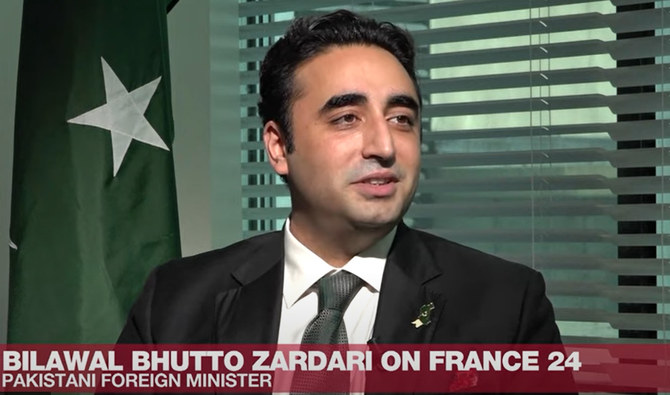
Pakistani Foreign Minister Bilawal Bhutto Zardari speaks during an interview with France 24 in New York on September 22, 2022. (Screengrab)
Short Url
Updated 23 September 2022
Follow

Engagement with India ‘untenable,’ Pakistan FM says when asked if neighbor sent flood aid

  • Muslim-majority Himalayan region has been at the heart of more than 70 years of animosity between Pakistan and India
  • Bhutto Zardari draws world’s attention to conflict in Indian-administered Kashmir, calls for “lasting” solution at OIC meeting

ISLAMABAD: Pakistani foreign minister Bilawal Bhutto Zardari said on Thursday engagement with neighbour and archrival India was “untenable” over what he called its anti-Muslim policies, especially in Indian-administered Kashmir.

The Muslim-majority Himalayan region of Kashmir has been at the heart of more than 70 years of animosity since the partition of the British colony of India into the separate countries of Muslim Pakistan and majority Hindu India. Both rule parts of the region but claim it in full.

Ties between the nuclear-armed rivals have been particularly strained since a suicide bombing of an Indian military convoy in Kashmir in 2019 that New Delhi says was carried out by Pakistan-based militants. The bombing led to India sending warplanes to Pakistan. Islamabad denies state complicity in any attacks in Indian-administered Kashmir.

In August 2019, Indian Prime Minister Narendra Modi withdrew Indian-administered Kashmir’s autonomy in order to tighten his grip over the territory, provoking outrage in Pakistan and the downgrading of diplomatic ties and suspension of bilateral trade.

“Unfortunately, the India today is a changed India … it is no longer the secular India promised by its founding fathers for all its citizens,” Bhutto Zardari said in an interview with a French TV channel when the host asked if India had sent aid to help victims of cataclysmic floods. “It is increasingly becoming a Hindu-supremacist India at the expense of its Christian and Muslim minorities.”

“We have seen certain steps and actions that had made engagement with India untenable for us, particularly the unilateral illegal actions of August 2019,” the foreign minister added. “All of this creates very little space for us to engage.”

On Wednesday, Bhutto Zardari drew the world’s attention to the ongoing conflict in Indian-administered Kashmir, calling for a “just and lasting” solution while speaking at a meeting of the OIC Contact Group on Jammu and Kashmir on the margins of the 77th United Nations General Assembly Session in New York on Wednesday.

The group reviewed the political and security environment in Kashmir Valley and what it called “the deteriorating humanitarian and human rights situation” there.

The Contact Group comprises Azerbaijan, Niger, Pakistan, Saudi Arabia and Turkey.

OIC Secretary General Hissein Brahim Taha chaired the meeting and in his opening remarks reaffirmed the OIC’s commitment to a “peaceful settlement of the Jammu and Kashmir dispute in accordance with the relevant resolutions of the United Nations and the OIC Summits and Council of Foreign Ministers.”

He also presented a report on the implementation of an action plan agreed upon during the last meeting of the Contact Group in March 2022 in Islamabad.

Speaking at the Contact Group meeting, Bhutto Zardari drew attention to “the worsening situation” in Kashmir since August 2019.

Indian security forces, he said, “continued to conduct cordon-and-search operations, put down protests violently, indiscriminately use pellet guns, imprison Kashmiri political leaders, abduct and torture children and women, and stage fake encounters.”

“The Foreign Minister stressed that durable peace and stability in South Asia would remain tense and fragile without a just and lasting solution to the Jammu and Kashmir dispute in accordance with United Nations Security Council resolutions and the wishes of the Kashmiri people,” the foreign office said in a statement.

The meeting of the Contact Group concluded with the adoption of a joint communiqué that “unequivocally reaffirmed the OIC’s position and resolutions on the Jammu and Kashmir dispute.”


Pakistan military says 12 soldiers killed in border fighting as Kabul calls for dialogue

Updated 50 min 46 sec ago
Follow

Pakistan military says 12 soldiers killed in border fighting as Kabul calls for dialogue

  • Military says 274 Afghan fighters killed, over 400 injured in ongoing operation
  • Afghan authorities earlier said 55 Pakistani soldiers killed in retaliatory strikes

ISLAMABAD: Pakistan’s military said on Friday 12 soldiers had been killed in cross-border fighting with Afghan forces, as it detailed the scale of an ongoing border operation and accused the Kabul government of coordinating with militant groups targeting Pakistan.

The announcement followed days of escalating hostilities triggered by Pakistani airstrikes earlier this week on what Islamabad said were Tehreek-e-Taliban Pakistan (TTP) and Daesh militant camps inside Afghanistan. Since then, both governments have reported retaliatory operations and issued conflicting casualty figures, marking the most serious deterioration in relations between the neighbors in recent months.

The 2,600-kilometer (1,600-mile) shared frontier between the two nations, a key trade and transit corridor, has remained closed to trade and movement since October 2025 amid recurring tensions.

Lt. Gen. Ahmed Sharif Chaudhry, director general of Inter-Services Public Relations (ISPR), told a news conference in Rawalpindi that Pakistani forces had repelled coordinated attacks at 53 locations along the border and responded under what he described as Operation Ghazab lil-Haq.

“While safeguarding Pakistan’s honor and territorial integrity, 12 brave soldiers have embraced martyrdom in the operation so far, while 27 have been injured and one soldier is missing in action,” he said.

Chaudhry said Pakistan had killed 274 Taliban fighters and injured more than 400, describing those figures as conservative estimates. He added that 73 Afghan posts had been completely destroyed along the border and 18 had been captured.

He said Afghan Taliban forces had launched physical raids “in collusion and in support of an internationally declared terrorist organization” and accused the Taliban administration of acting in coordination with militant groups.

“The Afghan Taliban regime is the master proxy of these terrorist proxies which are operating from Afghanistan,” he said.

Kabul has repeatedly said it does not allow militants to operate in its territory. 

Chaudhry said Pakistan had targeted 22 locations across the border, including in Kabul, Kandahar, Paktia, Nangarhar, Khost and Paktika.

“All targets were selected with great care based on intelligence. They were military objectives, and utmost care was taken to avoid any civilian collateral damage,” he said.

He said the Taliban authorities faced a choice.

“Either they choose terrorists and terrorism or side with Pakistan,” he said.

KABUL CALLS FOR DIALOGUE 

Separately on Friday afternoon, Afghan Taliban spokesperson Zabihullah Mujahid called for talks to resolve the crisis.

“We have always emphasized peaceful resolution, and now too we want the issue to be resolved through dialogue,” he said.

In a detailed statement earlier in the day, Afghanistan’s Ministry of National Defense said it had carried out airstrikes inside Pakistan in response to what it described as Pakistani “aerial incursions” into Kabul, Kandahar and Paktia.

Afghan officials said 55 Pakistani soldiers were killed and that several posts were captured, claims denied by Islamabad.

None of the casualty figures or battlefield claims from either side could be independently verified.

Pakistan’s Information Minister Attaullah Tarar earlier said militants had attempted to launch drones inside Pakistani territory.

“Fitna al khawarij terrorists have attempted to launch small drones in Abbotabad, Swabi and Nowshera. Anti Drone Systems have brought down all the drones. No damage to life,” Tarar said.

“The incidents have again exposed direct linkages between Afghan Taliban Regime and Terrorism in Pakistan.”

Separately, Prime Minister Shehbaz Sharif on Friday visited General Headquarters (GHQ) in Rawalpindi, where he was briefed by the military leadership on the evolving situation. 

According to a statement from the Prime Minister’s Office, Sharif said there would be “zero tolerance” toward what he described as collusion between the Afghan Taliban regime and militant elements.

“Pakistan knows very well how to defend itself against any aggression,” the statement quoted him as saying, adding that the armed forces were ready to safeguard the country.
Regional concern

Cross-border violence has intensified in recent weeks, with Pakistan blaming a surge in suicide bombings and militant attacks on insurgents it says are based in Afghanistan. Kabul denies providing safe havens and says Pakistan’s security challenges are an internal matter.

The latest clashes mark the third major escalation between the neighbors in less than a year. Similar strikes last year triggered weeklong fighting before Qatar, Türkiye and other regional actors mediated a ceasefire in October.

Several countries, including China, Russia, Saudi Arabia and Iran, have expressed concern and urged restraint.

Operations on both sides were ongoing as of Friday evening.