On sidelines of UN, a push for China’s abuses to be punished

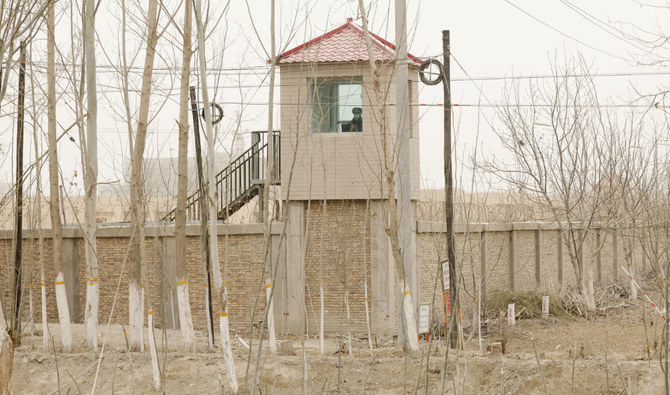
A security guard watches from a tower around a detention facility in Yarkent County in northwestern China's Xinjiang Uyghur Autonomous Region on March 21, 2021. (AP)
Short Url
Updated 20 September 2022
Follow

On sidelines of UN, a push for China’s abuses to be punished

  • the report said the evidence could constitute “crimes against humanity” but made no mention of genocide, which the United States and other countries have accused China of committing

NEW YORK: The United Nations will be judged by how it addresses China’s persecution of ethnic minorities, diplomats and human rights advocates charged Monday on the sidelines of the body’s General Assembly, calling for forceful action after a report raised the specter of “crimes against humanity.”
For years, rights watchdogs and journalists have exposed brutal treatment of Uyghurs and other mostly Muslim ethnic groups in the far western region of Xinjiang, where China is accused of a ruthless campaign of torture, sexual assault and ethnic cleansing. Those accusations have been widely accepted in the West, but were given a new imprimatur with the landmark report released last month by the UN human rights office.
“Inaction is no longer possible,” Fernand de Varennes, the United Nations’ special rapporteur on minority rights said at a forum sponsored by the Atlantic Council and Human Rights Watch as world leaders descend on New York. “If we allow this to go unpunished, what kind of message is being propagated?”
Jeffrey Prescott, a deputy US ambassador to the United Nations, suggested the integrity of the institution was at stake in its response to China.
“How these atrocities are addressed goes ultimately to the credibility of that system, to the credibility of our international system itself,” he said. “It’s deeply disheartening to see a country that has been so central to the creation of the modern UN system, and enjoys its status as a permanent member of the Security Council, so profoundly violating its commitments.”
The UN report on China’s alleged abuses was released in the final minutes of the last day in office of Michele Bachelet, now the former UN High Commissioner for Human Rights. Its release was believed to have been long delayed. Bachelet never explained the timing.
China responded to its release with fury, calling it “a patchwork of false information” and portraying it as a fabrication cooked up by Western nations. It issued a lengthy rebuttal and vowed to stop cooperating with the UN’s human rights office, and Chinese diplomats are now lobbying others to thwart the possibility of further scrutiny of its campaign in Xinjiang.
Rob Roe, Canada’s ambassador to the United Nations, called China’s reaction unsurprising and said new action was merited.
“We need to deal with this question. We need to deal with the question of what further sanctions will be required. We need to deal with the question of what further steps could be taken to respond to the extent of this crisis,” he said.
The UN’s report was drawn, in part, from interviews from more than two dozen former detainees and others familiar with conditions at eight detention centers who described being beaten, prevented from praying and forced to perform sex acts on guards. It said the evidence could constitute “crimes against humanity” but made no mention of genocide, which the United States and other countries have accused China of committing.
Prince Zeid Ra’ad Al Hussein, the immediate predecessor to Bachelet as UN High Commissioner for Human Rights, said his successor deserved credit for publishing the report, but said it was a “shortcoming” not to refer to the abuses as genocide. Likewise, he criticized it for not calling for the establishment of a formal UN commission of inquiry.
“To be silent is to be an accomplice,” he said.
Rayhan Asat, a Uyghur lawyer who works for the Atlantic Council and whose brother is imprisoned in Xinjiang, urged the world to insist that action be taken, not just against China, but companies who profit off its abuses.
“We should not let the Chinese government off the hook by normalizing what the state did,” she said, “because at the end of the day, this is state violence.”


China foreign minister blasts Middle East war, urges US to manage ties

Updated 57 min 3 sec ago
Follow

China foreign minister blasts Middle East war, urges US to manage ties

  • Wang Yi: ‘A strong fist does not mean strong reason. The world cannot return to the law of the jungle’

BEIJING: China’s top diplomat condemned on Sunday the war in the Middle East and urged the United States to iron out its differences with Beijing.
Foreign Minister Wang Yi told a press conference in the Chinese capital that the war, which was sparked by US and Israeli strikes on Iran, “should never have happened.”
“A strong fist does not mean strong reason. The world cannot return to the law of the jungle,” he told reporters.
He was speaking during China’s annual political gathering, which began this week, known as the “Two Sessions.”
The parallel meetings of China’s parliament and political consultative body are closely watched for clues as to the priorities of top leaders, in the face of a precarious geopolitical landscape
Wang addressed a range of issues, including a trade war with the United States, regional tensions in the South China Sea, as well as wars in the Middle East and Ukraine.
“This year is indeed a big year for Sino-US relations,” Wang said.
‘Manage differences’
Ties between China and the United States have been strained since US President Donald Trump returned to the White House last year, followed by a trade war that saw the two countries impose tit-for-tat tariffs on each other’s products.
“We observe certain country erecting tariff barriers and pursuing decoupling and supply chain disruption,” Wang said on Sunday.
“These actions are akin to trying to extinguish a fire with fuel. Ultimately, they will backfire and harm itself.”
While China and the United States “cannot change each other,” he said, “we can change the way we interact with each other.”
Wang urged both sides to “create a suitable environment, manage existing differences, and eliminate unnecessary interference.”
But a wide range of disagreements remain.
Beijing has blasted US and Israeli military strikes on Iran, with which it has diplomatic and trade ties.
It has in particular condemned the killing of the country’s supreme leader Ayatollah Ali Khamenei.
Wang also maintained that China’s relations with Moscow, which have been criticized by Western countries for sustaining the war in Ukraine, remained “steadfast and unshakeable.”
China ‘gym’
China has sought to profit off Trump’s volatile foreign policies, positioning itself as a reliable alternative to once traditional US allies.
Leaders from France, Canada, Finland and the United Kingdom, among others, have flocked to Beijing, recoiling from Trump’s bid to seize Greenland and tariff threats against fellow NATO members.
Wang welcomed the visits on Sunday, saying “we have noticed that more and more insightful Europeans agree that China is not a competitor, but a global partner.”
“We welcome our European friends to step out of the ‘small attic’ of protectionism and come to the ‘gym’ of the Chinese market, where they can strengthen their muscles and enhance their competitiveness,” he said.
In the spirit of warming relations, China has doled out visa-free travel agreements to around 50 countries including France, Germany, and the United Kingdom.
Beijing has also agreed to reduced tariffs with Ottawa and London in their exports to China.
Wang also addressed relations between China and Japan, which have been locked in a spat after comments by Prime Minister Sanae Takaichi in November that Tokyo could intervene militarily in any attack on self-ruled Taiwan.
Takaichi’s comments enraged Beijing, which views Taiwan as its territory and has not ruled out taking by force.
Wang emphasized on Sunday that Beijing “will never allow anyone or any force to separate Taiwan … from China once again.”
He warned Japan against “repeating the same disastrous mistakes,” adding that China “will never allow anyone to stand up for colonialism,” in an apparent reference to Tokyo’s actions during World War II.
The issue of Taiwan, he insisted, is “at the heart of China’s core interests” and “a red line that must not be crossed or trampled on.”