

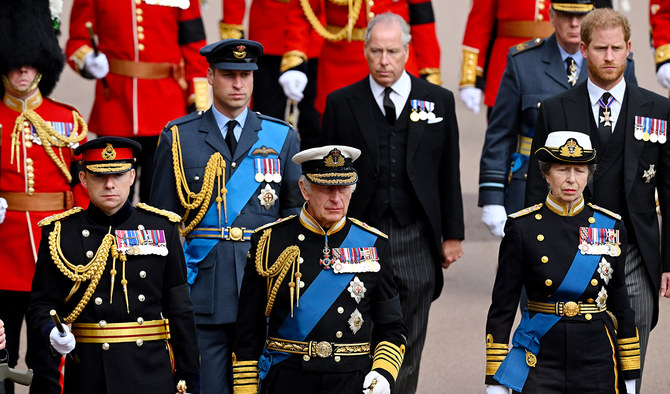

LONDON: Queen Elizabeth's closest relatives were ashen-faced throughout Monday's solemn funeral rituals in London and Windsor, silently playing their parts in meticulously choreographed processions that nevertheless betrayed the high emotions of the day.
Elizabeth's son King Charles and his three younger siblings, Anne, Andrew and Edward, followed the gun carriage pulled by 142 Royal Navy sailors that bore the queen's coffin to Westminster Abbey for her state funeral service.
Behind them came Charles's sons, Princes William and Harry, their grave faces showing the emotional impact of the moment as they marched to the sound of bagpipes and the tolling of a bell.
Charles, Anne, Edward and William, all dressed in ceremonial military uniform, saluted as the coffin was lifted off the gun carriage in front of the abbey.
Andrew and Harry, who are no longer working royals, were in morning suits and did not salute, even though both had served in conflict in the past, in the Falklands and in Afghanistan.
After 11 days of momentous change and activity since his mother died, Charles looked distraught and exhausted as eight pall bearers carried the coffin through the abbey's Great West Door for the service.
Waiting just inside were his wife Camilla, the Queen Consort, as well as William's wife Kate and their children George, 9, and Charlotte, 7, and Harry's wife Meghan.
The royals followed the coffin up the aisle, with close-up television shots showing the sorrow on their faces.
William and Kate had their children between them as they walked, touching their shoulders at various points. Later during the service, Charlotte could be seen swinging her legs as her feet could not reach the floor from her chair.
Edward, the youngest of the queen's four children, wiped away a tear with a handkerchief at the start of the service, during which the Archbishop of Canterbury spoke of the outpouring of love seen since her death on Sept. 8.
After the service, the royals once again followed the coffin as it was carried out of the abbey and placed back on to the gun carriage. Standing on the front steps of the abbey, Charles, the emotion showing once more on his face, fixed his gaze on his mother's coffin.
The royals then joined another solemn procession through the grand avenues of central London. Charles, his siblings and his sons marched behind the gun carriage, while Camilla, Kate, George and Charlotte followed in a car.
The presence of William and Harry, walking side-by-side behind their grandmother's coffin, was reminiscent of the day 25 years ago when, as boys, they took part in a similar procession to the funeral of their mother Diana, Princess of Wales.
The brothers' relationship has been strained since Harry and Meghan stepped away from royal duties and moved to the United States in 2020, but in the aftermath of the queen's death they have appeared united in grief.
At Hyde Park Corner, the coffin was placed in a hearse to be driven to Windsor Castle, the queen's final resting place. As the royals, lined up to the side of the hearse, watched the pall bearers transfer the coffin, Charlotte was photographed crying and rubbing her eyes.
After the coffin arrived in Windsor and was slowly driven into the perimeter of the castle, the close relatives marched behind it one last time as it was carried to St George's Chapel for a final service in public. Later, a private family burial service was due to be held with no cameras present.
After the coffin was slowly lowered into the royal vault at the end of the Windsor service, Charles held back tears as the congregation sang the national anthem in its updated form, "God Save the King".


