

Ashen-faced royals' grief for queen shows through ceremonial pageantry at funeral

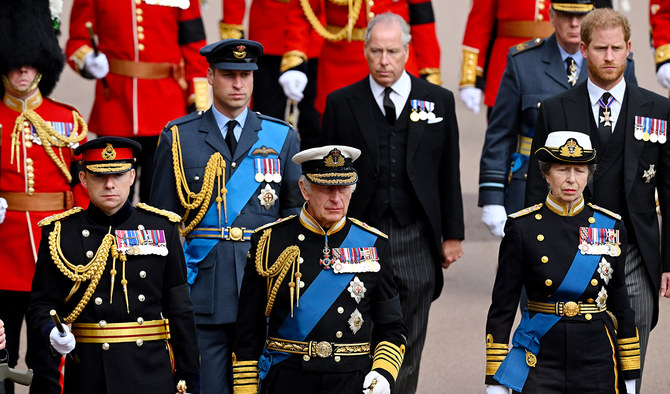
King Charles III (front center) along with members of the British royal family walk behind the State Hearse ahead of the Committal Service for Queen Elizabeth II at Windsor Castle on September 19, 2022 in Windsor, England. (AFP)
Short Url
Updated 19 September 2022
Follow

Ashen-faced royals' grief for queen shows through ceremonial pageantry at funeral

  • King Charles and his three younger siblings, Anne, Andrew and Edward, followed the gun carriage pulled by 142 Royal Navy sailors
  • Behind them came Charles's sons, Princes William and Harry, their grave faces showing emotional impact of the moment

LONDON: Queen Elizabeth's closest relatives were ashen-faced throughout Monday's solemn funeral rituals in London and Windsor, silently playing their parts in meticulously choreographed processions that nevertheless betrayed the high emotions of the day.

Elizabeth's son King Charles and his three younger siblings, Anne, Andrew and Edward, followed the gun carriage pulled by 142 Royal Navy sailors that bore the queen's coffin to Westminster Abbey for her state funeral service.

Behind them came Charles's sons, Princes William and Harry, their grave faces showing the emotional impact of the moment as they marched to the sound of bagpipes and the tolling of a bell.

Charles, Anne, Edward and William, all dressed in ceremonial military uniform, saluted as the coffin was lifted off the gun carriage in front of the abbey.

Andrew and Harry, who are no longer working royals, were in morning suits and did not salute, even though both had served in conflict in the past, in the Falklands and in Afghanistan.

After 11 days of momentous change and activity since his mother died, Charles looked distraught and exhausted as eight pall bearers carried the coffin through the abbey's Great West Door for the service.

Waiting just inside were his wife Camilla, the Queen Consort, as well as William's wife Kate and their children George, 9, and Charlotte, 7, and Harry's wife Meghan.

The royals followed the coffin up the aisle, with close-up television shots showing the sorrow on their faces.

William and Kate had their children between them as they walked, touching their shoulders at various points. Later during the service, Charlotte could be seen swinging her legs as her feet could not reach the floor from her chair.

Edward, the youngest of the queen's four children, wiped away a tear with a handkerchief at the start of the service, during which the Archbishop of Canterbury spoke of the outpouring of love seen since her death on Sept. 8.

After the service, the royals once again followed the coffin as it was carried out of the abbey and placed back on to the gun carriage. Standing on the front steps of the abbey, Charles, the emotion showing once more on his face, fixed his gaze on his mother's coffin.

The royals then joined another solemn procession through the grand avenues of central London. Charles, his siblings and his sons marched behind the gun carriage, while Camilla, Kate, George and Charlotte followed in a car.

The presence of William and Harry, walking side-by-side behind their grandmother's coffin, was reminiscent of the day 25 years ago when, as boys, they took part in a similar procession to the funeral of their mother Diana, Princess of Wales.

The brothers' relationship has been strained since Harry and Meghan stepped away from royal duties and moved to the United States in 2020, but in the aftermath of the queen's death they have appeared united in grief.

At Hyde Park Corner, the coffin was placed in a hearse to be driven to Windsor Castle, the queen's final resting place. As the royals, lined up to the side of the hearse, watched the pall bearers transfer the coffin, Charlotte was photographed crying and rubbing her eyes.

After the coffin arrived in Windsor and was slowly driven into the perimeter of the castle, the close relatives marched behind it one last time as it was carried to St George's Chapel for a final service in public. Later, a private family burial service was due to be held with no cameras present.

After the coffin was slowly lowered into the royal vault at the end of the Windsor service, Charles held back tears as the congregation sang the national anthem in its updated form, "God Save the King".


In Philippine presidential palace, staffers share generations of haunted stories

Updated 4 sec ago
Follow

In Philippine presidential palace, staffers share generations of haunted stories

  • Built in 1750, Malacanang has been serving as seat of power since Spanish colonial times
  • Ghost tales are so ingrained in the palace that staffers find it difficult to avoid their impact

MANILA: In Malacanang, the presidential palace of the Philippines, residents come and go usually every five years, but some are believed to have lingered for centuries, haunting its historical corridors with their mysterious presence.

Built in 1750 as a summer house for a Spanish aristocrat, the palace was acquired by the Spanish government in 1825 and served as the residence of the colonial governor-general — first of Spain and from 1898, the US. When the Philippines gained full independence in 1946, it remained its seat of power.

The building’s halls and walls have seen centuries of history and remain witnesses not only to politics but also to episodes that those who have worked there say they had to accustom themselves to: from phantom footsteps to a headless figure wearing the barong — the traditional Filipino shirt — complaining voices, or a waiter reporting for work long after his death.

Ignacio Bunye, press secretary during the administration of former President Gloria Macapagal-Arroyo, told Arab News that some officials, including Eduardo Ermita — executive secretary of the Philippines from 2004 to 2010 — took it seriously.

“In Secretary Ermita’s office, you’ll see so many medallions and little images of the Virgin Mary pasted on the windows. He even had his office blessed every now and then. Word is there’s a lot of strange apparitions in his office,” Bunye said.

“There are also stories about the sound of chains — clinking or being dragged. They hear those in other offices.”

Ghost tales are so ingrained in the palace environment that it is difficult to avoid their impact.

One evening, when Bunye stopped by his office after a palace dinner, he heard footsteps outside and then someone tried to turn his room’s doorknob.

“Fortunately, the door had automatically locked when I came in. I felt my hair stand on end. After a while, the footsteps moved away,” he said.

Once everything was quiet, he hurried out of the room and in the hallway saw a white-haired man in a suit, who slowly turned toward him and in a raspy voice, asked: “How do I get out of here?”

The person turned out to be his colleague.

“I sighed in relief. It was Justice Secretary Raul Gonzales,” Bunye said. “He had only been appointed to the Cabinet a week earlier and still didn’t know his way around the palace.”

But others who recall scary sightings have found no rational explanation. A documentary film released by Malacanang for last year’s Halloween had some of them share their stories.

Sgt. Ramson Gordo, a member of the Presidential Security Group, was on night duty when he noticed something odd in the main lobby. He saw three guards wearing the barong, while he knew there could be only two. When he approached the lobby and asked about the third man, he was told there were only two of them.

“There’s also a story of someone who took a photo of the palace’s main lobby. That was also nighttime and there was no one in there,” Gordo said. “When he looked at the picture, there was a person wearing a barong, but with no head.”

Riza Mulet, who usually arrives at work at 6:30 a.m., recounts seeing a man greeting her in the morning.

“He wasn’t familiar to me, but he said, ‘Good morning,’ so I greeted him back … I turned to look at him, but suddenly, he was gone,” she said.

When she told her colleagues that a tall man with a smiling face who looked like a waiter had greeted her and she asked if they knew him, they went silent and told her he had died during the COVID-19 pandemic.

Her second sighting was during a tour of the palace. She saw a man standing beside two antique chairs that had been used by former presidents.

“We were joking, teasing, saying ‘We will sit on them’. Then he got angry, really angry … I made the mistake of looking him in the eyes, so I just bowed my head because he came closer to me. My hands turned cold, and my hair stood on end,” Mulet said.

Her colleagues pulled her away from the place — not all of them aware of what had happened.

“You have to learn to coexist with those who can’t be seen by most people. I can see them, but not everyone can,” she said.

“You have to learn to live with them.”