

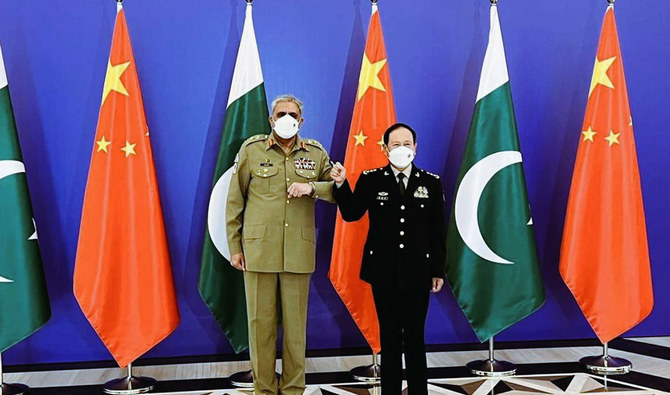
Pakistan army chief discusses CPEC security during Beijing visit – ISPR

Pakistan's Army Chief General Qamar Javed Bajwa calls on Chinese Defence Minister, General Wei Fenghe, during his two-day visit to China on September 19, 2022. (ISPR)
Short Url
Updated 19 September 2022
Follow

Pakistan army chief discusses CPEC security during Beijing visit – ISPR

  • Chinese nationals working on energy and infrastructure projects in Pakistan have been targeted by militants in the past
  • The Chinese minister expressed grief over flood devastation in Pakistan, offered technical support for flood relief activities

ISLAMABAD: China’s defense minister has expressed his gratitude during a meeting with Pakistan’s army chief General Qamar Javed Bajwa for taking necessary steps to provide a safe environment for energy and infrastructure projects jointly carried out by the two countries, said the military’s media wing, ISPR, on Monday.

The China-Pakistan Economic Corridor (CPEC) was launched in 2013 to strengthen the economy of the South Asian country and increase regional connectivity to ensure greater prosperity.

Originally valued at $47 billion, CPEC is now worth over $60 billion and includes construction projects focusing on ports, roads, bridges, special economic zones and hydroelectricity dams.

Thousands of Chinese nationals have also been working on these projects in Pakistan, though many of them were targeted by militant factions in different parts of the country which made the authorities in Beijing take up the issue with Pakistani officials.

China’s defense minister General Wei Fenghe met the army chief who is on a two-day visit to Beijing, saying his country valued its relations with Pakistan and its army and looked forward to expanding this cooperation.

According to the ISPR, the defense minister said the development of CPEC “aimed at bringing more benefits & prosperity to the people of both countries” while calling the “Pak-China military cooperation as an important pillar of bilateral relations.”

“The Defense Minister thanked [the chief of army staff] for special measures taken for provision of safe and secure environment to CPEC projects in Pakistan and efforts toward regional stability,” the statement added. “He expressed satisfaction over progress on CPEC and hoped for timely completion of the project.”

Earlier this year, a group of Chinese academics were killed in a suicide blast that took place at the entrance of Confucius Institute at the University of Karachi.

The incident led to the suspension of academic activities and all Chinese teachers decided to return to their country.

Speaking to the army chief, the Chinese defense minister also conveyed his grief over the devastation caused by recent floods in Pakistan due to climate change and offered condolences to the families of victims.

He said China was willing to provide technical assistance for flood relief efforts in Pakistan while praising the army’s rescue and relief efforts in flood-affected areas.

The army chief thanked the defense minister for his sentiments and continued Chinese support to his country.



Pakistan, seven Muslim nations back Palestinian technocratic body, stress Gaza-West Bank unity

Updated 15 January 2026
Follow

Pakistan, seven Muslim nations back Palestinian technocratic body, stress Gaza-West Bank unity

  • The National Committee for the Administration of the Gaza Strip was announced on January 14
  • Muslim nations call for consolidation of the ceasefire and unimpeded humanitarian aid into Gaza

ISLAMABAD: Pakistan and seven other Muslim-majority countries on Thursday welcomed the formation of a temporary Palestinian technocratic body to administer Gaza, stressing that it must manage daily civilian affairs while preserving the institutional and territorial link between the Gaza Strip and the West Bank amid the ongoing peace efforts.

In a joint statement, the foreign ministers of Pakistan, Egypt, Jordan, Saudi Arabia, Qatar, Türkiye, Indonesia and the United Arab Emirates said the newly announced National Committee for the Administration of the Gaza Strip would play a central role during the second phase of a broader peace plan aimed at ending the war and paving the way for Palestinian self-governance.

“The Ministers emphasize the importance of the National Committee commencing its duties in managing the day-to-day affairs of the people of Gaza, while preserving the institutional and territorial link between the West Bank and the Gaza Strip, ensuring the unity of Gaza, and rejecting any attempts to divide it,” the statement said.

The committee, announced on Jan. 14, is a temporary transitional body established under United Nations Security Council Resolution 2803 and is to operate in coordination with the Palestinian Authority, the ministers said.

The statement said the move forms part of the second phase of US President Donald Trump’s Comprehensive Peace Plan for Gaza, which the ministers said they supported, praising Trump’s efforts to end the war, ensure the withdrawal of Israeli forces and prevent the annexation of the occupied West Bank.

The top leaders of all eight Muslim countries attended a meeting with Trump in New York last September, shortly before he unveiled the Gaza peace plan.

The ministers also called for the consolidation of the ceasefire, unimpeded humanitarian aid into Gaza, early recovery and reconstruction and the eventual return of the Palestinian Authority to administer the territory, leading to a just and sustainable peace based on UN resolutions and a two-state solution on pre-1967 lines with East Jerusalem as the Palestinian capital.