

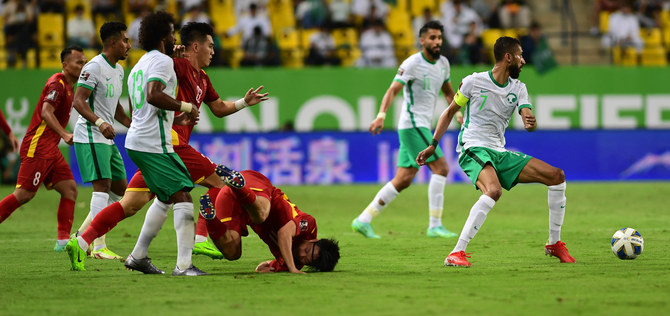

RIYADH: The World Cup moves a step closer next week with all four Arab participants taking part in friendly matches. Arab News has five talking points ahead of the crucial international break.
1. Saudi Arabia looking for result against Ecuador
The Green Falcons are heading to Spain for a training camp and games against fellow World Cup entrants Ecuador and the US.
At this stage of preparation, performances are more important than results but disappointing defeats against Colombia and Venezuela in June, two South American teams that will not even be in Qatar, showed that there is still much work to do.
Ecuador will be there and are once again concerned that they could be kicked out of the tournament after being accused of fielding an ineligible player in qualification. It is up to Herve Renard and the players to take advantage of any distraction.
It is important for confidence and self-belief to get a result. A win would obviously be ideal as it is important for Saudi Arabia to know they can defeat a team from South America – after all, the opening game in November is against Argentina – but not falling to a third straight defeat would be a step in the right direction.
After that is a test against the US who released a roster full of players in action at high levels in Europe, a sobering reminder of the quality that even a team that is not expected to go far at the World Cup possess – but all the focus needs to be on getting a result against Ecuador.
2. Tunisia need to build on encouraging results
Tunisia are heading to France for a training camp and it is a feather in their cap to be facing Brazil so close to the World Cup. It is also important given that the Carthage Eagles are going to be taking on defending champions France as well as Denmark and Australia in Qatar. It is a tough group and needs the best preparation.
Yet the North Africans will do well not to focus too much on the five-time world champions. First comes a crucial friendly against Comoros, an opponent that should not be underestimated as they reached the knockout stages of the Africa Cup of Nations earlier this year.
Tunisia are now flying, however, after scraping through their World Cup qualifying play-off. In June there was a 2-0 win over Chile and an excellent 3-0 victory over Japan in Japan, one that deserved more praise than it received as it really showed what the team is capable of.
All knew that the defense was solid, but they have been more ruthless in attack. A good win over Comoros would keep confidence high ahead of the big game with Brazil that should give an excellent indication of where the team is at.
3. Ziyech returns in new Moroccan era
As they prepare for a Spanish training camp and games against Chile and Paraguay, this is a crucial time for Morocco.
Much has happened since the Atlas Lions defeated Liberia 2-0 in June. It was not a big surprise that coach Vahid Halilhodzic was fired last month after falling out with players — especially star man Hakim Ziyech — and losing the support of fans.
Now it is all change. Local boss Walid Regragui has taken over and the nation is behind the man who led Wydad to the African Champions League title this May.
Now Ziyech is back in the team for the first time since June 2021 and it is a big chance for the player to take his national team to the next level. All eyes will be on the Chelsea star to show what he can do. It is also important for his club situation too. The winger has not had a great time in London, and it could be that he will be on the move in January.
Before then, however, he has a chance to play and also perhaps show new Chelsea boss Graham Potter what he can do.
4. Time for Qatar to get their stars shining
The World Cup hosts were in Austria just last month for games against Morocco, Ghana, and Jamaica. Now they return for three more: Bolivia, Canada, and Chile. The Maroons have played 13 friendlies this year so far, some against clubs and some against national teams. After 12 years of preparation, there are only a few weeks left.
There are no real surprises in the squad as coach Felix Sanchez has been in the job for five years and was with the youth teams before that. The Spanish boss knows all there is to know about his players.
Now it is about trying to ensure that the front two are firing. Almoez Ali and Akram Afif are two of the best players in Asia and were hugely important in the 2019 AFC Asian Cup triumph. Much depends on the duo staying fit and being at their best as there are no real replacements. When things are going well, they have an instinctive partnership and if the remaining games can ensure that feeling is present then it will be a case of job done.
5. Big chance for Haroune Camara to stake Saudi Arabia claim
It is no secret that Saudi Arabia are short of options in attack heading into the World Cup. With Saleh Al-Shehri still injured, there are going to be chances for others.
So up steps Haroune Camara who has not played for the national team since 2019. That the Al-Ittihad forward has talent is undeniable, but he has lacked consistency and end product too often.
Last season was a reasonable one with five goals scored in only six starts. This time around, there is a lot of attacking talent at the club and he has only played 34 minutes, though scored a fine goal at Al-Adalah.
Now, more mature at 24, he has a chance to go to the World Cup and must know that he has to show Renard what he can do, not only in games against Ecuador and the US, but also in the training camp.


