

Saudi banks’ real estate lending hobbles after 2018 ascent: SAMA

Short Url
Updated 18 September 2022
Follow

Saudi banks’ real estate lending hobbles after 2018 ascent: SAMA

  • The slowdown is because of decline in growth in retail sector, Saudi Central Bank says

RIYADH: After leading an ascent that began in 2018, Saudi banks’ real estate lending has slowed down over the past year caused by a decline in growth in the retail sector, according to the Saudi Central Bank, also known as SAMA.

In the second quarter of 2021, the real estate lending growth rate halved to 5.4 percent from 10.8 percent in the first quarter of 2021.

Although real estate loans by banks increased by SR28.2 billion ($7.5 billion) between January and March 2021 to SR502.7 billion between April and June 2021, their growth rate decelerated compared to the past six quarters.
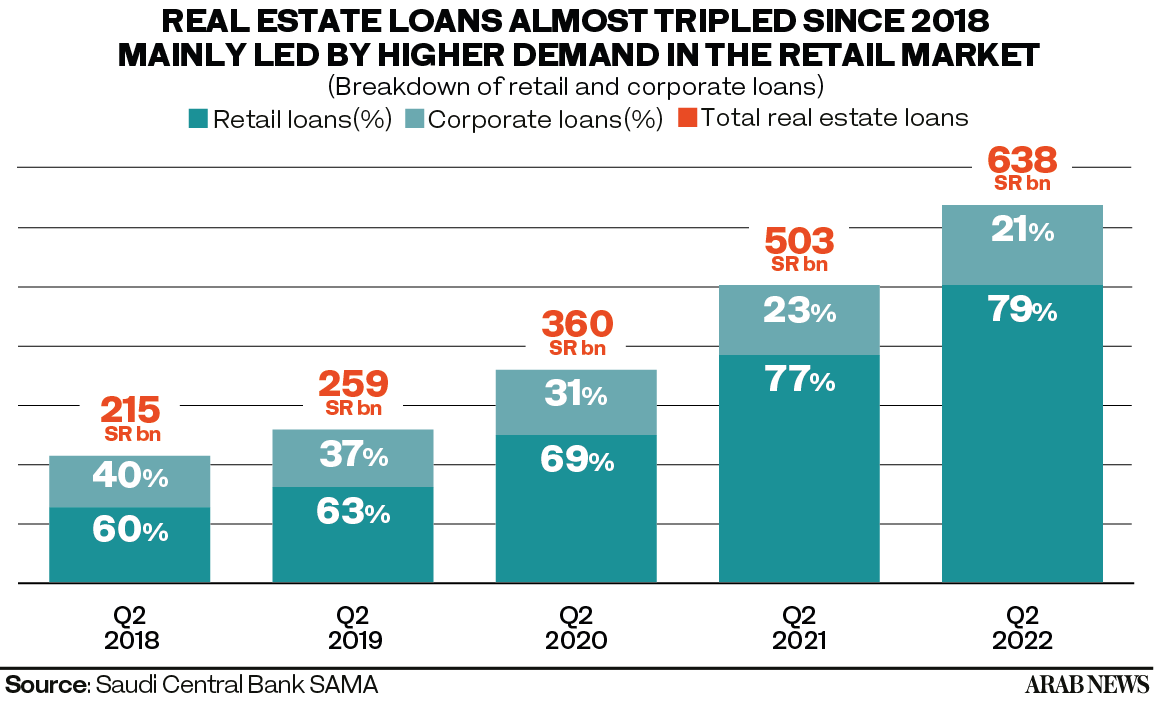
Moreover, this decrease in the growth trend has continued throughout the second quarter, where the total value of real estate loans stood at SR638.7 billion.

This dip came after a reduction in real estate bank loans to individuals who suffered the same fate since the quarter ending June 2021.

As a result, the bank loan growth rate stumbled from 13.6 percent to 5.7 percent in this quarter.

However, this was not the case during the coronavirus pandemic.

Saudi banks’ real estate lending surged 133 percent from SR215.6 billion in the second quarter of 2018 to SR502 billion in the second quarter of 2021, according to the data compiled by Arab News. The period was considered the peak of coronavirus restrictions.

The retail sector has driven this staggering increase, knowing that individual loans grew 180 percent, from SR128.3 billion to SR358.0 billion over this period.

As a result, the share of retail loans in Saudi banks’ total real estate lending portfolio went up to 79 percent at the end of the second quarter of 2022.

On the other hand, corporate loans kept decreasing their share of real estate bank loans.

Until 2019, corporate loans comprised approximately 40 percent of total credit banks’ loans. However, this number kept diminishing until it reached a mere 25 percent in the past year.

So, what could have been a possible cause for this change in trend? During the coronavirus outbreak, the Saudi government took it upon itself to aid citizens in their search for an affordable mortgage plan.

The government achieved it by removing the 15 percent value added tax from property deals and instead levied a lower 5 percent real estate transaction tax.

In fact, first-time Saudi homebuyers were exempted for transactions of up to SR1 million, according to a 2021 report by Bloominvest titled “Saudi Arabia Residential Market and its impact on the banking sector.”

The banks later increased their mortgage loans to align with the government’s plans to boost home ownership. This trend was evident through new residential mortgage finance for individuals provided by banks’ impeccable growth, hitting its all-time high record of 245 percent year on year in the third quarter of 2019 at SR19.5 billion in comparison to SR5.7 billion in the third quarter of 2018.

According to the SAMA data, this led to a 91 percent rise in the total value of new mortgage loans by banks to individuals.

However — like real estate loans — new mortgage finance loans to individuals plummeted over the past year. The number of new mortgage finance contracts declined 35 percent from 65,667 in the first quarter of 2021 to 42,693 in the second quarter of 2021. The value of new mortgage finance loans decreased 33 percent, from SR49.0 billion to SR32.8 billion during the same period. It fell further to SR31.2 billion in the second quarter of 2022.

Both contract and value mortgage loans performed slightly better in their year-on-year performances in the second quarter of 2022, which could have signified a possible recovery; however, this was countered by another drastic decrease in quarterly values of mortgage loans and contracts.

Therefore, it seems like the future of real estate loans to individuals will continue on a downward spiral.


Arab food and beverage sector draws $22bn in foreign investment over 2 decades: Dhaman 

Updated 28 December 2025
Follow

Arab food and beverage sector draws $22bn in foreign investment over 2 decades: Dhaman 

JEDDAH: Foreign investors committed about $22 billion to the Arab region’s food and beverage sector over the past two decades, backing 516 projects that generated roughly 93,000 jobs, according to a new sectoral report. 

In its third food and beverage industry study for 2025, the Arab Investment and Export Credit Guarantee Corp., known as Dhaman, said the bulk of investment flowed to a handful of markets. Egypt, Saudi Arabia, the UAE, Morocco and Qatar attracted 421 projects — about 82 percent of the total — with capital expenditure exceeding $17 billion, or nearly four-fifths of overall investment. 

Projects in those five countries accounted for around 71,000 jobs, representing 76 percent of total employment created by foreign direct investment in the sector over the 2003–2024 period, the report said, according to figures carried by the Kuwait News Agency. 

“The US has been the region's top food and beverage investor over the past 22 years with 74 projects or 14 projects of the total, and Capex of approximately $4 billion or 18 percent of the total, creating more than 14,000 jobs,” KUNA reported. 

Investment was also concentrated among a small group of multinational players. The sector’s top 10 foreign investors accounted for roughly 15 percent of projects, 32 percent of capital expenditure and 29 percent of newly created jobs.  

Swiss food group Nestlé led in project count with 14 initiatives, while Ukrainian agribusiness firm NIBULON topped capital spending and job creation, investing $2 billion and generating around 6,000 jobs. 

At the inter-Arab investment level, the report noted that 12 Arab countries invested in 108 projects, accounting for about 21 percent of total FDI projects in the sector over the past 22 years. These initiatives, carried out by 65 companies, involved $6.5 billion in capital expenditure, representing 30 percent of total FDI, and generated nearly 28,000 jobs. 

The UAE led inter-Arab investments, accounting for 45 percent of total projects and 58 percent of total capital expenditure, the report added, according to KUNA. 

The report also noted that the UAE, Saudi Arabia, Egypt, and Qatar topped the Arab ranking as the most attractive countries for investment in the sector in 2024, followed by Oman, Bahrain, Algeria, Morocco, and Kuwait. 

Looking ahead, Dhaman expects consumer demand to continue rising. Food and non-alcoholic beverage sales across 16 Arab countries are projected to increase 8.6 percent to more than $430 billion by the end of 2025, equivalent to 4.2 percent of global sales, before exceeding $560 billion by 2029. 

Sales are expected to remain highly concentrated geographically, with Egypt, Saudi Arabia, Algeria, the UAE and Iraq accounting for about 77 percent of the regional total. By product category, meat and poultry are forecast to lead with sales of about $106 billion, followed by cereals, pasta and baked goods at roughly $63 billion. 

Average annual per capita spending on food and non-alcoholic beverages in the region is projected to rise 7.2 percent to more than $1,845 by the end of 2025, approaching the global average, and to reach about $2,255 by 2029. Household spending on these products is expected to represent 25.8 percent of total expenditure in 13 Arab countries, above the global average of 24.2 percent. 

Arab external trade in food and beverages grew more than 15 percent in 2024 to $195 billion, with exports rising 18 percent to $56 billion and imports increasing 14 percent to $139 billion. Brazil was the largest foreign supplier to the region, exporting $16.5 billion worth of products, while Saudi Arabia ranked as the top Arab exporter at $6.6 billion.