

Tunisian president makes new changes to electoral law

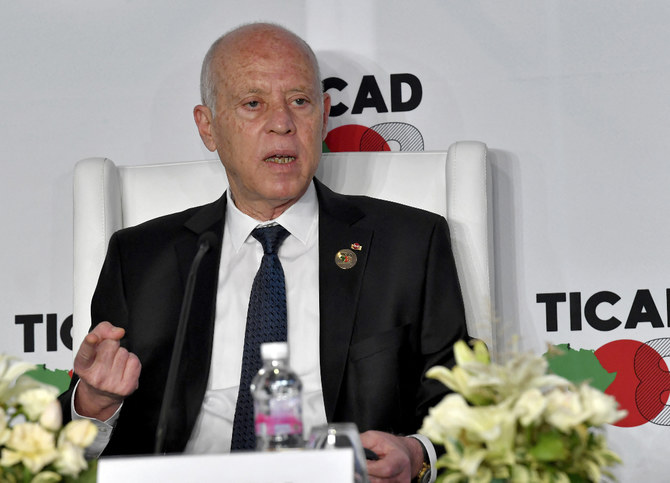
Tunisian President Kais Saied issued new electoral law to reduce the number of members of the lower house of parliament from 217 to 161. (File/AFP)
Short Url
Updated 17 September 2022
Follow

Tunisian president makes new changes to electoral law

  • Government hopes to reach deal with IMF by end of October, spokesperson says

TUNIS: Tunisian President Kais Saied has made new changes to electoral law that diminish the role of political parties, three months ahead of legislative elections.

A new electoral law reduces the number of members of the lower house of parliament from 217 to 161, and says candidates will now be elected directly instead of via party lists. Voters will elect a new legislature Dec. 17.
“In the past, the parliament deputy drew his legitimacy from his party. Today, he must assume his responsibilities, above all, before his constituents,” Saied said at a Cabinet meeting.
According to the new rules, parliament members “who do not fulfill their roles” can be removed if 10 percent of constituents who voted for them lodge a formal request with parliament.

In the past, the parliament deputy drew his legitimacy from his party. Today, he must assume his responsibilities, above all, before his constituents.

Kais Saied, Tunisian president

Several opposition parties, including the Ennahdha movement, have said they will boycott the December elections and say the new electoral law is aimed at muffling them.
Saied froze parliament in 2021 after years of political deadlock and economic crisis, and then dissolved it in March. A constitution approved in a July referendum hands broad executive powers to the president and weakens the influence of Tunisia’s parliament and judiciary.
While opposition members and Western critics warned the moves threaten hard-won democratic gains, many Tunisians welcomed Saied’s actions after years of exasperation with the country’s political elites.
The president insisted at a Cabinet meeting Thursday that he had no intention of excluding any party from the parliamentary elections.
He argued that the new law was based on a study of systems in other countries, and “will allow the people to freely express their will and to vote for the person of their choice.”
His critics accuse him of authoritarian drift and endangering the democratic process initiated in Tunisia in 2011.
Tunisia is struggling to revive its public finances as discontent grows over inflation running at nearly 9 percent  and a shortage of many food items in stores because the country can’t afford to pay for some imports.
The International Monetary Fund and major foreign donors want Tunisia to push ahead with cuts in subsidies and the restructuring of state-owned companies as well as steps to bring the public sector wage bill under control.
The government’s spokesperson said on Friday that Tunisia hopes to reach an agreement with the IMF by the end of October after a wage deal agreed on  with unions was seen as a key step toward getting IMF support.
The government and the powerful UGTT union on Thursday signed a deal to boost public sector wages by 5 percent, a step that may ease social tensions. But they did not announce any further agreement on reforms needed for an IMF bailout.
“The Tunisian negotiating team was in contact yesterday with (the) IMF regarding the last terms of the agreement with the Fund,” said Nasreddine Nsibi, the government spokesperson.
“We seek to reach a deal with the IMF before the end of October, which would make Tunisia able to fulfill all its commitments, including providing foods and energy products, paying wages and debt service,” he added.
Fitch Ratings said on Friday that Tunisia’s wage agreement raises the likelihood of an IMF deal.
Tunisian officials have said that Tunis aims for a $3 billion loan.
The IMF has signaled it will not move forward with a bailout sought by Tunis unless the government brings on board the UGTT, which says it has more than a million members and has previously shut down the economy in strikes.


US and Iran slide towards conflict as military buildup eclipses nuclear talks

Updated 28 min 13 sec ago
Follow

US and Iran slide towards conflict as military buildup eclipses nuclear talks

  • Washington building up one of its biggest military deployments in the region since the invasion of Iraq in 2003
  • Iran is expected to submit a written proposal in the coming days, a US official says

Iran and the United States are sliding rapidly towards military conflict as hopes fade for a diplomatic solution to their standoff over Tehran’s nuclear program, officials on both sides and diplomats across the Gulf and Europe say.

Iran’s Gulf neighbors and its enemy Israel now consider a conflict to be more likely than a settlement, these sources say, with Washington building up one of its biggest military deployments in the region since the invasion of Iraq in 2003.

Israel’s government believes Tehran and Washington are at an impasse and is making preparations for possible joint military action with the United States, though no decision has been made yet on whether to carry out such an operation, said a source familiar with the planning.

It would be the second time the US and Israel have attacked Iran in less than a year, following US and Israeli airstrikes against military and nuclear facilities last June.

Regional officials say oil-producing Gulf countries are preparing for a possible military confrontation that they fear could spin out of control and destabilize the Middle East.

Two Israeli officials told Reuters they believe the gaps between Washington and Tehran are unbridgeable and that the chances of a near‑term military escalation are high.

Some regional officials say Tehran is dangerously miscalculating by holding out for concessions, with US President Donald Trump boxed in by his own military buildup - unable to scale it back without losing face if there is no firm commitment from Iran to abandon its nuclear weapons ambitions.

“Both sides are sticking to their guns,” said Alan Eyre, a former US diplomat and Iran specialist, adding that nothing meaningful can emerge “unless the US and Iran walk back from their red lines - which I don’t think they will.”

“What Trump can’t do is assemble all this military, and then come back with a ‘so‑so’ deal and pull out the military. I think he thinks he’ll lose face,” he said. “If he attacks, it’s going to get ugly quickly.”

Two rounds of Iran-US talks have stalled on core issues, from uranium enrichment to missiles and sanctions relief.

When Omani mediators delivered an envelope from the US side containing missile‑related proposals, Iranian Foreign Minister Abbas Araghchi refused even to open it and returned it, a source familiar with the talks said.

After talks in Geneva on Tuesday, Araghchi said the sides had agreed on “guiding principles,” but the White House said there was still distance between them.

Iran is expected to submit a written proposal in the coming days, a US official said, and Araghchi said on Friday he expected to have a draft counterproposal ready within days.

But Trump, who has sent aircraft carriers, warships and jets to the Middle East, warned Iran on Thursday it must make a deal over its nuclear program or “really bad things” will happen.

He appeared to set a deadline of 10 to 15 days, drawing a threat from Tehran to retaliate against US bases in the region if attacked. The rising tensions have pushed up oil prices.

US officials say Trump has yet to make up his mind about using military force although he acknowledged on Friday that he could order a limited strike to try to force Iran into a deal.

“I guess I can say I am considering that,” he told reporters.

The possible timing of an attack is unclear. US Secretary of State Marco Rubio is due to meet Israeli Prime Minister Benjamin Netanyahu on February 28 to discuss Iran. A senior US official said it would be mid-March before all US forces were in place.