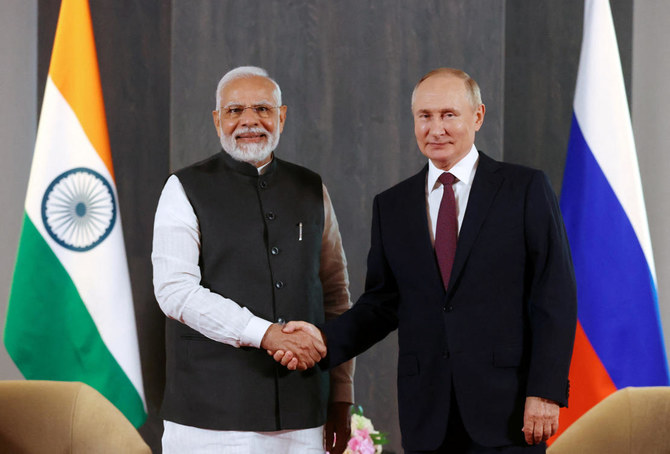
SAMARKAND, Uzbekistan: Indian Prime Minister Narendra Modi told Russian President Vladimir Putin that now was “not a time for war” on Friday on the sidelines of a regional summit.
New Delhi and Moscow have longstanding ties dating back to the Cold War, and Russia remains by far India’s biggest arms supplier.
But in their first face-to-face meeting since Moscow’s forces invaded Ukraine in February, Modi told Putin: “Excellency, I know today’s time is not a time for war.”
India has shied away from explicitly condemning Russia for the invasion, which sent the price of oil and other commodities soaring.
But he stressed the importance of “democracy and diplomacy and dialogue” in the meeting on the sidelines of the Shanghai Cooperation Organization (SCO) summit in the Uzbek city of Samarkand, footage showed on Indian public service broadcaster Doordashan.
They would discuss “how to move forward on the path of peace,” Modi added.
The SCO summit comes as Russian forces face major battlefield setbacks in Ukraine, and represented an opportunity for Putin to show his country had not been fully isolated despite Western efforts.
“I know your position on the conflict in Ukraine, your concerns... We will do our best to end this as soon as possible,” Putin told Modi.
But he added that Ukraine’s leadership had rejected negotiations “and stated that it wants to achieve its goals by military means, on the battlefield.”
On Thursday, Putin met with his Chinese counterpart Xi Jinping and acknowledged that his key ally Beijing also had “concerns” over the conflict.
New Delhi has long walked a tightrope in its relations with the West and Moscow — and the Russian invasion of Ukraine has highlighted the difficulty of that balancing act.
It has urged a cessation of hostilities but repeatedly brushed off calls from Washington to condemn Russia, despite India pursuing greater security ties with the United States.
Unusually, India is a member of both the SCO and the so-called Quad, a strategic bloc grouping it, the United States, Japan and Australia, and aimed at providing a more substantive counterweight to China’s rising military and economic power.
Former Indian ambassador to Russia Pankaj Saran described Modi’s comments as “quite frank” in saying that the Ukraine crisis “had caught the attention of the whole world and created problems for the developing world.”
“This was a fairly strong message to Russia,” he told Doordashan. “As a friend, his recommendation and India’s position is that this needs to be resolved only through dialogue and diplomacy.”
Putin visited New Delhi late last year, bear-hugging Modi and hailing India as a “great power” as the two men bolstered military and energy ties.
India is the world’s second largest importer of arms and according to the Business Standard, between 2016-20, 49.4 percent of its purchases were from Russia.
The Asian giant of 1.4 billion people is also a major consumer of Russian oil, ramping up discounted purchases in the wake of a Western embargo.


![]()


India’s Modi tells Putin now is ‘not a time for war’
Short Url
https://arab.news/vn7un
India’s Modi tells Putin now is ‘not a time for war’
- Modi told Putin: "Excellency, I know today's time is not a time for war"
- India has shied away from explicitly condemning Russia for the invasion, which sent the price of oil and other commodities soaring


Bangladesh criticizes India over fugitive leader Hasina’s speech
DHAKA: Bangladesh said on Sunday it was “surprised” and “shocked” that India had allowed fugitive former prime minister Sheikh Hasina to make a public address in New Delhi.
Hasina, 78, fled to neighboring India in August 2024 after a student-led uprising ended her iron-fisted 15-year rule. She made her first public speech since then in an audio address to a packed press club in Delhi on Friday.
She was found guilty in absentia by a Dhaka court in November of incitement, issuing an order to kill and inaction to prevent atrocities and was sentenced to be hanged.
“The government and the people of Bangladesh are surprised and shocked,” Dhaka’s foreign ministry said in a statement.
“Allowing the event to take place in the Indian capital and letting mass murderer Hasina openly deliver her hate speech... constitute a clear affront to the people and the Government of Bangladesh.”
It said allowing Hasina to make the speech set “a dangerous precedent” that could “seriously impair bilateral relations.”
Bangladesh voters go to the polls on February 12 to choose new leaders after a period of turmoil that followed the overthrow of Hasina’s autocratic government.
Hasina said in her audio address that “Bangladesh will never experience free and fair elections” under interim leader Muhammad Yunus.
More than 100,000 people watched the address, which was broadcast online.
Bangladesh has asked India to extradite Hasina, but New Delhi has yet to comment on the request.
India’s past support for Hasina has frayed relations between the South Asian neighbors since her overthrow.
Hasina, 78, fled to neighboring India in August 2024 after a student-led uprising ended her iron-fisted 15-year rule. She made her first public speech since then in an audio address to a packed press club in Delhi on Friday.
She was found guilty in absentia by a Dhaka court in November of incitement, issuing an order to kill and inaction to prevent atrocities and was sentenced to be hanged.
“The government and the people of Bangladesh are surprised and shocked,” Dhaka’s foreign ministry said in a statement.
“Allowing the event to take place in the Indian capital and letting mass murderer Hasina openly deliver her hate speech... constitute a clear affront to the people and the Government of Bangladesh.”
It said allowing Hasina to make the speech set “a dangerous precedent” that could “seriously impair bilateral relations.”
Bangladesh voters go to the polls on February 12 to choose new leaders after a period of turmoil that followed the overthrow of Hasina’s autocratic government.
Hasina said in her audio address that “Bangladesh will never experience free and fair elections” under interim leader Muhammad Yunus.
More than 100,000 people watched the address, which was broadcast online.
Bangladesh has asked India to extradite Hasina, but New Delhi has yet to comment on the request.
India’s past support for Hasina has frayed relations between the South Asian neighbors since her overthrow.
Latest updates


Recommended


© 2026 SAUDI RESEARCH & PUBLISHING COMPANY, All Rights Reserved And subject to Terms of Use Agreement.