BEIRUT: A Lebanese activist group on Thursday vowed to organize more bank heists to help people retrieve their locked savings as the country’s years-long economic crisis continues to worsen.
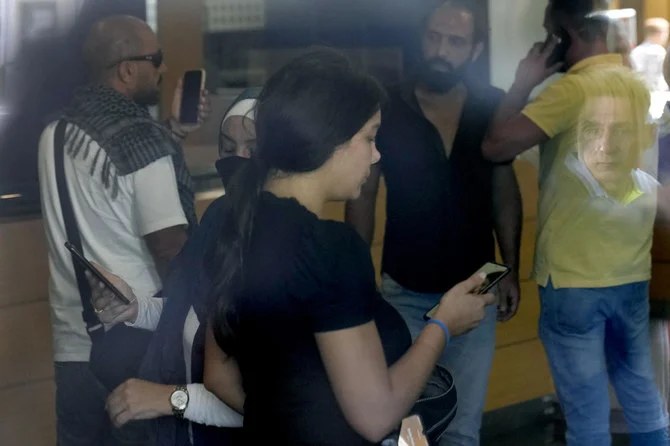
Activists from Depositors’ Outcry group accompanied Sali Hafez into a Beirut bank branch on Wednesday, and she was able to retrieve some $13,000 in her savings to fund her sister’s cancer treatment.
Hafez carried a toy gun when she walked into BLOM Bank on Wednesday, while the activists who accompanied her poured about gasoline, threatening to set the bank on fire if she did not get her money out.
The group told AP that they had also coordinated with a man who tried to take some of his money from a bank in the mountainous town of Aley. Local media said he carried an unloaded shotgun.
Lebanon’s cash-strapped banks have imposed strict limits on withdrawals of foreign currency since 2019, tying up the savings of millions of people. About three-quarters of the population has slipped into poverty as the tiny Middle East country’s economy continues to spiral.
Alaa Khorchid, the head of Depositors’ Outcry, said there is now no other choice for Lebanese bank depositors but to “take matters into their own hands.” He spoke at a press conference in Beirut.
“BLOM Bank issues a statement saying that this is a pre-orchestrated operation. Yes it is, what were you thinking?” Khorchid told reporters, referring to the bank’s statement condemning Hafez and the activists.
“And we’re organizing more than this, and you have no choice. People’s rights are sacred,” he added, addressing banks in general.
“The real beginning of the revolution started yesterday, when Sali Hafez entered the bank, and there is no turning back,” Ibrahim Abdullah, a member of the Depositors’ Outcry group said at the press conference. “This revolution is against all the banks.”
Several groups advocating and protesting for Lebanese depositors have emerged since 2019, with some — like the one named the Depositors’ Union — opting to file lawsuits against banks to help depositors retrieve their money.
Wednesday’s heist occurred weeks after a food delivery driver broke into another bank branch in Beirut and held 10 people hostage for seven hours, demanding tens of thousands of dollars in his trapped savings. Many Lebanese hailed him as a hero.
The standoff and public sympathy for those taking matters into their own hands to get their savings has exposed the depths of people’s despair in Lebanon’s economic crisis, which has pulled over three-quarters of the country’s population into poverty, unable to cope with skyrocketing food, electricity, and gasoline prices.
Meanwhile, Lebanese officials struggle to implement structural reforms for an economic recovery plan approved by the International Monetary Fund to unlock billions of dollars in loans and aid to make the country viable again.


![]()

After heist, Lebanese activists promise more bank raids
Short Url
https://arab.news/zuakw
After heist, Lebanese activists promise more bank raids
- Alaa Khorchid, the head of Depositors’ Outcry, says there is now no other choice for Lebanese bank depositors
- The Lebanese activist group says it also coordinated with a man who tried to take some of his money from a bank
Latest updates



© 2026 SAUDI RESEARCH & PUBLISHING COMPANY, All Rights Reserved And subject to Terms of Use Agreement.