Climate change likely made Pakistan’s extreme rainfall more intense — study

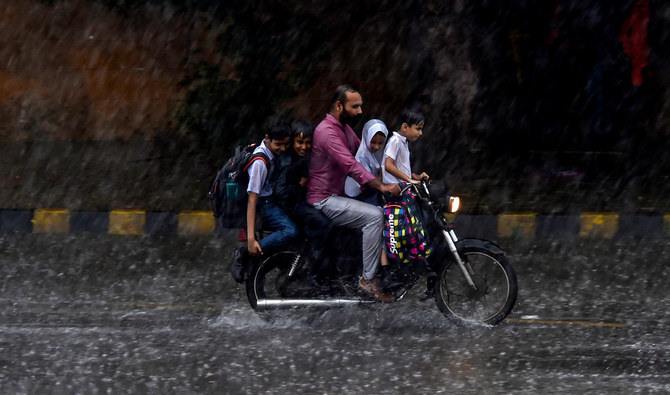
A man rides a motorcycle with children as pillion along a road during heavy rains in Karachi, Sindh-Pakistan on September 12, 2022. (AFP)
Short Url
Updated 16 September 2022
Follow

Climate change likely made Pakistan’s extreme rainfall more intense — study

  • In Sindh, Balochistan, climate warming made average maximum rainfall 75% more intense
  • Pakistan authorities have said it could take up to six months for flood waters to fully recede

LONDON: The torrential monsoon that has submerged more than a third of Pakistan was a one in a hundred-year event likely made more intense by climate change, scientists said on Thursday.

In the hardest-hit areas of Sindh and Balochistan provinces, where August rainfall was seven to eight times heavier than usual, climate warming made average five-day maximum rainfall about 75% more intense, according to a report by World Weather Attribution (WWA), an international research collaboration that teases out the role of climate change in extreme events.

Across the entire Indus River basin, the scientists found maximum rainfall was about 50% heavier during a two-month monsoon period due to climate change.

They used 31 computer models in their analysis, combined with real-world observations.

WWA previously analyzed the deadly heatwave that scorched India and Pakistan in March and April, with temperatures reaching 50C. Climate change, they said, had made that heatwave 30 times more likely.

Their findings were less concrete for Pakistan’s heavy rains.

“The role of climate change in heatwaves is much larger than in extreme rainfall when it comes to likelihood,” said WWA co-leader Friederike Otto, a climate scientist at Imperial College London.

It’s also trickier to parse out the role of climate change in the Pakistan floods, scientists said, because there have been so many drivers behind this year’s extremes.

Ongoing La Nina conditions — a global weather pattern that can affect ocean temperatures — combined with a negative dipole in the Indian Ocean — whereby rainfall is heaver in the eastern Indian Ocean – have been feeding the monsoon.

The floods have so far claimed the lives of more than 1,400 people and displaced millions, washing away roads, homes, and farmland. Damages are expected to total more than $30 billion.

Pakistan authorities say it could take up to six months for flood waters to fully recede, spiking concerns about waterborne diseases such as dengue and cholera.

While climate change may have made this year’s monsoon rains worse, the devastation they caused can’t be attributed to warming alone.

Scientists stressed the construction of homes and agricultural land on known flood plains, as well as inadequate infrastructure such as dams, had worsened the impacts of heavier rains.

“There have been significant drainage problems in the lower Indus Basin, even in non-flood years,” said geographer Ayesha Siddiqi at the University of Cambridge.



Pakistan finance minister touts debt discipline, export focus at Davos panel

Updated 5 sec ago
Follow

Pakistan finance minister touts debt discipline, export focus at Davos panel

  • Aurangzeb says debt must fund exports, not consumption, for sustainable growth
  • He says Pakistan used fiscal buffers to respond to floods without external appeals

KARACHI: Pakistan’s Finance Minister Muhammad Aurangzeb said on Wednesday disciplined borrowing, export-led growth and careful debt management were central to stabilizing the country’s economy, as Islamabad looks to unlock new sources of growth amid rising global debt levels.

Speaking at a panel discussion on the sidelines of the World Economic Forum (WEF) in Davos, he said debt was not inherently harmful if used productively, but warned that emerging economies such as Pakistan could not afford to deploy borrowed funds for consumption.

“For countries like Pakistan, debt must be channeled into investments that generate exportable surplus,” Aurangzeb said, according to a statement circulated by the Finance Division. “It is not about the availability of debt or funding, but how wisely and effectively it is steered to create long-term economic value.”

Pakistan has been pursuing fiscal reforms as part of an International Monetary Fund-backed stabilization program, including cutting subsidies, broadening the tax base and restructuring state-owned enterprises, as the government seeks to restore macroeconomic stability and revive growth.

Aurangzeb said Pakistan had reduced its debt-to-GDP ratio to 70 percent from 75 percent, achieved a primary fiscal surplus and brought inflation down from a peak of 38 percent to single digits, allowing the central bank to cut its policy rate to 10.5 percent.

He also flagged ongoing debt-management reforms, including liability management operations and buybacks, and said Pakistan plans to enter China’s capital markets with its first Panda bond, structured as a green bond.

Addressing climate risks, Aurangzeb said building fiscal buffers had allowed Pakistan to respond to recent floods using domestic resources rather than international emergency appeals, underscoring the need for resilience in climate-vulnerable economies.

He added that public-private partnerships and capital markets were playing a growing role in financing development, citing a $3.6 billion syndicated financing for a major copper mining project expected to generate $2.8 billion in annual exports from 2028.

The finance minister is part of Pakistan’s delegation visiting Davos for the annual gathering of global leaders and investors.

The delegation is led by Prime Minister Shehbaz Sharif, who highlighted the country’s shift toward an export-driven growth model, with a focus on minerals, information technology, artificial intelligence and digital services, while speaking at a breakfast event on the sidelines of the forum.