

Former Pakistani elite umpire Asad Rauf passes away

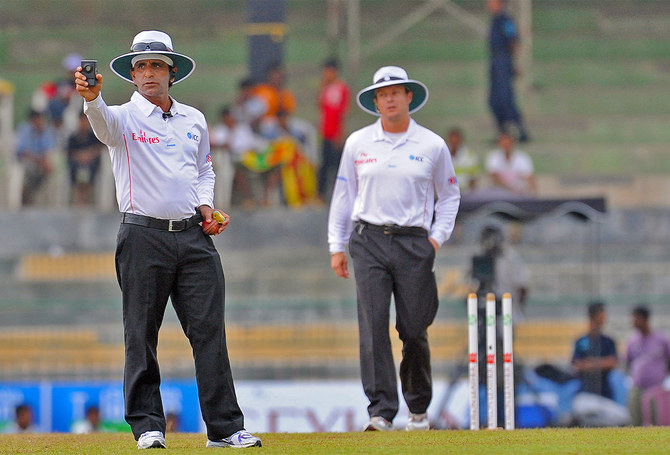
Umpire Asad Rauf of Pakistan (L) checks the light on the pitch after the cricket match was stopped during the third day of the second Test match between Sri Lanka and West Indies in Colombo on November 25, 2010. (AFP/File)
Short Url
Updated 15 September 2022
Follow

Former Pakistani elite umpire Asad Rauf passes away

  • Asad Rauf, 66, passes away after suffering heart attack
  • Rauf’s demise draws condolences from cricket fraternity 

ISLAMABAD: Former Pakistani umpire Asad Rauf, who was part of the International Cricket Council’s (ICC) elite panel, passed away in Lahore on Thursday.  

Rauf, 66, died from a cardiac arrest, according to multiple media reports. He officiated in 64 Tests (49 as on-field umpire and 15 as TV umpire), 139 ODIs and 28 T20Is before his career ended abruptly following a damning Indian Premier League (IPL) scandal in 2013.  

Rauf, alongside fellow Pakistani umpire Aleem Dar, was one of the most prominent Pakistani umpires in the mid-2000s. He was elevated to the ICC’s elite panel list in 2006, a year after he officiated his first Test match.  

After standing in his first ODI in 2000, Rauf was elevated to the ODI panel in 2004. However, his career suffered a downward spiral in 2013 when he was named a “wanted accused” by Mumbai Police in a spot-fixing investigation.  

The Pakistani umpire left India before the IPL final on May 26 that year. It is believed police were investigating alleged gifts he received.  

News of his demise, however, drew condolences from various quarters. Pakistan Cricket Board (PCB) Chairman Ramiz Raja said Rauf’s death had saddened him. ‘Not only was he a good umpire but also had a wicked sense of humour,” Raja wrote on Twitter.  

Pakistani cricketer Kamran Akmal prayed for Rauf’s forgiveness and wished his family would have the patience to bear his demise.  

Indian sports journalist Sanjay Kishore expressed his condolences as well, referring to Rauf as “one of the finest umpires of his time.” 

Pakistani sports broadcast anchor Dr. Nauman Niaz said Rauf “saw the lows but sustained all pressures.” 

Pakistani batter Faisal Iqbal said Rauf was “a dear friend who I have some cherished memories on the field in domestic and International cricket.” 

Before he began his career as an umpire, Rauf played 71 matches as a first-class cricketer in Pakistan’s domestic cricket circuit. He represented the National Bank and Railways teams, averaging 28.76. 


Pakistan urges concessional finance for developing nations to boost clean energy security

Updated 11 January 2026
Follow

Pakistan urges concessional finance for developing nations to boost clean energy security

  • Pakistan has emerged as one of world’s fastest growing solar markets, with 12GWs of off-grid and 6GWs of net-metered capacity in 2025
  • PM’s aide says Islamabad remains committed to Paris Agreement, looks for continued support in building a resilient and low-carbon future

ISLAMABAD: Pakistan has urged international partners to scale up concessional financing for developing countries, the country’s Press Information Department (PID) said on Sunday, citing an aide to Prime Minister Shehbaz Sharif.

The call was made by Sharif’s coordinator on climate change, Romina Khurshid Alam, while delivering Pakistan’s national statement at the 16th International Renewable Energy Agency (IRENA) Assembly in Abu Dhabi.

Pakistan has emerged as one of the world’s fastest growing solar markets, with 12 gigawatts (GWs) of off-grid and over 6GWs of net-metered solar capacity by the end of 2025. Last fiscal year, renewables accounted for a historic 53 percent of total electricity generation, according to Alam.

The prime minister’s aide stressed that affordable funding for developing nations is critical to accelerating their transition to clean energy and strengthening energy security amid rising climate and economic challenges.

“Alam reaffirmed Pakistan’s target of achieving 60 percent renewables in the power mix by 2030,” the PID said in a statement.

“In her call to action, she urged IRENA and Member States to increase concessional finance for developing nations, treat technologies such as energy storage and green hydrogen as global public goods, and strengthen regional cooperation for shared energy security.”

IRENA is a global intergovernmental agency for energy transformation that serves as the principal platform for international cooperation, supports countries in their energy transition, and provides state of the art data and analyzes on technology, innovation, policy, finance and investment. Its membership comprises 170 countries and the European Union (EU).

The 16th session of the IRENA Assembly is taking place on Jan. 10-12 in Abu Dhabi and focuses on the theme of “Powering Humanity: Renewable Energy for Shared Prosperity.” The session has gathered global leaders and energy decision-makers to discuss strategies and underline necessary actions for the acceleration of renewable energy across countries, regions, and the world, driving economic inclusion, equity, and human well-being.

Alam shared that Pakistan is taking action against energy poverty through initiatives like the Punjab Solar Panel Scheme 2026, which provides free or subsidized systems to low-income households.

She highlighted how distributed solar kits have restored power and livelihoods in flood-affected communities and offer a replicable model for climate-resilient recovery.

“Pakistan remains fully committed to the Paris Agreement and looks to IRENA for continued technical and financial support in building a resilient, inclusive, and low-carbon future,” Alam said.

Adopted in 2015 to combat climate change, the Paris Agreement binds nations to hold “the increase in the global average temperature to well below 2°C above pre-industrial levels” and pursue efforts “to limit the temperature increase to 1.5°C above pre-industrial levels.”