

Armenia reports truce after new clashes with Azerbaijan

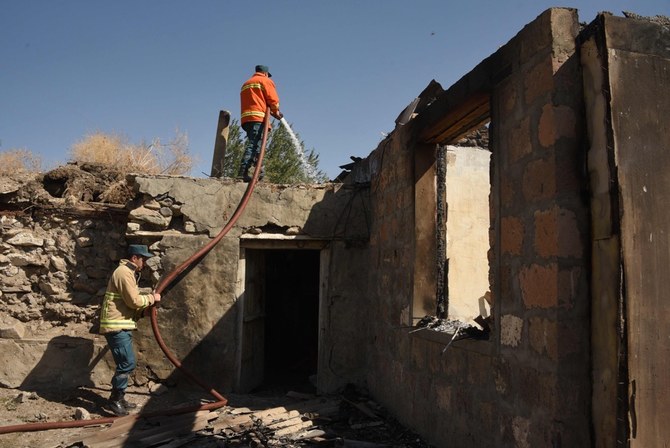
Azerbaijan reported 50 military deaths on the first day of fighting. (AFP)
Short Url
Updated 15 September 2022
Follow

Armenia reports truce after new clashes with Azerbaijan

  • Azerbaijan’s defense ministry: 71 servicemen had been killed during clashes this week on the border with Armenia

TBILISI: A senior Armenian official said late on Wednesday that a truce had been agreed with Azerbaijan after two days of violence linked to a decades-old dispute between the ex-Soviet states over the territory of Nagorno-Karabakh.

There was no word from Azerbaijan about a truce to halt the deadliest exchanges between the countries since 2020.

Azerbaijan’s defense ministry said on Thursday that 71 of its servicemen had been killed during clashes this week on the border with Armenia.

Fighting along the border of the two countries, which have been at loggerheads over the breakway region of Nagorno-Karabakh since the 1980s, erupted afresh on Tuesday. Armenia said 105 of its soldiers had died.

Russia is the pre-eminent diplomatic force in the region and maintains 2,000 peacekeepers there. Moscow brokered the deal that ended the 2020 fighting — dubbed the second Karabakh war — in which hundreds died.

Russian news agencies quoted Armen Grigoryan, Secretary of Armenia’s Security Council, as telling Armenian television: “Thanks to the involvement of the international community, an agreement has been reached on a cease-fire.”

The announcement said the truce had been in effect for several hours. Armenia’s defense ministry had earlier said that shooting in border areas had stopped.

Each side blames the other for the fresh clashes.

Armenian Prime Minister Nikol Pashinyan had previously told parliament that 105 Armenian servicemen had been killed since the violence began this week.

Azerbaijan reported 50 military deaths on the first day of fighting. Reuters was unable to verify the two sides’ accounts.

Grigory Karasin, a senior member of Russia’s upper house of parliament, told the RIA news agency that the truce was clinched largely through Russian diplomatic efforts.

Kremlin leader Vladimir Putin had spoken to Pashinyan, he said. Putin appealed for calm after the violence erupted and other countries called for restraint on both sides. In his address to parliament, Pashinyan had said his country had appealed to the Moscow-led Collective Security Treaty Organization to help restore its territorial integrity.

“If we say that Azerbaijan has carried out aggression against Armenia, it means that they have managed to establish control over some territories,” Russia’s Tass agency quoted him as saying.

Armenia and Azerbaijan have been fighting for decades over Nagorno-Karabakh, a mountainous enclave recognized as part of Azerbaijan while being home to a large Armenian population.

Fighting first erupted toward the end of Soviet rule, and Armenian forces took control of large swathes of territory in and around it in the early 1990s. Azerbaijan, backed by Turkey, largely retook those territories over six weeks in 2020.

Skirmishes have since erupted periodically despite meetings between Pashinyan and Azerbaijani President Ilham Aliyev aimed at clinching a comprehensive peace settlement.

Domestic unhappiness in Armenia about the 2020 defeat has prompted repeated protests against Pashinyan, who dismissed reports he had signed a deal with Baku.

In a Facebook post, he blamed the reports on “informational sabotage directed by unfriendly forces.”

A full-fledged conflict would risk dragging in Russia and Turkey, and destabilize an important corridor for oil and gas pipelines just as war in Ukraine disrupts energy supplies.

Armenian Deputy Foreign Minister Paruyr Hovhannisyan told Reuters the clashes could escalate into a war — a second major armed conflict in the former Soviet Union while Russia’s military is focused on Ukraine.

Azerbaijan accused Armenia, which is in a military alliance with Moscow and home to a Russian military base, of shelling its army units.

Baku said Azerbaijani Foreign Minister Jeyhun Bayramov had met US State Department Caucasus adviser Philip Reeker, telling him Armenia must withdraw from Azeri territory.

US Secretary of State Antony Blinken on Tuesday said Russia could either “stir the pot” or use its influence to help “calm the waters.”

French Foreign Minister Catherine Colonna, in a call with her counterparts from both countries, also called for the “end of strikes against Armenian territory.”



Venezuela’s acting president calls for oil industry reforms to attract more foreign investment

Updated 4 sec ago
Follow

Venezuela’s acting president calls for oil industry reforms to attract more foreign investment

  • In her speech, Rodríguez said money earned from foreign oil sales would go into two funds: one dedicated to social services for workers and the public health care system, and another to economic development and infrastructure projects

CARACAS, Venezuela: Venezuela’s acting President Delcy Rodriguez used her first state of the union address on Thursday to promote oil industry reforms that would attract foreign investment, an objective aggressively pushed by the Trump administration since it toppled the country’s longtime leader less than two weeks ago.
Rodríguez, who has been under pressure from the US to fall in line with its vision for the oil-rich nation, said sales of Venezuelan oil would go to bolster crisis-stricken health services, economic development and other infrastructure projects.
While she sharply criticized the Trump administration and said there was a “stain on our relations,” the former vice president also outlined a distinct vision for the future between the two historic adversaries, straying from her predecessors, who have long railed against American intervention in Venezuela.
“Let us not be afraid of diplomacy” with the US, said Rodriguez, who must now navigate competing pressures from the Trump administration and a government loyal to former President Nicolás Maduro.
The speech, which was broadcast on a delay in Venezuela, came one day after Rodríguez said her government would continue releasing prisoners detained under Maduro in what she described as “a new political moment” since his ouster.
Trump on Thursday met at the White House with Venezuelan opposition leader María Corina Machado, whose political party is widely considered to have won 2024 elections rejected by Maduro. But in endorsing Rodríguez, who served as Maduro’s vice president since 2018, Trump has sidelined Machado.
In her speech, Rodríguez said money earned from foreign oil sales would go into two funds: one dedicated to social services for workers and the public health care system, and another to economic development and infrastructure projects.
Hospitals and other health care facilities across the country have long suffered. Patients are asked to provide practically all supplies needed for their care, from syringes to surgical screws. Economic turmoil, among other factors, has pushed millions of Venezuelans to migrate from the South American nation in recent years.
In moving forward, the acting president must walk a tightrope, balancing pressures from both Washington and top Venezuelan officials who hold sway over Venezuela’s security forces and strongly oppose the US Her recent public speeches reflect those tensions — vacillating from conciliatory calls for cooperation with the US, to defiant rants echoing the anti-imperialist rhetoric of her toppled predecessor.
American authorities have long railed against a government they describe as a “dictatorship,” while Venezuela’s government has built a powerful populist ethos sharply opposed to US meddling in its affairs.
For the foreseeable future, Rodríguez’s government has been effectively relieved of having to hold elections. That’s because when Venezuela’s high court granted Rodríguez presidential powers on an acting basis, it cited a provision of the constitution that allows the vice president to take over for a renewable period of 90 days.
Trump enlisted Rodríguez to help secure US control over Venezuela’s oil sales despite sanctioning her for human rights violations during his first term. To ensure she does his bidding, Trump threatened Rodríguez earlier this month with a “situation probably worse than Maduro.”
Maduro, who is being held in a Brooklyn jail, has pleaded not guilty to drug-trafficking charges.
Before Rodríguez’s speech on Thursday, a group of government supporters was allowed into the presidential palace, where they chanted for Maduro, who the government insists remains the country’s president. “Maduro, resist, the people are rising,” they shouted.