

Iran nuclear talks in ‘stalemate,’ says EU foreign policy chief

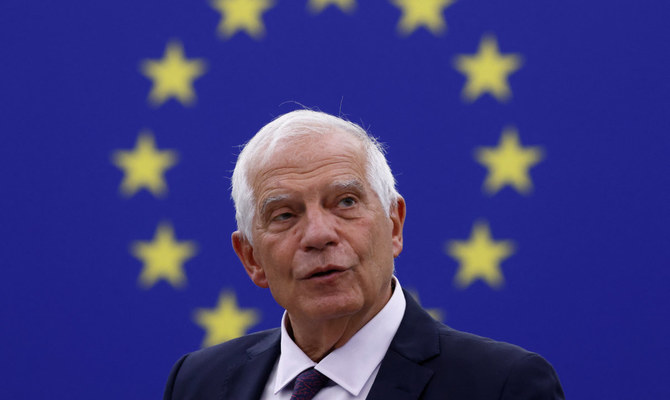
EU Foreign Policy Chief Josep Borrell addresses a plenary session of the European Parliament in Strasbourg, France September 13, 2022. (Reuters)
Short Url
Updated 15 September 2022
Follow

Iran nuclear talks in ‘stalemate,’ says EU foreign policy chief

  • Borrell has coordinated efforts over the past year and a half to try to revive the 2015 Iran nuclear deal, which was badly damaged when Trump had America withdraw from it in 2018

STRASBOURG, France: Negotiations to bring Iran and the US back into the nuclear deal curbing Tehran’s nuclear program in exchange for lifting sanctions are in “stalemate,” EU foreign policy chief Josep Borrell said on Wednesday.

“I am afraid that with the political situation in the US, and so many directions without being conclusive, now we are going to stay in a kind of stalemate,” Borrell said.

Borrell has coordinated efforts over the past year and a half to try to revive the 2015 Iran nuclear deal, which was badly damaged when then-President Donald Trump had America withdraw from it in 2018.

Iran has responded by rolling back its adherence to its commitments, greatly increasing its stock of enriched uranium and turning off monitoring cameras operated by the UN nuclear watchdog, the International Atomic Energy Agency.

Last month, Borrell put a text in front of all parties that he described at the time as “final” and which he said was “the best equilibrium point between the positions of everybody.”

But Iran is sticking to a demand that the IAEA draw a line under a probe launched when the agency found traces of nuclear material at three undeclared sites.

And the US political situation has changed as President Joe Biden faces midterm Congressional elections in November that make deals with Iran harder to reach.

Borrell said that, over the past couple of months, “the proposals were converging but unhappily, after the summer, the last proposals are not converging — they are diverging.”

He added: “The last proposals from the Iranians were not helping because we were almost there, then new proposals came and the political environment is not the most propitious. I am sorry to say, but I don’t expect any breakthrough in the next days.”

The European parties to the nuclear deal, Britain, France and Germany, last week said they had “serious doubts” about Iran’s sincerity in wanting the pact restored.

Iran called the joint declaration “unconstructive” and “regrettable.”

Borrell said there was nothing else he could put forward to clear the impasse. “From my side, I don’t have anything more to propose,” he said.


Syria Kurds chief says ‘all efforts’ being made to salvage deal with Damascus

Updated 25 December 2025
Follow

Syria Kurds chief says ‘all efforts’ being made to salvage deal with Damascus

  • Abdi said the Syrian Democratic Forces (SDF), the Kurds’ de facto army, remained committed to the deal
  • The two sides were working toward “mutual understanding” on military integration and counter-terrorism

DAMASCUS: Syrian Kurdish leader Mazloum Abdi said Thursday that “all efforts” were being made to prevent the collapse of talks on an agreement with Damascus to integrate his forces into the central government.
The remarks came days after Aleppo saw deadly clashes between the two sides before their respective leaders ordered a ceasefire.
In March, Abdi signed a deal with Syrian President Ahmed Al-Sharaa to merge the Kurds’ semi-autonomous administration into the government by year’s end, but differences have held up its implementation.
Abdi said the Syrian Democratic Forces (SDF), the Kurds’ de facto army, remained committed to the deal, adding in a statement that the two sides were working toward “mutual understanding” on military integration and counter-terrorism, and pledging further meetings with Damascus.
Downplaying the year-end deadline, he said the deal “did not specify a time limit for its ending or for the return to military solutions.”
He added that “all efforts are being made to prevent the collapse of this process” and that he considered failure unlikely.
Abdi also repeated the SDF’s demand for decentralization, which has been rejected by Syria’s Islamist authorities, who took power after ousting longtime ruler Bashar Assad last year.
Turkiye, an important ally of Syria’s new leaders, sees the presence of Kurdish forces on its border as a security threat.
In Damascus this week, Turkish Foreign Minister Hakan Fidan stressed the importance of the Kurds’ integration, having warned the week before that patience with the SDF “is running out.”
The SDF control large swathes of the country’s oil-rich north and northeast, and with the support of a US-led international coalition, were integral to the territorial defeat of the Daesh group in Syria in 2019.
Syria last month joined the anti-IS coalition and has announced operations against the jihadist group in recent days.