

Facebook parent company Meta donates Rs125 million for Pakistan flood relief

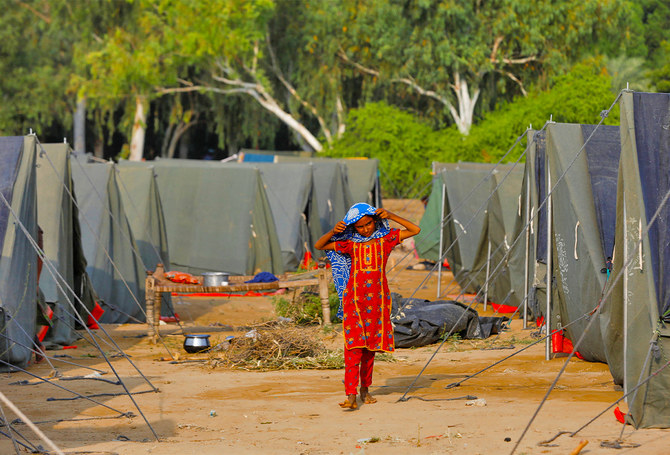
A girl whose family became displaced walks amid tents, following rains and floods during the monsoon season in Sehwan, Pakistan, on September 13, 2022. (REUTERS)
Short Url
Updated 14 September 2022
Follow

Facebook parent company Meta donates Rs125 million for Pakistan flood relief

  • So far, UN agencies and various countries, including United States, have sent over 90 plane loads of aid
  • Authorities said overall death toll reached 1,481 on Tuesday, hundreds of thousands rendered homeless

ISLAMABAD: Meta Platforms, the multinational technology conglomerate that owns Facebook, Instagram, and WhatsApp among other products and services, has announced a donation of Rs125 million to help communities impacted by floods in Pakistan.

Rains in Pakistan started in mid-June, triggering floods that have swept away entire villages, bridges and roads and left hundreds of thousands homeless. At one point, a third of the country’s territory was inundated with water. Authorities said on Tuesday the overall death toll had crossed 1,400.

So far, UN agencies and various countries, including the United States, have sent over 90 plane loads of aid.

The donation from Meta will support emergency aid, food, water, and sanitation and help children get back to school in the provinces of Sindh, Punjab, Khyber Pakhtunkhwa, and Balochistan.

When the flooding began, Meta activated the Safety Check feature on Facebook, which allowed people to let friends and family know they were safe. A Crisis page was also established where people could use the Community Help feature to enable people to ask for and offer help from different communities.

“Pakistan is going through one of the worst natural disasters we have seen to date. Millions of people are affected and the entire nation is rallying to support them during this difficult time. We hope that our contributions help the communities impacted by the catastrophe and our thoughts are with these communities and families as they try to recover,” said Jordi Fornies, Director for Emerging Markets, Asia-Pacific at Meta.

Additionally, Meta’s ‘Data for Good’ activated its Disaster Maps program and is providing data to Pakistan’s regional response partners. One of those partners, CrisisReady (a collaboration between Direct Relief and Harvard University), has focused on combining data sources into situation reports being used daily by thousands of on-the-ground first responders.

“The torrential monsoon rains over the past weeks have damaged or completely washed away people’s houses, critically affecting millions of people, including children. With winter just weeks away in some parts of the country, we need urgent help to continue our relief efforts in Pakistan and support for children and their families. We express our gratitude to Meta for all the support,” said Michael J. Nyenhuis, President and CEO of UNICEF USA.

Communities across various Meta-owned platforms have raised more than a million dollars for non-profits supporting flood relief efforts. Leading NGOs across the globe have also raised substantial amounts via Facebook and Instagram.

Meta’s donation will go to UNICEF, Hands, and Idara-e-Taleem-o-Aagahi (ITA).

Commenting on the development, Baela Raza Jamil, CEO, ITA, said: “We will rehabilitate schools, ensure 2nd Chance Accelerated learning programs with life skills (psychosocial support, climate change and digital literacy), and provide hygiene and health with dignity kits. This is a comprehensive and inclusive approach to #BuildingBackBetter by reaching homes, communities, schools, parents, children, and especially adolescent girls and teachers embedded within government systems for effective emergency response and preparedness.”

Meta said it was continuously exploring further avenues to facilitate not just families in the devastated regions but also supporting NGOs and other causes in their efforts.


Pakistan, UK sign £35 million Green Compact to strengthen climate resilience

Updated 21 December 2025
Follow

Pakistan, UK sign £35 million Green Compact to strengthen climate resilience

  • Pakistan ranks among nations most vulnerable to climate change and has seen erratic changes in its weather patterns
  • UK will help Pakistan mobilize climate finance, strengthen regulatory frameworks and develop bankable climate projects

ISLAMABAD: Pakistan and the United Kingdom (UK) have formalized a comprehensive climate partnership with the launch of a Green Compact that aims to enhance climate resilience, accelerate clean energy transition and scale up nature-based solutions, including mangrove conservation, Pakistani state media reported on Sunday.

The agreement, signed in Islamabad by Federal Minister for Climate Change and Environmental Coordination Dr. Musadik Malik and UK Minister for International Development Jennifer Chapman, unlocks £35 million in targeted support for green development and long-term climate action, according to Radio Pakistan broadcaster.

Pakistan ranks among nations most vulnerable to climate change and has seen erratic changes in its weather patterns that have led to frequent heatwaves, untimely rains, storms, cyclones, floods and droughts in recent years. In 2022, monsoon floods killed over 1,700 people, displaced another 33 million and caused over $30 billion losses, while another 1,037 people were killed in floods this year.

Mohammad Saleem Shaikh, a spokesperson for Pakistan’s Ministry of Climate Change, described the compact as a “decisive move toward action-oriented climate cooperation,” noting that its implementation over the next decade will be critical for Pakistan which regularly faces floods, heatwaves and water stress.

“The Compact is structured around five core pillars: climate finance and investment, clean energy transition, nature-based solutions, innovation and youth empowerment, and adaptation and resilience,” the report read.

“Under the agreement, the UK will work with Pakistan to mobilize public and private climate finance, strengthen regulatory frameworks for green investment, and develop bankable climate projects.”

Clean energy forms a central component of Pakistan’s transition, with Islamabad planning to expand solar and wind generation to reduce fossil fuel dependence, improve energy security and stabilize power costs, according to Shaikh.

“Renewable energy is now economically competitive, making the transition both environmentally and financially viable,” he was quoted as saying.

“Nature-based solutions, particularly large-scale mangrove restoration, will protect coastal communities from storm surges and erosion while enhancing biodiversity and carbon sequestration.”

Under the Compact, technical support, mentoring and access to investors will be provided to climate-smart startups and young innovators, reflecting Pakistan’s recognition of youth-led initiatives as central to future climate solutions.

On the occasion, Chapman, on her first official visit to Pakistan, underscored the urgency of climate action, highlighting the UK’s support for renewable energy, mangrove and ecosystem restoration, early-warning systems, climate budgeting and international investment flows into Pakistan.

Shaikh described the Green Compact as “a strategic turning point” in Pakistan–UK relations on climate change, saying its effective implementation is essential for Pakistan to meet its national climate targets.