

Milan design school Istituto Marangoni arrives in Dubai

1 / 2
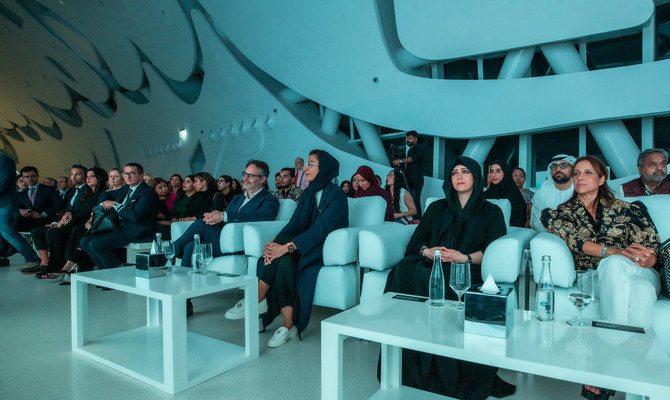
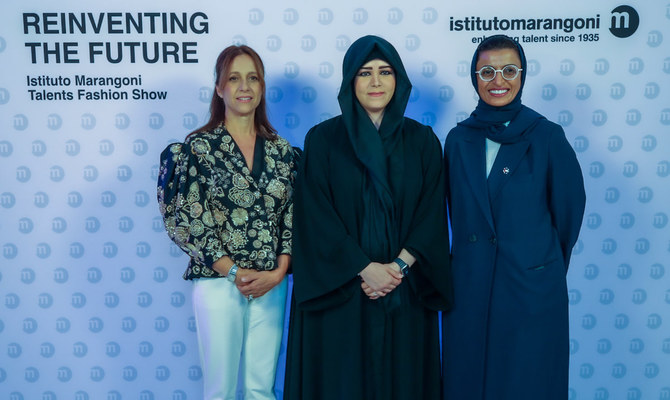
Sheikha Latifa, chairperson of Dubai Culture and Arts Authority was among the guests of honor at landmark fashion show that marked the Middle East debut of Italian fashion and design school Istituto Marangoni, the Emirates News Agency reported. (Twitter: @DXBMediaOffice)
2 / 2
Sheikha Latifa, chairperson of Dubai Culture and Arts Authority was among the guests of honor at landmark fashion show that marked the Middle East debut of Italian fashion and design school Istituto Marangoni, the Emirates News Agency reported. (Twitter: @DXBMediaOffice)
Short Url
Updated 14 September 2022
Follow

Milan design school Istituto Marangoni arrives in Dubai

  • The landmark event at the Museum of the Future combined a traditional physical fashion show with a complementary digital version in the metaverse
  • ‘Istituto Marangoni’s Dubai branch is a valuable addition to the city’s rapidly developing creative and cultural landscape,’ said Sheikha Latifa

DUBAI: Sheikha Latifa bint Mohammed Al-Maktoum, chairperson of Dubai Culture and Arts Authority and a member of the Dubai Council, was among the guests of honor at a landmark fashion show that marked the Middle East debut of Italian fashion and design school Istituto Marangoni, the Emirates News Agency reported.

The concept for the event combined a traditional physical fashion show at the Museum of the Future in Dubai with a complementary digital version in the metaverse. Models appeared on the real-world catwalk alongside their virtual avatars, creating a unique event that blended tradition with innovation in a world where reality and virtual reality coexist.

The event showcased the work of five top graduates of Istituto Marangoni’s fashion-design courses in Milan, Florence, Paris, London and Shanghai. The grand finale featured designs by Rahul Mishra, a well-known alum who was the first Indian designer to show his work at Paris Haute Couture Week.

In Dubai he paid tribute to his alma mater with creations that combine traditional Indian designs with modern luxury fashion trends in a sustainable, ethical, “slow fashion” approach.

Sheikha Latifa said: “Istituto Marangoni’s Dubai branch is a valuable addition to the city’s rapidly developing creative and cultural landscape. Its diverse offering will provide creatives in Dubai and the region with the right tools to launch their design careers.”

She added that Dubai has cemented its position as a global design hub, one of the primary goals of Prime Minister Sheikh Mohammed bin Rashid Al-Maktoum’s Dubai Creative Economy Strategy, which was launched last year.

As part of that strategy, Dubai Culture is working to strengthen education in the creative arts and, as a result, support the emergence and development of creative talents while establishing an ecosystem of creators in the emirate.

“Bringing global institutions with decades of experience in the field of design to the region reinforces our commitment to the sector and to being a cultural and creative hub,” Sheikha Latifa said. “We look forward to the incredible talent that will graduate from (Istituto Marangoni Dubai) in the coming years.”

Noura Al-Kaabi, minister of culture and youth, said: “It gives me great joy to welcome a globally renowned fashion and design school to Dubai. I see a great partnership in the making, where the UAE and other MENA (Middle East and North Africa) countries will have the advantage of a world-class design school, while Istituto Marangoni will benefit from the untapped talent waiting to be harnessed.

“The UAE is making waves in the creative space and building an ecosystem for future generations to contribute effectively to the creative economy. We are focusing on developing our cultural and creative industries to make them a more significant part of the UAE’s economy.

“We believe nurturing talent is critical to developing the creative sector and Istituto Marangoni will play an important role in achieving that. Imparting world-class education and specialized skills to our youth will boost their creative energy and support emerging talent.”

Stefania Valenti, the managing director of Istituto Marangoni, said: “It’s an honor to celebrate the opening of Istituto Marangoni Dubai at the Museum of the Future with the warm endorsement of Her Highness Sheikha Latifa bint Mohammed bin Rashid Al-Maktoum and Her Excellency Noura bint Mohammed Al-Kaabi, and in this museum where our immersive experience found its perfect space.”

Dubai is the latest addition to the ranks of global fashion capitals that host an Istituto Marangoni school, including Milan, Florence, Paris, London, Mumbai, Shanghai, Shenzhen and Miami.

Valenti said that with the help of qualified, professional staff from Italy and an innovative “learning by doing” approach, students at Istituto Marangoni Dubai will develop the skills they need to realize their potential and turn their passion and talent into a successful career.

“Today’s event showcases what Istituto Marangoni students can achieve,” she added. “With the opening of our school in Dubai, we are offering local aspiring fashion and interior designers the opportunity to acquire the skills and knowledge required to kick-start their careers.

“Istituto Marangoni is committed to playing an active role in the Middle East to encourage a new ecosystem of talent, institutions, stakeholders and industries. We hope to contribute to fostering a new generation of fashion designers in the region, with special attention to empowering women in their aspirational field of interest, be it fashion, design or arts.”


Robert Duvall: understated actor’s actor, dead at 95

Updated 16 February 2026
Follow

Robert Duvall: understated actor’s actor, dead at 95

  • One of his most memeorable characters was the maniacal, surfing-mad Lt. Gen. William Kilgore in Francis Ford Coppola’s 1979 Vietnam War epic ‘Apocalypse Now’
  • One regret was turning down the lead part in ‘Jaws’ (which went to Roy Scheider) because he instead wanted to play the salty fisherman, a role that went to Robert Shaw

LOS ANGELES: Robert Duvall, a prolific, Oscar-winning actor who shunned glitz and won praise as one of his generation’s greatest and most versatile artists, has died at age 95.
Duvall’s death on Sunday was confirmed by his wife Luciana Duvall in a statement posted Monday on Facebook.
Duvall shone in both lead and supporting roles, and eventually became a director over a career spanning six decades. He kept acting in his 90s.
His most memorable characters included the soft-spoken, loyal mob lawyer Tom Hagen in the first two installments of “The Godfather” and the maniacal, surfing-mad Lt. Gen. William Kilgore in Francis Ford Coppola’s 1979 Vietnam War epic “Apocalypse Now.”
The latter earned Duvall an Oscar nomination and made him a bona fide star after years playing lesser roles. In it he utters what is now one of cinema’s most famous lines.
“I love the smell of napalm in the morning,” his war-loving character — bare chested, cocky and sporting a big black cowboy hat — muses as low-flying US warplanes strafe a beachfront tree line with the incendiary gel.
That character was originally created to be even more over the top — his name was at first supposed to be Col. Carnage — but Duvall had it toned down in a show of his nose-to-the-grindstone approach to acting.
“I did my homework,” Duvall told veteran talk show host Larry King in 2015. “I did my research.”
Duvall was a late bloomer in the profession — he was 31 when he delivered his breakout performance as the mysterious recluse Boo Radley in the 1962 film adaptation of Harper Lee’s novel “To Kill a Mockingbird.”
He would go on to play myriad roles — a bullying corporate executive in “Network” (1976), a Marine officer who treats his family like soldiers in “The Great Santini” (1979), and a washed-up country singer in “Tender Mercies” (1983), for which he won the Oscar for best actor. Duvall was nominated for an Oscar six other times as well.
Duvall often said his favorite role, however, was one he played in a 1989 TV mini-series — the grizzled, wise-cracking Texas Ranger-turned-cowboy Augustus McCrae in “Lonesome Dove,” based on the novel by Larry McMurtry.
Film critic Elaine Mancini once described Duvall as “the most technically proficient, the most versatile, and the most convincing actor on the screen in the United States.”
In her statement Luciana Duvall said, “to the world, he was an Academy Award-winning actor, a director, a storyteller. To me, he was simply everything. His passion for his craft was matched only by his deep love for characters, a great meal, and holding court.”

‘A lot of crap’ 

Born in 1931, the son of a Navy officer father and an amateur actress mother, Duvall studied drama before spending two years in the US Army.
He then settled in New York, where he shared an apartment with Dustin Hoffman. The pair were friends with Gene Hackman as all three worked their way up in showbiz. These were lean times for the future stars.
“Hoffman, me, my brother, three or four other actors and singers had a place on 107th and Broadway in Manhattan, uptown,” Duvall told GQ in 2014.
Duvall said he had few regrets in his career.
But one was turning down the lead part in “Jaws” (which went to Roy Scheider) because he instead wanted to play the salty fisherman, a role that went to Robert Shaw.
Director Steven Spielberg told Duvall he was too young for that part.
Duvall also admitted he took some jobs just for the money.
“I did a lot of crap,” he told The Wall Street Journal in 2017. “Television stuff. But I had to make a living.”
Duvall made his home far from the glitz and chatter of Hollywood — in rural Virginia, where his family had roots.
He and his fourth wife, Argentine-born Luciana Pedraza, 40 years his junior, lived in a nearly 300-year-old farmhouse. Duvall never had children.
He said he went to New York and Los Angeles only when necessary.
“I like a good Hollywood party,” he told the Journal. “I have a lot of friends there. But I like living here.”
And of all his storied roles, Duvall says his favorite was indeed that of the soft-hearted cowboy McCrae in “Lonesome Dove.”
“That’s my ‘Hamlet,’” he told The New York Times in 2014.
“The English have Shakespeare; the French, Moliere. In Argentina, they have Borges, but the Western is ours. I like that.”