

World needs Arabian peninsula’s expertise in desalination sector: top expert

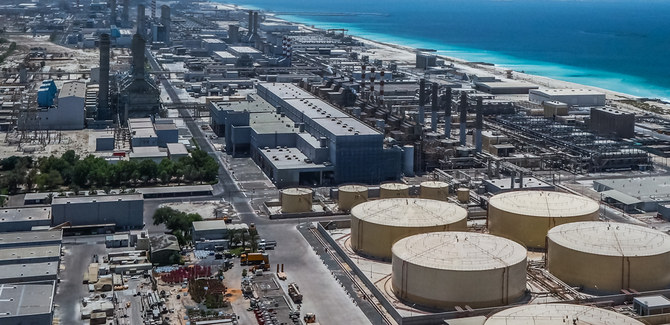
Desalination plant on the shores of the Arabian Gulf (Shutterstock)
Short Url
Updated 13 September 2022
Follow

World needs Arabian peninsula’s expertise in desalination sector: top expert

RIYADH: Countries across the world, particularly in Southern Europe, will soon need to tap into the the Arabian peninsula’s desalination expertise, according to leading strategist Henrik von Scheel.

Speaking at the Future of Desalination International Conference in Riyadh on Sept. 13, von Scheel warned that Europe, particularly the south of the continent, has been using too much groundwater, and as a result needs desalination processes.

He said: “The Arabian Peninsula has been investing heavily in desalination because they have no other choice. Today, they have the expertise, and today the world is desperately in need to leverage that expertise and consuming some of it.”

During his speech, von Scheel noted that Saudi Arabia’s Saline Water Conversion Corp. has a crucial role to play in the future of desalination. 

“You all see SWCC as a buyer. But I see SWCC as a main player in the desalination sector in the next few years,” said von Scheel. 

He claimed Saudi Arabia has the expertise, capability and willingness to take the lead in the desalination sector. 

He added: “Saudi Arabia’s efforts will make desalination cheaper, smaller, more customized for the smaller regions that are islands. We can also make it bigger, and more customized for the regions where there is a need for renewable economic generators. We have to be broad on this.” 

Talking about the vitality of embracing local production, he said: “If you are serious about saving the environment, we need to rethink our focus on globalization and growth. 

“Globalization is a drug most of us are addicted to. We need to focus on local production to ensure zero footprints.” 

Hosted by Saudi Arabia from Sept. 11-13 in Riyadh, the Future of Desalination International Conference aims to discuss opportunities for innovation and entrepreneurship in the desalination sector.

Policymakers, developers, contractors, researchers and innovators will attend to discuss the sector’s future.


Saudi non-oil trade surplus with GCC jumps 102% in November  

Updated 13 sec ago
Follow

Saudi non-oil trade surplus with GCC jumps 102% in November  

RIYADH: Saudi Arabia’s non-oil trade surplus with Gulf Cooperation Council countries more than doubled in November, driven by a surge in exports, preliminary government data showed. 

The surplus reached about SR6.6 billion ($1.76 billion), up 102 percent from SR3.3 billion a year earlier, according to the General Authority for Statistics. 

Total non-oil trade with GCC countries rose 30 percent to SR20.4 billion from SR15.7 billion, as exports outpaced import growth. Non-oil goods exports climbed to SR13.5 billion in November from SR9.5 billion a year earlier, while imports increased to SR6.9 billion from SR6.2 billion. 

Re-exports made up the bulk of outbound trade, rising to SR9.76 billion in November from SR6.56 billion a year earlier, while national exports increased to SR3.75 billion from SR2.92 billion. 

The UAE remained Saudi Arabia’s largest GCC trading partner on a non-oil basis. Exports to the Emirates totaled SR10.48 billion in November versus SR7.18 billion a year earlier, comprising SR8.38 billion in re-exports and SR2.10 billion in national exports.   

Imports from the UAE were SR4.79 billion, up from SR3.95 billion, lifting the non-oil trade surplus with the UAE to about SR5.69 billion from SR3.23 billion.  

Trade with Kuwait also expanded, with exports rising to SR769.9 million from SR610.6 million, including SR199.2 million in re-exports and SR570.7 million in national exports. Imports from Kuwait fell to SR176.4 million from SR333.3 million, pushing the trade surplus to SR593.5 million from SR277.3 million.  

With Bahrain, exports edged down to SR900.7 million from SR929.7 million, reflecting a decline in re-exports to SR380.3 million from SR572.7 million, while national exports increased to SR520.4 million from SR356.9 million. Imports rose to SR862.4 million from SR662.4 million, reducing the surplus to SR38.3 million from SR267.2 million.  

Saudi Arabia narrowed its non-oil trade deficit with Oman, as exports increased to SR666.7 million from SR356.5 million, supported by re-exports of SR259.6 million versus SR39.3 million and national exports of SR407.0 million versus SR317.3 million.   

Imports from Oman declined to SR873.2 million from SR1.11 billion, bringing the trade balance to a deficit of SR206.6 million compared with a deficit of SR749.1 million in November 2024.  

Trade with Qatar strengthened, with exports rising to SR691.1 million from SR395.8 million, including re-exports of SR536.2 million versus SR253.9 million and national exports of SR155.0 million versus SR141.9 million. Imports increased to SR199.3 million from SR148.9 million, resulting in a surplus of SR491.8 million, up from SR246.9 million.