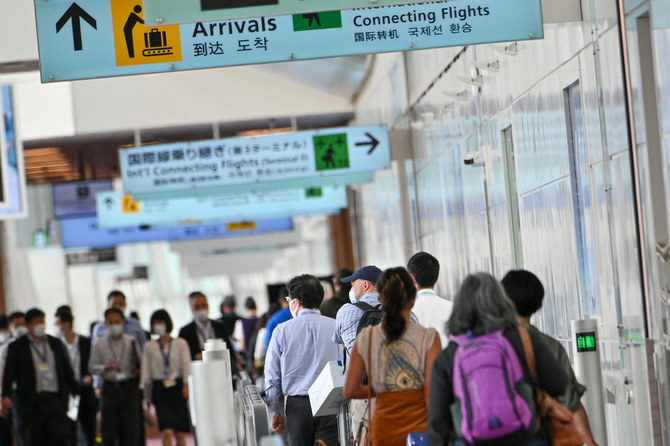
Japan to waive tourist visa requirements as part of border easing

Japan last week raised the daily ceiling of inbound travelers to 50,000 from 20,000 and eliminated a requirement for pre-departure COVID tests in major easing of restrictions. (AFP)
Short Url
Updated 12 September 2022
Follow

Japan to waive tourist visa requirements as part of border easing

  • Easing would also allow individual travelers to visit Japan without travel agency bookings

TOKYO: Japan’s government is planning to waive tourist visa requirements from some countries as part of a further easing of border controls enacted to stop the spread of COVID-19, Fuji News Network reported on Monday.
Prime Minister Fumio Kishida may decide as early as this week on the easing, which would also allow individual travelers to visit Japan without travel agency bookings, FNN reported. Japan did not require tourist visas for 68 countries and regions before the pandemic.
The government may scrap a daily cap on arrivals by October, the Nikkei newspaper reported on Sunday.
Deputy chief cabinet secretary Seiji Kihara said on a television program on Sunday that “a weak yen is most effective in attracting inbound tourism,” adding that further steps must be taken to draw in foreign visitors.
Japan last week raised the daily ceiling of inbound travelers to 50,000 from 20,000 and eliminated a requirement for pre-departure COVID tests, easing what have been among the most restrictive border measures among major economies.


Asylum applications drop to 40-year low in Sweden

A picture taken on June 26, 2023, shows migrants receiving food and clothes from an NGO in Athens. (AFP)
Updated 7 sec ago
Follow

Asylum applications drop to 40-year low in Sweden

  • Asylum seekers and their family members accounted for just 6 percent of the total, compared with 31 percent in 2018, when total immigration was 133,000

STOCKHOLM: The number of people applying for asylum in Sweden dropped by 30 percent in 2025 to the lowest level since 1985, with the ​right-of-center government saying it planned to further tighten rules this year ahead of an election in September.
The ruling minority coalition, which is supported by the anti-immigration Sweden Democrats, has made cutting the number of asylum seekers a key policy platform since taking power in 2022. It blames a surge ‌in gang ‌crime on decades of loose ‌asylum laws and ​failed ‌integration measures under previous Social Democrat-led governments.

FASTFACT

The Swedish government has cracked down on asylum seekers, made it more difficult to gain residency and citizenship, and introduced financial incentives for immigrants to leave the country.

“The change is not just about numbers in terms of lower immigration, it’s also about the way that’s made up, who is coming to Sweden with the proportion from asylum at a record low,” said Immigration Minister Johan Forssell.
The number of immigrants, excluding refugees from Ukraine, fell to 79,684 last year from 82,857 in 2024, according to figures from the Migration Board. 
Asylum seekers and their family members accounted for just 6 percent of the total, compared with 31 percent in 2018, when total immigration was 133,000.
The number of people either voluntarily returning to another country or being expelled by authorities was also up.
“This is an area which is a high priority for us,” Forssell said.
The government has cracked down on asylum seekers, made it more difficult to gain residency and citizenship, and introduced financial incentives for immigrants to leave the country since it came to power.
Forssell said the government planned to further tighten regulations in the coming year, including a new law to increase the number of returnees and stricter citizenship rules, among other measures.
Swedes will ‌vote in what is expected to be a tight general election in September.
Meanwhile, Denmark’s strict immigration policies drove asylum admissions to a historic low in 2025, with 839 requests granted by the end of November, the government said.
“It is absolutely critical that as few foreigners as possible come to Denmark and obtain asylum. My main priority is to limit the influx of refugees,” said Immigration Minister Rasmus Stoklund in a press release.
According to the ministry, “there have been very few years when the annual total remained below 1,000 ... 2025 will be a year with a historically low number of residence permits granted on asylum grounds.”
Denmark registered 1,835 asylum requests by November 2025.
The country’s immigration approach has been influenced by far-right parties for more than 20 years, and Prime Minister Mette Frederiksen, leader of the Social Democrats, has pursued a “zero refugee” policy since taking office in 2019.
Copenhagen has, over the years, implemented a slew of initiatives to discourage migrants and make Danish citizenship harder to obtain.
In 2024, the country of 6 million people accepted some 860 of the 2,333 asylum requests lodged that year.